If you don't know the kind of person I am
and I don't know the kind of person you are
a pattern that others made may prevail in the world
and following the wrong god home we may miss our star.
For there is many a small betrayal in the mind,
a shrug that lets the fragile sequence break
sending with shouts the horrible errors of childhood
storming out to play through the broken dyke.
And as elephants parade holding each elephant's tail,
but if one wanders the circus won't find the park,
I call it cruel and maybe the root of all cruelty
to know what occurs but not recognize the fact.
And so I appeal to a voice, to something shadowy,
a remote important region in all who talk:
though we could fool each other, we should consider--
lest the parade of our mutual life get lost in the dark.
For it is important that awake people be awake,
or a breaking line may discourage them back to sleep;
the signals we give--yes or no, or maybe--
should be clear: the darkness around us is deep.
Thursday, February 2, 2012
The signals we give ... should be clear


Wednesday, February 1, 2012
Death comes without warning
I called my mom the evening of John's funeral, assuming that she would be upset. I would have liked to accompany her, but I couldn't make it to the funeral.
But she wasn't down at all. She told me that she had told Uncle John to "put in a reservation for me."
"Did you give him a day and time?" I asked.
No, she said. When it was her time. Some other people might have to go first.
If you listen to enough dharma talks, you'll hear that fear of death is the root fear, that everything else boils down to the fact that we are afraid to die. But I don't feel that. (At this point I either get pouty or want to slink out of the room because everyone is deathly afraid of death.)
My mom knows where she's going. She's got a seat at the table. If she's right, I'm sure she'll make space for me and my family.
I don't know what happens after death. It doesn't much interest me. If I have any control over that, it's about what happens in this life/in this day/in this moment. My only control over the future, on earth and in the hereafter, is how I act now. If I live with kindness and compassion -- as much as possible -- then it pays off in how I feel now and what the results of my actions will be.
Every morning I recite:
My death is certain; the exact time is unknown. Knowing this, what is most important?
To me, the answer is clear. What do you say?
Godspeed, Uncle John. Say hi to my dad.
Friday, January 27, 2012
Making the world safe

I pitched a fit at work this week ("pitch a fit: Urban emotional outburst using verbal and animated expressions." urbandictionary.com -- oh, yeah, that pretty much covers it). I usually employ mindfulness in the workplace -- drop the story line, rest in the middle of the vicissitudes, adopt an attitude of "what do we have to do now, in this minute?" Remember to breathe.
But this day ... there were notes waiting for me on my keyboard about issues I thought were already settled, people coming up to ask questions about things I didn't have the information yet to answer and who were huffy about the preliminary answers I gave them, capped off by a computer that was reluctant to get moving at the speed I needed.
That was all workable. But then I went to the spare work station (because we have backup plans for working with frequently uncooperative equipment) -- and it had no mouse. No f*ing mouse, as I loudly and repeatedly announced. The desk behind this one had a mouse but no computer, so the problem was fairly easily solved and my fit dissolved.
But I felt bad. A fit pitched cannot be unpitched -- and a couple of days later, at a going-away party for a colleague, a co-worker brought it up, not critically, but as uncharacteristic and (my tag) discouraging. If you're driven to fit-pitching, he said (not in those words), what hope is there for non-meditators to hold onto their shit?
Karma comes home.
I like to think that one of the benefits of my meditation practice is that I no longer react as if everything is about me; this is most noticeable for me at work. If there is a problem, then it is something to be worked with, not a blame to throw around. Let's do what needs to be done rather than getting caught up in stories about who's to blame or why we are insulted or what we would like to be happening in this moment. It has made work more fun for me and for others who work in my wake.
The skillful thing to do when there is no mouse is to find a mouse. Not to yell about why would there be a computer with no mouse. Unskillful.
Also this week, I listened to a talk on intention and the precepts by Mary Stancavage of Against the Stream Buddhist Meditation Society. Something she said stuck with me:
"When we're behaving skillfully, we make it safe for others."
 In Buddhism, when you break a precept, you confess -- not for absolution, as in the Roman Catholic Church, but to take responsibility for your actions. So this is my confession. In the Roman Catholic Church a priest would tell me what to do as penance for my sin. In the Buddhist tradition, I start over, knowing that every day offers myriad opportunities to behave skillfully.
The person who practices the precepts gives freedom from danger, freedom from animosity, freedom from oppression to limitless numbers of beings, and in giving freedom from danger and freedom from animosity and freedom from oppression to limitless numbers of beings, she gains a share in limitless freedom from danger, freedom from animosity, and freedom from oppression.
(The Abhisanda Sutta)
Monday, January 23, 2012
Being human

We are not just humans learning to become buddhas, but also buddhas waking up in human form, learning to become fully human. -- John Welwood
Buddhism, where we sit in silence, looking at our own minds, might seem like the most solitary of spiritual practices. But really it's all about relationships. That's what it means to be human. Once, on a weekend retreat, the teacher how many of the people there had come to Buddhist practice after a bad break-up. I was the only one who didn't raise a hand. I had 99 problems, but that wasn't one.
Generally, we come to Buddhism because we realize the truth of suffering. And what shows us suffering better than a broken relationship? Nothing.
The problem with that, says John Welwood, is that we may use Buddhism to assist us in avoiding further relationships (ie attachments). Welwood, a psychotherapist and Buddhist who blends east-west approaches, coined the term "spiritual bypassing" 30 years ago to describe this phenomenon. It means adopting the attitudes of a more spiritually advanced person without doing the work to make the realizations authentic.
In terms of human evolution, non-attachment is an advanced teaching, I'm suggesting that we
need to be able to form satisfying human attachments before genuine non-attachment is
possible. Otherwise, someone suffering from insecure attachment is likely to confuse
non-attachment with avoidant attachment behavior. For avoidant types, attachment is
actually threatening and scary. So healing for avoidant types would involve becoming willing
and ablet to feel their need for human connectedness instead of .spiritually bypassing it. Once
that happens, non-attachment starts to make more sense. --
Welwood in an interview with Tina Fossella
(Avoidant types are those who avoid human attachments because they have had painful
experiences in the past.)
So we sit, and we look at our minds, and we look at the patterns that repeat over and over in our
lives, and we look at whether they are useful. Or skillful. Or accurate. And we go out into the
world with fresh eyes and raw hearts, willing to brave the tenderness of being human.
Tangent: "Being Human" is a series on SyFy on Monday nights, in which a vampire, a werewolf,
and a ghost live together in "normal" society. It's based on a BBC show and the premise,
according to Wikipedia, is that they are "attempting (as much as is possible) to live ordinary
human lives despite the pressures and dangers of their situations. They are constantly
threatened with exposure or persecution, with pressure from other ... creatures, and with
problems caused by their attempts to deal with their own natures."
That pretty much sums it up ... even for us natural beings.
Friday, January 20, 2012
Giving and taking
Truly they are my sangha, my companions on the path to liberation, whichever vehicle they are riding in. I treasure the opportunity to share in their wisdom and the different ways we present the same teachings. It's fascinating. And you can hear many of them speak on coming Wednesday nights at IDP.
In Buddhism, there is a word for a teacher, kalianamitri, that translates as "spiritual friend." It's a very specific relationship between a student and teacher in which they meet with the intention of working on student's spiritual path, with the teacher providing guidance or suggestions. It's not a guru relationship, in which the student does what the guru says. It's less formal.
I found myself wondering, however, whether two students could be spiritual friends to each other after a conversation with one of my dear friends from the program. We're both serious students of Buddhism with a few years of experience and a strong sense that we've experienced the benefits of practice in profound ways. Our conversations are sacred -- and sometimes silly. And we dance.
I wonder too if this isn't a model that would have emerged if there had been a buddhette and her followers rather than a man, however ambisexual he's presented in icons. The female energy is more fluid -- and water seeks a level, not a rock sticking out of it.
Back when I used to go to Al Anon Adult Children of Alcoholics groups, a friend asked if I would be her sponsor. I said that I didn't feel qualified for that, and we talked and agreed to be each other's sponsors, to listen and give advice from a place of knowing and compassion. Again, neither of us were newcomers at that point, so we knew the marks and the benefit of holding the other person responsible for their conduct.
Of course, nothing prevents me and my dharma sistas from getting together to talk on our own. And nothing says these talks can't take place with men.
It's the structure, the organization that interests me. Does wisdom have to be handed down? Or can it bubble up? Or put its arm over your shoulder?
What do you think? Do structures build trust? Can be BFF be an SF (spiritual friend)?
Saturday, January 7, 2012
Hello, gorgeous! Yes, you, on the cushion

The other morning I read the product description of a substance I put on my face. It promised "inner radiance."
Hmm. I thought that was what meditation was for.
After all, the Buddha said that if you practice loving-kindness meditation, you'll have a serene countenance and you'll sleep better ... which would make you look better. (The list of the benefits of metta practice is a joy in itself.*)
Scientists have found that meditation can make you less stressed, which also, of course, makes you prettier. When you relax, you look different than when you're stressed. (See these before and after photos of participants in a monthlong retreat.)
Then this link, on some other post, caught my eye:
Meditation Is Better Than A Facelift
An observer might wonder whether the topic of physical appearance is even an appropriate subject for a Buddhist blog. After all, Buddhism is about getting beyond the narrow cultural definitions of beauty, finding space where we don't have to apply those concepts, and knowing, deeply knowing, that everyone is beautiful. Even when their faces are twisted in hate, there is an inner beauty that is obscured by unexamined beliefs based in fear.
And there is a freedom in accessing that inner beauty, giving up the obsession with how others see us, and letting our outer nature show our inner nature.
Clothing, when used to hide our imperfections or as a mask to show others someone who we are not, can be a bullet train to suffering. When it flows from who we are, it's a step in synchronizing mind and body, outer and inner, being fearless and confident. It doesn't have to be expensive or trendy.
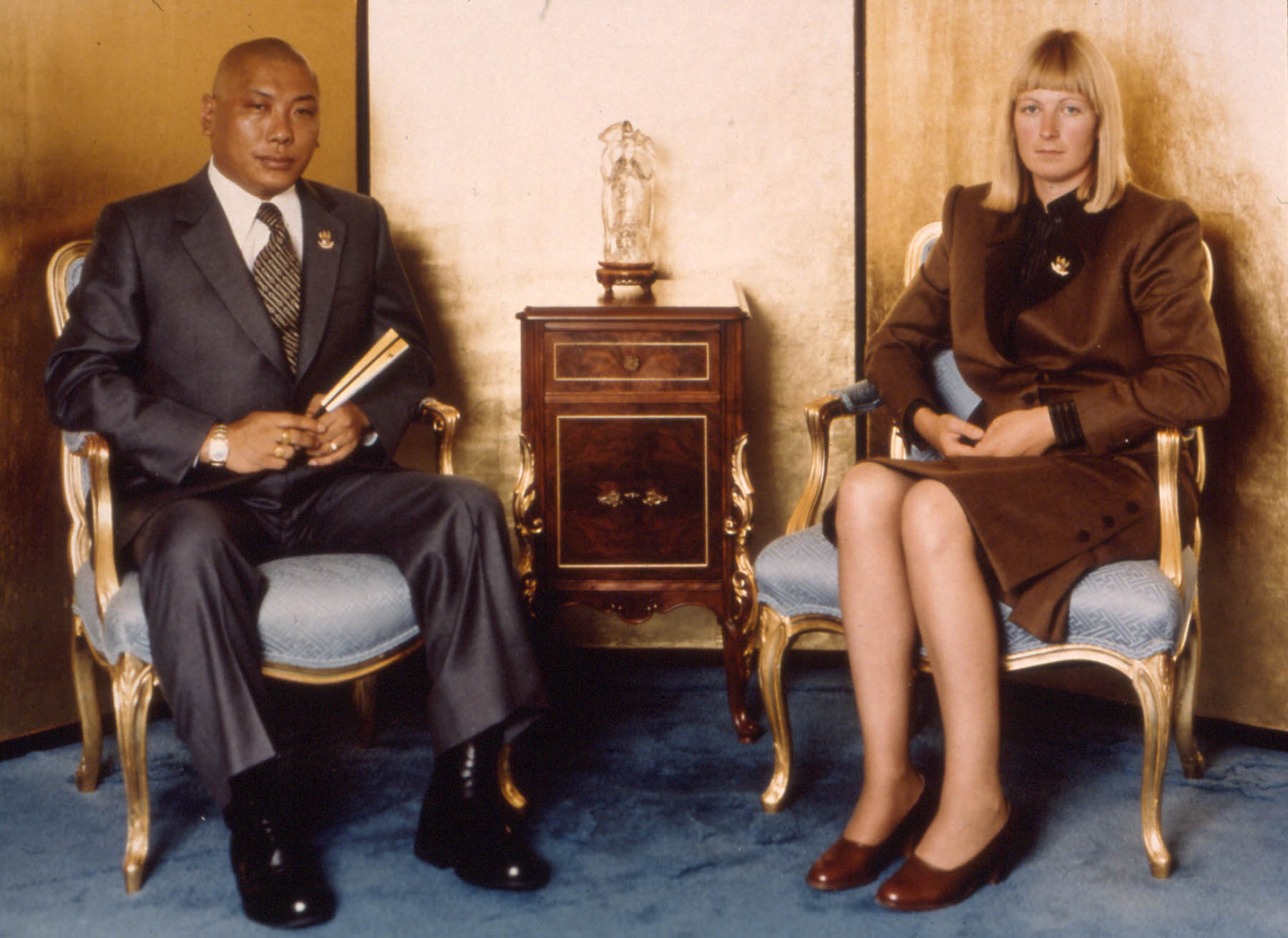
Chogyam Trungpa Rinpoche was famous for making his hippie students dress up in shirts and ties or dresses and nylons. He called it "uplifted clothing" and said it displayed the respect and dignity of their basic goodness. While he had unkind words for leisure suits, he did say that T-shirts and jeans could be uplifted, if properly cared for and maintained.

- - - -----------------------------------------------------------------------------------------------------------------------------
*According to the Mettanisamsa Sutta: Eleven advantages are to be expected from the release of heart/mind by [the absorbed] practice of loving-kindness (metta), by constantly increasing thoughts of loving-kindness, by regarding loving-kindness as a vehicle and as something to be treasured, by living according to loving-kindness, by putting these sentiments into practice, and by establishing them. What are the eleven? The practitioner:(1) sleeps in comfort, (2) awakes in comfort, (3) sees no bad dreams, (4) is dear to human beings, (5) is dear to non-human beings, (6) is protected by devas, (7) is safe from fire, poison, and swords, (8) concentrates the mind quickly, (9) is of serene countenance, (10) passes away free of confusion, (11) and if one does not attain full enlightenment here and now in this very life is reborn in a brahma world [a literal divine abode].
** On another level:
Liberation as the (primordial buddha) occurs in the following way: The instant the ground's manifestations arise, one does not apprehend them as something else but rather recognizes them as one's own inner radiance. Consequently, the movement (of constructive thoughts) ceases in itself: at the first instant (of movement), the recognition that the manifestations are inner radiance causes realization to dawn. This realization defines the difference (between liberation and deception).
Immediately thereafter, deception is dispelled and pristine wisdom unfolds. At this point, the ground fully develops into the result (i.e., awakening). This is re-enlightenment, the realization of primordial enlightenment within one's own nature. When self-manifestations dissolve into primordial purity, the result is awakening within the ground of being itself before anything else manifests (from the ground). (The personification of) this awakening is the enlightened guide known as Ever-Perfect.
-- Jamgon Kongtrul Lodrö Thaye the Great, Myriad Worlds. Translated & edited by the International Translation Committee founded by the V.V. Kalu Rinpoche, Snow Lion Publications, Ithaca, 1995, page 211.
Friday, January 6, 2012
A toad is a meal is a myth is a mate is a metaphor

In the abandoned ornamental garden, Rahel, watched by lolling dwarves and a forsaken cherub, squatted by the stagnant pond and watched toads hop from stone to scummy stone.
Beautiful Ugly Toads.
Slimy. Warty. Croaking.
Yearning, unkissed princes trapped inside them.
Food for snakes that lurked in the long June grass.
Rustle. Lunge.
No more toad to hop from stone to scummy stone. No more prince to kiss.
-Arundhati Roy
The God of Small Things
A toad is a toad, a collection of constantly changing cells. By the time your mind reacts to the image with the label "toad" and whatever adjectives follow, it's already not the same toad. Some molecules have died, others been born.
slimy warty croaking yearning -- all of that is view, based on your relationship to "toad."
What else in your life gets labeled automatically, even before your have time to really see it? What might look different to you -- friend instead of foe, opportunity instead of obstacle -- if you looked at it with more open eyes?
