Saturday, December 22, 2012

A new era, based on love

If you're reading this, then you're aware that the world did not end -- despite what many have said the Mayan calendar predicted.

It was said, widely and loudly, that the Mayan calendar predicted the world would end Dec. 21, 2012. There was a movie. There was the popular imagination.

We really can't deal very well with mystery. We want clues, so we can figure it out at the same time as the detective. We hunt down where our presents are hidden so we can open them ahead of time; we can't wait for the day. We want -- we think we need -- to know what happens after death. We want SPOILER ALERTS for life so that we don't have to live with uncertainty, with groundless. It's too scary, not knowing.

But that's what life is: Not knowing.

We can never know with absolute certainty what will happen. We can never know even what is happening because it's colored by our experience and hope. And everyone who is present in the present has a different perspective, a slightly different story. Was the man tall? Only in relation to the observer's height.

What the Mayan calendar predicted was not the end of the world but the end of an era. And honestly, I'm ready for a new era.

We can't know what will happen, but we can influence it, through our actions, speech, and thoughts, through our intention, through our view of what is possible. We can let the world continue on its fear-based descent into a Mad Max-like hell of aggression and defensiveness. Or we can move it in a new direction.

 bell hooks, in her book "all about love: New Visions," breaks down the ways in which our culture is hostile to love, how we can overcome that, and what it would look like. If we think of "love" as a verb, an action, rather than an emotion, it becomes a source of responsibility and accountability, she writes.
Awaking to love can happen only as we let go of our obsession with power and domination. Culturally, all spheres of American life -- politics, religion, the workplace, domestic households, intimate relationships -- should and could have as their foundation a love ethic ... a love ethic presupposes that everyone has the right to be free, to live fully and well. To bring a love ethic to every dimension of our lives, our society would need to embrace change.

The last era was built on a foundation of fear and defensiveness: Is there enough? Will it run out? How can I get more? How can I keep others from taking what I have?

The ancients say this is a new era. Things will change -- in the direction we choose.

What would a world built on love look like? How would it feel to live there? How would people act in that world -- in mundane moments, in conflict, in friendship, in celebration? What's stopping you from acting that way now?

Wednesday, December 19, 2012

A bear hug teddy

One Christmas, when he was very young, my son wanted nothing more than a bear-hug teddy that would hug you right back. This was not something he had seen advertised on television. It came from a book about the Bearenstain Bears Christmas. Given the source, I'm sure the book had a positive message. I don't remember it. Neither did my son -- all he heard was the Christmas list of one of the young bears, which included a bear-hug teddy that will love you right back.

It might as well have been world peace. It simply did not exist in any toy store. (This was before Internet shopping.) The potential for a bear hug teddy that would hug right back was there, as is the potential for world peace, but neither was manifesting.

Of course I bought him the best teddy bear I could find, big and soft with long arms. Of course it did not hug him right back. And of course he was disappointed -- and so was I.

Maybe it gave him (and me) the inevitable life lesson that our desires can't be met exactly in the way we want them, but we can be happy anyway. Maybe it showed him (and me) that we could sit with the pain of disappointment -- in Santa and ourselves -- even amid the general joy of the morning. That the human spirit toggles between happiness and sadness, and both are impermanent.

My memory stops at the cry, "But it doesn't hug me right back!" and that the tears that choked my response. (I'm working on remembering the joy, not just the disappointments.)

I'm sure that I hugged him. He may not have hugged me right back in that moment. He's grown now and has survived greater disappointments. And he's a good hugger, so I guess the lesson that you can only control the hugs you give, not the ones you receive -- which is all the more reason you should give them freely -- stuck with him.

Friday, December 14, 2012

A new way

I work at a newspaper in Connecticut. It's not close to Newtown, where nearly 30 people -- many children -- were shot in an elementary school today, but Connecticut's a small state, and the story broke on our deadline. For three hours straight pretty much all I did was look and listen to what news outlets with people on the scene were reporting, assess the sources and the contradictions, listen to pundits filling time while waiting for a much-delayed news conference, and write and rewrite.

The truest thing I heard in that time was from an expert on some news show, talking when all that was known was that a gunman had gone into an elementary school and there were dead people, who said, "We have to find a different way" to handle anger or frustration or whatever emotion makes this seem right.

We have to find a different way.

And that starts with a different way of communicating with those who disagree with us. I support gun control. I see no reason why people need to have guns -- and no logical reason whatsoever why ANYONE needs automatic or semi-automatic weapons. But if people who support gun control harden and face off with people who oppose it, all we do is increase aggression. And this world already is swimming in a sea of aggression.

Oddly enough, this morning -- before hell broke loose -- I was reading an article on how to deal with difficult people at work, "What's the Secret to Communicating with Irritational, Angry, or Just Plain Crazy People?" by Eric Barker. He did research; I'm just going to quote him.


We all have to deal with our share of hotheads and crazies. What does research say works with them?
First off, you can’t get angry too. Because then there are two crazy people arguing. While very entertaining to onlookers, this doesn’t accomplish much.
Tell yourself they are having a bad day and that it’s not about you:
Telling yourself that an angry person is just having a bad day and that it’s not about you can help take the sting out of their ire, a new study suggests… the researchers monitored participants’ brain activity and found that reappraising another person’s anger eliminated the electrical signals associated with negative emotions when seeing angry faces.
They’re being crazy. You’ll want to shut them up or talk over them. Don’t. It’s a natural reaction but it doesn’t work.
They don’t think they’re wrong. They’ll just interpret it as a status game where you’re trying to win. Stop being so sure you’re right and listen.
But here’s the important part: just shutting up is not enough.
Listening isn’t just listening. It’s letting the other person know you’re listening.
This is “active listening.”

Active listening is a lot like what we do in meditation. It's about putting your practice into practice. You listen without judgment. You inquire -- a sort of active contemplation to find out what's under the surface, which is what really needs to be addressed. And you acknowledge it. Both participants can see that the enemy isn't what it appears to be and can find ground to move forward instead of getting stuck.

Active listening, Barker says, is the first thing FBI hostage negotiators use to de-escalate incidents and save lives. It is how behaviors can change.

The Dalai Lama has said that the last century was a century of bloodshed. This century, he says, can be the century of dialog.

May it be so.

May all beings everywhere be safe.

Tuesday, December 11, 2012

12.12.12

Today is 12.12.12. It's notable because it's the last time this repetitive digital pattern will happen for a calendar date in this century. The next time the month, day, and year will be represented by the same digits will be Jan. 1, 2101 -- 01.01.01.

There are lots of things you can read into the date. But for Buddhists, it serves as a reminder that every
day -- every moment -- happens and is gone, replaced by a new moment. We are always starting fresh.

As it says in the Heart Sutra:
Therefore, the great mantra of prajnaparamita, the mantra of great insight, the unsurpassed mantra, the unequaled mantra, the mantra that calms all suffering, should be known as truth, since there is no deception. The prajnaparamita mantra is said in this way:

OM GATE GATE PARAGATE PARASAMGATE BODHI SVAHA
That translates to "gone gone all the way gone crossing over yes!"

Or "arriving arriving always arriving arriving again Awake!"

Each moment is here, then gone -- as is this day, this year, this life. Live in it fully because you don't get a second chance.

Use 12.12.12 as a reminder to appreciate this precious human birth -- and all the days that come with it.

Friday, December 7, 2012

Bodhi Day


Dec. 8 is Bodhi Day, the day of the Buddha's enlightenment.

The story -- and it is a story, an unverifiable tale used to educate his followers -- is that while meditating under the Bodhi tree, the Buddha was harassed and tempted by the god Mara (literally, "Destroyer" in Sanskrit), demon of illusion.  In an attempt to dissuade the Buddha from his path of awakening, it is said that Mara presented him with many temptations to muddy his thinking: Dancing girls, intoxicants, memories of his past lives, a hail of arrows. Each time, the Buddha realized what was happening, and said, "I see you, Mara." Resting in his clear mind, the Buddha discovered the law of karma, the cycle of rebirth, the Eightfold Path, and the Four Noble Truths. He would go on to teach those.

It is said that that the last of Mara's weapons was doubt. When Mara said, essentially, who do you think you are, thinking you can become enlightened? The Buddha simply touched the ground with one hand, an indication that he was someone who was in touch with the undiluted, non-illusory present moment.

As the morning star rose in the sky in the early morning, he experienced nirvana and became enlightened.


Then he went on to teach for many years.

The two crucial aspects of the Buddha's Awakening are the what and the how: what he awakened to and how he did it. His awakening is special in that the two aspects come together. He awakened to the fact that there is an undying happiness, and that it can be attained through human effort. The human effort involved in this process ultimately focuses on the question of understanding the nature of human effort itself — in terms of skillful kamma and dependent co-arising — what its powers and limitations are, and what kind of right effort (i.e., the Noble Path) can take one beyond its limitations and bring one to the threshold of the Deathless. Thanissaru Bikkhu
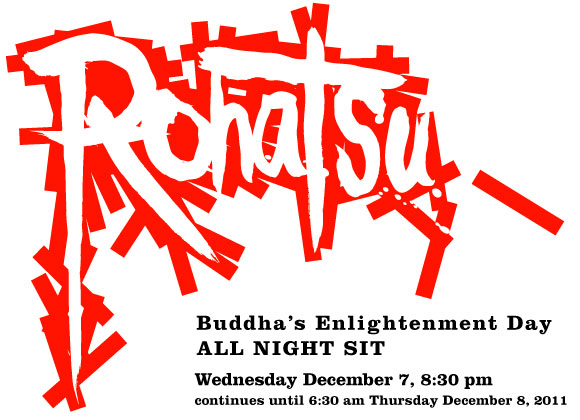
Bodhi Day isn't a big celebration day. The Japanese Zen tradition seems to observe it the most widely with Rohatsu sesshin, an intense period of meditation that starts the week before, on Dec. 1, and ends when the morning star comes up Dec. 8. Often participants will stay up all night on the last night, meditating.

From within this state of mind the Buddha said: How wondrous, how wondrous! All beings are endowed with this pure nature! What a wondrous, astonishing thing has been realized! All the ten thousand things, all the flowers, all the trees, all the rocks, all things everywhere are shining brilliantly!

You've probably  missed this morning's star. But the beautiful thing about the story is that every day is a good day to wake up. The stars are always there -- you don't see them in the daylight, but they're there -- and something in your sight always is shining brightly. You can always look at a star and see the brilliance of our pure nature. 

Or you can celebrate western-style at IDP's annual party. Get your groove on!


Tuesday, November 27, 2012

The story and the storyline

In developing mindfulness through meditation, we're advised to drop the storyline and simply be aware of what's happening in the moment.

For instance, in this moment, I'm sitting in the largely empty newsroom of a daily newspaper. It's bit chilly and a bit darker than usual since it's snowing out. My hands are cold. The police radio chatters away, the voices matter-of-fact. That's what's happening.

The storyline is Why am I the last one here again? Where is everyone? Yes, they come in earlier than me, but is it that much earlier? Why do I have so much work to do? (And here's where the rollercoaster goes over the top of the hill...) it's always this way. I always get stuck with the metaphorical ditch-digging. I do more work. Everybody else gets away with murder ....

The story is that I'm here. Maybe there could be some discernment around why I am generally the last one here. But my wise witness has to own that I arrive late, that I like to get certain things done the afternoon before so that I have time in the morning, that it's not even the usual quitting time, that I left early yesterday. My wise witness reminds me that it is never always this way. And that I have control here.

The story describes what's happening. The storyline blames or justifies or feels guilty or sulks or whines. Not 'this is how it is' but 'this is how it is and why it's not fair/right/deserved.'

Pema Chodron talks about it as the hook -- as in, don't bite it. She describes the process of avoiding an emotional reaction as Recognizing that the hook is baited, Refraining from biting it on sight, Responding wisely (by swimming away, unless we decide we're skillful enough to steal the worm without getting hooked), and Relaxing with the Result.

This is seen in the 12 Nidanas around the creation of karmic seeds. Something happens and we react. But if we slow it down, we see there's a stimulus, a recognition, and then a gap before the response. In that gap we can choose to react in our habitual way or to respond to what is new in the situation.

The storyline is the habitual, usually emotion-laden, response to the story, the set of details.

I've been thinking of this because of a class I'm taking in Mayahana Buddhism and Psychology,. The psychology aspect of it looked at attachment theory and styles ... based on what happened when you were a child, how do you react now?

This makes me uncomfortable, personally, because it's hard to see that as story without getting caught up in the storyline. It's hard to be dispassionate and not relive experiences that are long past. The past has an emotional charge that is hard to avoid -- and that I don't necessarily want to set off.

Can you listen to your story without getting tangled in the storyline. Don't know. I am a work in progress.

Body issues

I've been working a lot with body issues recently -- not the body issues you usually hear talked about of weight and height and hair and bra size, but the ones that have to do with functioning. It could be a(nother) diagnosed condition, which brings another medication and another doctor I have to fit into my schedule. It could be the infection that I tried to treat naturopathically, only to give in and go for antibiotics.

Or it could be the new practice I'm working with, a form of chod, in which you locate demons in your body and transmute them into protectors.

Along with all the relative reality of going to doctors, taking pills, doing yoga, lifting weights, getting exercise -- and trying to determine when it's wise to take a break from that and just rest -- there's the larger reality.

Five Daily Recollections

  1. I am of the nature to grow old; I cannot avoid aging.
  2. I am of the nature to become ill or injured; I cannot avoid illness or injury
  3. I am of the nature to die; I cannot avoid death.
  4. All that is mine, dear and delightful, will change and vanish.
  5. I am the owner of my actions;
    I am born of my actions;
    I am related to my actions;
    I am supported by my actions;
    Any thoughts, words or deeds I do, good or evil, those I will inherit.
from AN V.57  Upajjhatthana Sutta: Subjects for Contemplation

For a lot of people, #3 is the big one, judging by the way many Buddhist teachers talk. Death! The great fear at the bottom of all others! I'm not all that troubled by death. It will happen. I don't know when or what happens after. All I can control is what I do now, in this moment; I live my life with the aspiration to create as much ease and benefit as I can for the most people, and what happens next time around will be the inevitable result.


I don't even mind #1 that much. I'm 55. I don't dye my hair, don't wear makeup to try to hide that. I probably dress too young for my age, but it's not to appear younger. I don't like mom jeans around my waist, shirts tucked in. Maybe there's some deeper issue here, but I don't project what I think people think about how I look -- "they must think I look hot/cool/silly/old." I smile at them, and I hope they feel a moment of lightness, but I own only my actions, not their reactions.

Nah. It's #2 that makes me anxious. I am of the nature to become ill or injured; I cannot avoid illness or injury.

I understand the reality of that one. And it terrifies me. I don't want to have a knee replacement that will take me away from my routine for at least six months. I don't want my stomach to hurt. I don't want to feel drained of energy, where the thought of leaving the house is daunting.


I resist the idea that I won't just drop dead one day, that I may have to experience the limitations of body that come with age. That I already am experiencing them. I suffer about it. Sometimes.

And yet ... most days I get up and walk around and do what I want. I take a two-mile walk at lunchtime on workdays. I breath, and I don't even think about it except when it's impeded. I type. I type a lot. And sometimes my hands hurt, but they still work. Truly, my medical conditions are not all that serious in the moment, just annoying.

So I try to stay present, meditating on examining tables while waiting for doctors to come in, feeling the feels, rejoicing and mourning from moment to moment. It is the best medicine I have found.

[4] "Furthermore...just as if a sack with openings at both ends were full of various kinds of grain — wheat, rice, mung beans, kidney beans, sesame seeds, husked rice — and a man with good eyesight, pouring it out, were to reflect, 'This is wheat. This is rice. These are mung beans. These are kidney beans. These are sesame seeds. This is husked rice,' in the same way, monks, a monk reflects on this very body from the soles of the feet on up, from the crown of the head on down, surrounded by skin and full of various kinds of unclean things: 'In this body there are head hairs, body hairs, nails, teeth, skin, flesh, tendons, bones, bone marrow, kidneys, heart, liver, pleura, spleen, lungs, large intestines, small intestines, gorge, feces, bile, phlegm, pus, blood, sweat, fat, tears, skin-oil, saliva, mucus, fluid in the joints, urine.'
"In this way he remains focused internally on the body in & of itself, or focused externally... unsustained by anything in the world. This is how a monk remains focused on the body in & of itself.

(gory descriptions of rotting corpses)

"In this way he remains focused internally on the body in & of itself, or externally on the body in & of itself, or both internally & externally on the body in & of itself. Or he remains focused on the phenomenon of origination with regard to the body, on the phenomenon of passing away with regard to the body, or on the phenomenon of origination & passing away with regard to the body. Or his mindfulness that 'There is a body' is maintained to the extent of knowledge & remembrance. And he remains independent, unsustained by (not clinging to) anything in the world. This is how a monk remains focused on the body in & of itself.
Satipattana Sutta