Thursday, September 25, 2014

I've often thought that if I were to get a word tattoo, it would be lines from the Heart Sutra
  
Form is emptiness; emptiness also is form.
The sutra continues: Form is not other than emptiness, emptiness is not other than form, but I don't think I'd invest the skin space in the second sentence. (It's not pure repetition, though -- it says that form is not emptiness, but it's also not not-emptiness. And on.) 

Why choose one of the most confounding set of words in all of Buddhism? It's the pith instruction: Don't solidify anything, not even emptiness. Hold space open for everything.

Which is not to say that this wasn't a head-scratcher at first. Emptiness is a conundrum that takes some exploration to understand. While it is empty of fixed definitions -- like a permanent self -- it is full of possibility. Everything happens in emptiness.
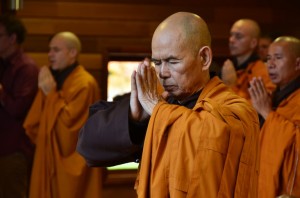

Thich Nhat Hahn has released a new translation of the Heart Sutra that he says corrects that misperception -- which has been going on for about 2,000 years, he says in a letter of explanation.

Emptiness of self only means the emptiness of self, not the non-being of self, just as a balloon that is empty inside does not mean that the balloon does not exist. The same is true with the emptiness of dharma: it only means the emptiness of phenomena and not the non-existence of phenomena. It is like a flower that is made of only un-flower elements. The flower is empty of a separate existence, but that doesn't mean the flower is not there.
The Heart Sutra is a distillation of the much longer Prajanaparamita Sutra, which lays out the ultimate truth of emptiness. It counters the extreme views of nihilism and eternalism, detailing the parts that make up our personalities -- the skandhas of form, feeling, perception, conceptualization, and consciousness -- and says they don't exist.

Thay says that's the source of the misunderstanding.  
It removes all phenomena from the category 'being' and places them into the category of 'non-being' ... Yet the true nature of all phenomena is the nature of no being nor non-being, no birth and no death.
Instead of: "In emptiness there is no form, no feeling, no perception, no formation, no consciousness ..." Thay writes, "That is why in emptiness, body, feelings, perceptions, mental formations, and consciousness are not separate self-entities. Even insight and attainment do not exist as separate self-entities."

The Heart Sutra, with its apparent negation of previous teachings, caused great consternation when it was spoken and ever since. The word "emptiness" confuses students who equate it with "voidness," a black hole of nothingness, when really it is the light that enables us to see -- sourceless, luminous, all-pervading wisdom. Prajnaparamita.

He calls the chant "The Insight that Brings Us to the Other Shores," in reference to the chanted mantra. See if this resonates with you.


Avalokiteshvara
while practicing deeply with
the Insight that Brings Us to the Other Shore,
suddenly discovered that
all of the five Skandhas are equally empty,
and with this realisation
he overcame all Ill-being.
“Listen Sariputra,
this Body itself is Emptiness
and Emptiness itself is this Body.
This Body is not other than Emptiness
and Emptiness is not other than this Body.
The same is true of Feelings,
Perceptions, Mental Formations,
and Consciousness.
“Listen Sariputra,
all phenomena bear the mark of Emptiness;
their true nature is the nature of
no Birth no Death,
no Being no Non-being,
no Defilement no Immaculacy,
no Increasing no Decreasing.
“That is why in Emptiness,
Body, Feelings, Perceptions,
Mental Formations and Consciousness
are not separate self entities.
The Eighteen Realms of Phenomena
which are the six Sense Organs,
the six Sense Objects,
and the six Consciousnesses
are also not separate self entities.
The Twelve Links of Interdependent Arising
and their Extinction
are also not separate self entities.
Ill-being, the Causes of Ill-being,
the End of Ill-being, the Path,
insight and attainment,
are also not separate self entities.
Whoever can see this
no longer needs anything to attain.
Bodhisattvas who practice
the Insight that Brings Us to the Other Shore
see no more obstacles in their mind,
and because there
are no more obstacles in their mind,
they can overcome all fear,
destroy all wrong perceptions
and realize Perfect Nirvana.
“All Buddhas in the past, present and future
by practicing
the Insight that Brings Us to the Other Shore
are all capable of attaining
Authentic and Perfect Enlightenment.
“Therefore Sariputra,
it should be known that
the Insight that Brings Us to the Other Shore
is a Great Mantra,
the most illuminating mantra,
the highest mantra,
a mantra beyond compare,
the True Wisdom that has the power
to put an end to all kinds of suffering.
Therefore let us proclaim
a mantra to praise
the Insight that Brings Us to the Other Shore.
Gate, Gate, Paragate, Parasamgate, Bodhi Svaha!
Gate, Gate, Paragate, Parasamgate, Bodhi Svaha!”

Wednesday, September 17, 2014

Goodbye, Dali Lama?

The Dalai Lama, the world's best-known Tibetan Buddhist, stirred things up this week with an interview in which he seemed to suggest that he should be the last to hold that title. “The 14th Dalai Lama now is very popular. Let us then finish with a popular Dalai Lama,” he told a German newspaper, which interpreted it to mean he did not want a successor.

Lots of people had lots to say, even Stephen Colbert.

Tricycle explicated the politics and tradition -- it could be a way to thwart China, to further remove the position from politics, to express the traditional humility of the position.

HHDL has speculated before about his return, saying he would reincarnate in the west, maybe as a woman.

While this obviously has a lot of meaning for Tibetans, those with an interest in geopolitics, and Richard Gere, what does it mean to you?

Some western Buddhists see the Dalai Lama as an anachronism, a symbol of an institution and tradition that doesn't translate to this culture, a way of keeping the teachings in the hands of a few and away from the masses. (Although HHDL has offered previously secret teachings to large crowds.)

Others see him as him as their guru, a teacher with whom they have a special relationship -- even if they've never met him. And others see him as an example of an enlightened being in human form, an inspiration, a for practice.

The outer guru is like the key, but when we open the door we discover ourselves, our true guru. (Yonge Minyur Rinpoche)

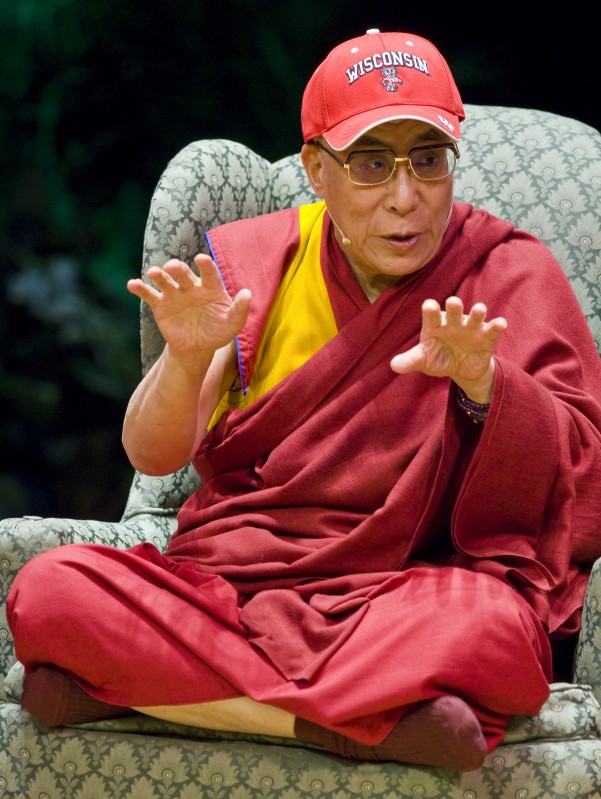
This 14th incarnation of the lineage has done a lot to explore the connection between science and Buddhism, to support women, and to be an ambassador of Tibetan Buddhism to the world, bringing  his ready smile and willingness to wear a local baseball cap around the globe.

What do you think?


Friday, September 5, 2014

That iPhone (and your happiness) is impermanent

It's a truth of existence that material things won't bring you lasting happiness. Things break. Or get outdated. Maybe the iPhone 5 brought you bliss -- but now the iPhone 6 is about to be introduced. And that might make you even happier. Until you find the bugs in it or the 7 is rumored.

Expecting things to make us happy only leads to disappointment, which leads to wanting new things. That desire for something to improve the present moment is what creates stress and dissatisfaction, aka unhappiness, the Buddha said.

A new study, Waiting for Merlot: Anticipatory Consumption of Material and Experiential Purposes,  found that people get more enduring happiness when they spend money on experiences than on acquiring things. That extends to waiting in line for those things.

People tended to be more competitive about purchases, and a comparison of news reports about people waiting in line found that long waits for material purchases were more likely to end in violence, researchers said.

One of the study's authors, Amit Kumar, a doctoral student at Cornell University, speculates that experiences give people the opportunity to bond and socialize. Even when if you aren't guaranteed a ticket to a concert or a taco from the cool new food truck, people often enjoy waiting in line. "While waiting for concert tickets, people reported singing songs together, or people would be playing games with each other while they're waiting," he says.

Waiting for the experience became part of the experience, not something that was preventing acquisition of The Thing That Would Give Us All the Happiness.

Westerners speak of the "pursuit" of happiness, which generally depends on running after external conditions ... There is only one problem: The very nature of desire is that it cannot be satisfied -- at least not for long.
The happiness that I'm talking about is not "pursued." In fact, the more we remains elf-contained and do not pursue thoughts or fantasies, or rush from one attractive object to another, the more we can access a wakeful contentment that is always with us. ... This wakeful state of ease is quite joyful and approaches a profound sense of well-being. -- Yongey Mingyur Rinpoche
It's important to note that contentment doesn't require you to renounce your smartphone or wear nothing but caftans. It's OK to like things -- just know that the happiness they bring is conditional, impermanent, and dependent. It won't last. Contentment, though, is unconditional, luminous, and always there. Pursue that.


Saturday, August 23, 2014

I can't make you happy

The happiness or suffering of others is the result of their actions and not my wishes for them.

This was my mantra, and it was an important part of my path.  I grew up believing that my role was to make people happy, and my value was tied to whether I was successful at that. So Buddhism was a revelation in that it proposed that I have my own intrinsic value and that everyone is responsible for their own happiness.  I can't make you happy -- you have to make that choice. I can try to act ethically, with kindness and compassion, but I can't control whether that makes you happy.

So why metta, why wish for another's happiness, safety, health, and ease?

It's about training your mind, opening up to the common experience of sentient beings, loosening your grip on the solid people you project the wishes onto, letting go of your own definitions of what that means.

Metta is about letting go.

May you be happy -- however that manifests for you. You don't have to meet my definition of happiness. YOU DON'T HAVE TO SMILE. I wish that you have happiness that's not tied to a new iPhone or a text from your crush, that you find a deeper source of contentment that lasts, that you see that happiness is not tied to external circumstances. May you find that, in your time and your way, which may not be mine.

May you be safe -- I have adult children; I learned a long time ago that I can't control whether someone else is safe. With kids, ultimately, all you can do is hope that you've passed on enough information so that they avoid those dangers that are avoidable. Then trust. May you avoid the risks you can and not be so frightened of the ones you can't that you get paralyzed.

May you be healthy -- and may you have ease with whatever level of health you have. (See safety.)

May you live with ease -- I hope that you can find a way to accept what you cannot change and to change the things that you can. And the courageous wisdom to figure out which is which.

I can't make you happy or keep you safe or give you health or put you at ease. But I hope that you find it. May I create the conditions that will enable you to uncover that in yourself.


Saturday, August 16, 2014

Kindness in the news

We crave stories of kindness. How else can you explain why a photo of a grocery store worker tying an elderly man's shoelace goes viral?

There are scary things happening all around the world today, from Ferguson, Missouri, to Iran and Syria and, seemingly, everywhere.

But there are also good things happening. Often those things are small actions performed by an individual -- like the grocery clerk -- while the scary things are big, like thousands of people trapped on a mountain or an angry crowd facing police cloaked in padded gear.

If you look only at the big things, it's easy to be overwhelmed by anger and despair.

If you look only at the small things, you can become a delusional Pollyanna, radically accepting the status quo when wisdom sees that the situation needs to change.

To me, Buddhist teachings often come back to balance -- finding the pivot point that holds the awareness that people and the situations they create are both kind and mean, avoiding the traps of despair and elation, seeing the good and how to mobilize it to work with the bad.


Anger is a contagion. It spreads in a flash. When met with anger, it roils and builds.

When met with kindness, it dissipates. The situation in Ferguson changed dramatically when the militarized police were taken out of the equation. Hugs replaced hate when highway patrol officers with visible faces and no body armor took over from the padded, helmeted local police.

Of course, the situation is more complicated than that in Ferguson and there are many things to be looked at and addressed. It's impossible to do that in the confusion of anger, which locks everyone into their own view.

Robin Williams' death also stirred up lots of emotions this week, not just grief but anger and hurt over the comments around suicide, addiction, and depression. And it brought stories of his great kindness behind the scenes, like this tribute from Norm Macdonald.

Kindness is all around. When you practice metta, you train your mind to notice it. And you train yourself to respond kindly. Practice in meditation is all about training your reflexes to respond in the post-meditation world.

Kindness is contagious. Here is a story, a true poem, by Naomi Shahib Nye, of what kindness can do. It's describes what happens at an airport gate during a flight delay when passengers and crew became a community rather than adversaries:

And I looked around that gate of late and weary ones and I thought, This 
is the world I want to live in. The shared world. Not a single person in that 
gate--once the crying of confusion stopped--seemed apprehensive about 
any other person. They took the cookies. I wanted to hug all those other
women, too.

This can still happen anywhere. Not everything is lost.


Friday, August 8, 2014

Release your heart

Today is a full moon. I could tell even before I checked the calendar, based on the phone calls that came in to the newspaper where I work. That's not unusual -- the callers range from those with tomatoes that resemble Richard Nixon to ones who tell you they're wearing tinfoil on their heads while they talk on the phone about conspiracies.

Friday's calls had a different quality than the usual lunacy, though. The callers wanted to tell me about kindnesses they'd experienced. And they simply wanted to share their gratitude and joy -- they didn't even launch into the usual rant about how we only report bad news and how about writing something good for a change.

One was a big deal: A woman was lying on a downtown sidewalk in May, and another woman stopped to check on her, then called 9-1-1, saving her life. The woman didn't remember any details but wanted to thank her unknown helper. She couldn't write a letter to the editor because, she said, she had a stroke and "all I can do is talk."

Another caller praised a newspaper customer service worker, who had driven to her disabled brother's home to hand him a newspaper after a delivery snafu. Getting the newspaper is the highlight of his day, she said (giving me a highlight for my day), and getting a special delivery gave him great joy.

The calls reminded me of the importance of developing an attitude of kindness, seeing the small ways that the world supports us rather than focusing on the insults.

The magic of metta practice is not that it makes us more loving toward the person we love or tolerant of the annoying person. It is that it turns our mind. We begin to see everything with the wide eyes of compassion rather than the narrowed eyes of judgment.

The Buddha identified 11 benefits of lovingkindness (speaking to monks, so Buddha says "he"):

1. "He sleeps in comfort. 2. He awakes in comfort. 3. He sees no evil dreams. 4. He is dear to human beings. 5. He is dear to non-human beings. 6. Devas (gods) protect him. 7. Fire, poison, and sword cannot touch him. 8. His mind can concentrate quickly. 9. His countenance is serene. 10. He dies without being confused in mind. 11. If he fails to attain arahantship (the highest sanctity) here and now, he will be reborn in the brahma-world.
These advantages "are to be expected from the release of heart." What a beautiful phrase. If you released your heart from its constrictions, from its limits, from its cages, where would it go?

What if you looked for the kindness in the world instead of the meanness? What if you realized the ground-floor gratitude of being able to take in breath? How would that change your life?


Tuesday, August 5, 2014

Identity

Last month at a group meditation retreat, in silence, among people who aren't familiar with me, I was known to some as the woman with coffee -- coffee was something of a contraband thing, not prohibited but not provided. I brought my own. To others, who shared my assigned daily work of cleaning the community center, I was the one who obsessively went over the checklist each day to make sure everything got done. I was a meditator, a student, a roommate.

Without the usual social cues of speech and context, identity gets stripped down to behavior and appearance. Name and history and stories don't mean much when you aren't having conversations. And that's part of what happens when you sit in silence -- you get glimpses that identity is mutable, relational, contextual, rather than something solid that you own. The stories that we think define us carve habitual patterns that can be hard to break out of, but our minds are the only things forcing us into those ruts.

"If you're determined to think of yourself as limited, fearful, vulnerable, or scarred by past experience, know only that you have chosen to do so. The opportunity to experience yourself differently is always available." —Yongey Mingyur Rinpoche 

In any given day, each of us has many identities -- spouse, pet owner, parent, householder, employee, customer, etc. -- even though we're only one person. We can't be all things to everyone but we can be many things to many people.

Seeing the multiplicity of identities and the lack of solidity in each one allows us to wear our identities loosely, leaving room for things to move in a different way. A boss doesn't always have to be authoritative; sometimes listening to others' ideas is appropriate. A parent doesn't always have to know the answer -- knowing how to look something up or being willing to try something we're not expert at can be a good lesson too.

"Misfortunes and obstacles to practice do not exist intrinsically. For something to be a misfortune for me, I must identify it as such," Buddhist scholar B. Alan Wallace says. If we refuse to identify something as an obstacle but see it instead as an opportunity or a challenge, we approach it differently. "We can then rebound from these calamities with courage and understanding, instead of wilting under their pressure," Wallace adds.

The Buddha said that there is no solid, permanent self or identity -- all we have are our actions, our karma. And we can always choose to act differently.  We can't chose our race or whether we have a disability that affects how we move or other visible characteristics, but we can choose how we relate to that identity, just as others choose how they relate to that in us. Do we define ourselves by what others see in us or do we focus on showing them something that's hidden? Do we chose to spend time with others who share an aspect of our identity or to vote in a bloc -- identity politics -- or do we cast a wider net?