Showing posts with label buddha. Show all posts

Friday, February 1, 2013

Social media and secret practices

If you're my friend on Facebook, you know that I share a lot of links. I think of Facebook as a community bulletin board or an envelope of newspaper and magazines clippings that I want to send off to my friends. Here's a bunch of stuff I think is interesting or cute or need-to-know. Maybe you'll think so too.


A large part of what I share is related to Buddhism. (The rest has to do with feminism, grammar, cats, and food. Some music.) So I was interested when I saw Dzongsar Jamyang Khyentse's "Social Media Guidelines for So-Called Vajrayana Students" posted on his Facebook page. He's speaking to students in a particular tradition, the Vajrayana path, but his suggestions raise interesting points for all practitioners.

Basically, it boils down to: Don't talk about your practice. Don't post images of deities, don't post your mantra (won't count toward your 100,000 repetitions), don't talk about your teacher or your practices and empowerments. He writes: "If you think images from your weekend Vajrayana empowerment are worthy of being posted up next to photos of your cat on Facebook, you should send your cat to Nepal for enthronement."

Guess he didn't recall that the Buddha said sarcasm is not skillful speech. But the Buddha didn't say anything about the Vajrayana, actually. Some say he taught vajrayana practices, but since they were secret, between him and specific students, they didn't become known until later (third to eighth century). Others say they grew from non-Buddhist traditions, particularly Indian Tantras and Bon practices in Tibet.

Vajrayana practices, he says, are secret "to protect the practitioner from the pitfalls and downfalls that ego can bring to the practice. In particular, practitioners tend to fall prey to 'spiritual materialism,' where their practice becomes just another fashion statement intended to adorn their egos and make them feel important, or have them feel that they’re part of a ‘cool’ social tribe, rather than to tame and transform their minds."

Putting aside the secrecy aspect, Khyentse raises some good points. I share quotes (with and without photos of cats) on Facebook because they touch something in me and may do so for others. It only takes one idea that catches our attention to launch a deeper look at the dharma. Or maybe it takes seeing a dozen quotes that resonate and realizing they're all from the same source. For those of us who aren't dharma brats, something had to arouse our interest.

And my teacher, Ethan Nichtern, has noted that many formerly secret practices are available to anyone on the Internet. If it's out in the public, those with some understanding have some responsibility to it. Vajrayana practices can seem pretty bizarre.

But I also feel strongly that the dharma should be respected and protected. There's a depth of understanding that comes from practice, from working with things over time. It's also interesting to go back over things you were introduced to earlier and see how it's different when you've practiced more and gained perspective.
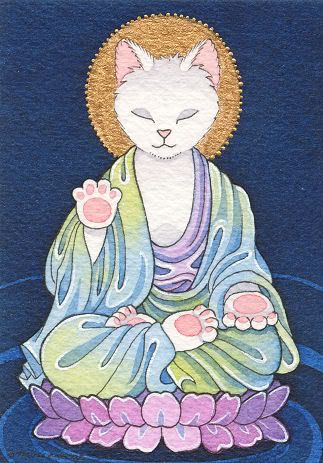
And I worry about the dharma being trivialized or reduced to a buzzword -- mindfulness, comes to mind -- and practice turning into three breaths and a mala on your wrist. Khyentse offers an important observation for all practitioners:

Trying to impress others with your practice is not part of the practice.

For practitioners, it means examining our intention. Are we hoping to impress? To sound authoritative? To win an argument? To appear farther along the path than another? To have secret knowledge? To have achieved something? To be worthy of praise? If the motive is connected with ego, it's likely not skillful. Who benefits from what you share?

Here are more of the guidelines:

-- Don’t attempt to share your so-called wisdom: If you think receiving profound teachings gives you license to proclaim them, you will probably only display your ignorance. Before you “share” a quote from the Buddha or from any of your teachers, take a moment to think if they really said those words, and who the audience was meant to be.

-- Don’t confuse Buddhism with non-Buddhist ideas: No matter how inspired you might be of rainbows and orbs, and how convinced you are about the end of the world, try not to mix your own fantasies/idiosyncracies with Buddhism.

-- Respect others. If you think attacking other buddhists will improve Buddhism, do a service for Buddhism, take aim at your own ego and biasedness instead.

-- Don’t create disharmony: Try to be the one who brings harmony into the sangha community with your online chatter instead of trouble and disputes.  


Friday, January 11, 2013

Limping toward nirvana

I've been thinking about writing something about the IDP's Year-Long Immersion and Instructor Training  program since early December, when the early application deadline was approaching, but I wasn't sure what I could say. I was a graduate of the first iteration of the program, in 2011. (Originally, it was called the Buddhist Teacher/ Meditation Facilitator Training; my inner 12-year-old delighted in the idea of being a certified MF, but the name changed quietly during the year.)

I did not enter the program expecting to become a teacher. I was looking for a way to deepen my study of Buddhism, and this program appealed to me for a lot of reasons.

2011 was a transformative year. The IDP training was part of that, but I also did a two-week retreat with Lance Brunner, a fabulously kind and creative teacher; was a head oryoki server during that program, and did several weekend retreats in the Shambhala Sacred Path program. All of those things worked with other things, the warp and the woof of life and study.

Now I lead meditation and Buddhist groups. I don't really look at it as teaching -- I see it as sharing information that I've learned from studying and inviting people to explore how that works in their lives. Maybe that's possible because my groups are small. I don't live in New York, and to study and practice with people on a regular basis is difficult. Leading these groups gives me a chance to develop live sangha.

The Buddha said that you are your own best teacher. He told his followers not to take anything he said on faith but to try it for themselves and see if it was useful on the path toward the transformation of suffering.

And that's what the IDP program does -- help you find ways to teach the dharma, to yourself or others; in a class setting or through art, music, dance, blogging, or simply being at peace with yourself in a chaotic world.

Stephen Schettini is a former Catholic and Buddhist monk whose post on religion and righteousness on his blog, The Naked Monk, question life's big answers; expose yourself to doubt, caught my interest, partly because of this discussion on the IDP blog about the teacher training program

Schettini writes:
In Tibetan Buddhism, one’s teacher never gets angry or befuddled. Rather, he ‘manifests wrath,’ meaning that he puts on a show of anger because you need shock treatment, or silence because you’re unable to process the truth. You cannot be part of the community and question his motives. ‘The Path’ is itself code for steering clear of creative acts of discovery. When I eventually acted on the realization that I should find my own way or lose all self-respect, my connection to the community was severed. I was still there; I hadn’t yet even disrobed, but I was excluded from the circle of trust.
Buddhism, he says, was no different from the Catholic church is shutting down questions or challenges to its dogma.

Eventually, he writes, he went outside the organizations and back to study the lives of Jesus Christ and the Buddha. What he found were inspirational examples.
Buddhism was a crutch when I was psychically lame. The tools and the community healed me sufficiently that when the time came I was able to leap from my ivory tower and go on my way. Luckily, I landed on my feet. To ascribe it to destiny or karma is to retreat, pretending I have an explanation when all I have is a code word.
That's his story. It makes valid points, as does the IDP blog post. The Buddha -- who was reluctant to teach in the first place -- didn't set out to create Buddhism. I think he'd endorse using the path he laid out to find your own wisdom. But the path requires you to keep checking in, to see if your wisdom comes from your buddhanature or from dogma, and that's the value of it.

You will get something all your own out of the training. Intrigued? The application deadline is Tuesday, Jan. 15.


.

Monday, June 4, 2012

Don't believe everything you think


Say you smell the odor of a hamburger cooking. That's just a sensation. Quickly you have a reaction -- you're hungry and you like it; in fact you want one. Or you're a vegetarian and you're repulsed. Or things are fine the way you are and it doesn't make much of an impression.
The pure sensation is mindfulness of body.
The unpleasant-pleasant-neutral overlay is mindfulness of feeling tones.
And the thought about the sensation is mindfulness of mind.
Why does this matter?
These are the components of experience. This is how we interpret the world and how we respond to the world.
As with most of the Buddha’s teachings, the foundations form a logical progression.
We practice mindfulness of body to see what our experience is in this moment in a real, tangible way. Our form, our body, is what we experience as reality. We are with the sensations of what’s happening within the moment, rather than through ideas we have of it. When we are present with our body in this moment – without visualizing or interpreting or worrying – we are meeting reality with full integrity.
The experience of sensation usually is followed by a feeling tone, a subtle mental experience that’s present in every moment. It precedes conscious thought or emotion – no matter how much we think that emotional reaction just happens, the feeling tone comes first.
If it’s pleasant, we want more or we want it to stay as it is, and we manipulate experience or reality to try to make that possible. This leads to grasping and craving, which leads to suffering. Unpleasant and we run from it or push it away or push it down, or bring in something else, something we perceive as pleasant, to try to dislodge it. This gives rise to fear and anger and other negative reactions. Neutral and we look elsewhere – or go to sleep.
Seeing the link between attraction or aversion and the mind’s immediate response is liberating, the Buddha says. And liberation is the path to nirvana.
The Buddha says that an “untaught, worldly person” – most of us – who experiences an unpleasant body sensation, such as pain, worries about it, grieves, gets upset, gets resistant, gets angry. When we do that we actually experience two kinds of unpleasant feelings – the physical pain and the mental pain. In the Buddha’s example, the physical pain is like being struck by an arrow; then when you react with anger and resistance, it’s as if you’ve been struck by a second arrow: the unpleasant mental feeling.
An awakened being will still feel unpleasant sensations, but that person recognizes that it’s an unpleasant feeling and dodges the second arrow, the self-inflicted one of worry and anger and resistance. When you can just be with things as they are, there’s freedom and ease.
Or let’s say the original sensation is like a string around your wrist that’s gotten tangled and is too tight and becomes uncomfortable. When you stay with that discomfort, you notice it, you may notice it changes, and you may decide that the skillful action is to unwrap it or cut it off. But when you’re caught in your reaction, it’s like wrapping more string around your wrist so that it gets tighter and tighter and you panic or become paralyzed, unsure how to get out of the trap.
Which leads to the third foundation, mindfulness of mind, or consciousness of consciousness. In Buddhist terms, consciousness is the sixth sense; it is a moment of knowing – seeing, hearing, smelling. When consciousness arises with a particular mental factor, an emotion or quality, the mental factors color it. So in Mindfulness of Mind, we’re talking about knowing a moment of consciousness AND what’s coloring it.
The traditional teaching, taken from the Sattipattana Sutta, is about mindfulness of mind states. The Buddha outlines a bunch of specific ones.
A monk knows the consciousness with lust as with lust; the consciousness without lust as without lust; the consciousness with hate as with hate; the consciousness as without hate as without hate …
Through lust, hate, ignorance, the shrunken state of consciousness, the distracted state, the concentrated state, the freed state, and their opposites.
Note that the Buddha doesn’t judge the value of the mind states. He doesn’t talk about hating the mind with lust and loving the mind free from lust, or even seeking to develop the mind free from lust. He talks only about knowing what is there. The mind is contracted or the mind is spacious; the mind is full of ill will or free from it.
Think of being in love. Particularly newly in love. The world is bright and shiny. Everything is beautiful. Has everything changed? No. Your mind state has.
Think of when you are grieving or sad. The world is dull. Sunlight is too bright and washes out the colors instead of enhancing them. In the cartoon strip "Mary Worth," there’s a story line about a young woman who’s boyfriend has broken up with her and who has a new girlfriend. In every panel that she appears, this young woman is lying on the couch saying, “Life is brutal.”
If we’re not aware of the mind states that are coloring our perceptions, we think that our perceptions are true.
Contemporary western teachers often teach this as Mindfulness of Thoughts, rather than mind states. The thoughts are the signs that point us to the mind states.
(Think of the mind as bartender or an ice cream store clerk, and thoughts are the customers – the mind welcomes thoughts, observes them, hears what they want, takes care of them, and move on. Do they come in a big rowdy group? Alone? You can’t spend all night waiting on one customer, but that’s what we do with our thoughts, stay with one and worry it to death.)
Most of the time we don’t see our thoughts as visitors. We just believe them.
“Nobody likes me.”
“I can’t do this.”
“This is too hard.”
And then we act from those thoughts.
If you believe the thought that no one likes you, you’re less likely to open up to others and your life becomes contracted. You become isolated.
If you believe you can’t do something or that it’s too hard, you won’t try. You give up – or you don’t start.
There is a real difference between the thought “my back is killing me” and the sensation of back pain.
When we watch the quality of mind, we become less identified with the thought or the emotion. We still feel anger arising, but we don’t leap to the judgment that we are angry people – and therefore always act with anger. We feel fully angry, in body and mind, but we know that it’s not who we are. Because we pay attention to the state of consciousness, we see that it changes. We may experience conflicting emotions coming up very rapidly.
The terrible, horrible, very bad day does not have only negative things in it, if you pay attention moment by moment. There’s something good there – the smell of coffee, the quality of light, the one person who smiled at you. Every state of mind is transitory. It’s only by noticing them in detail that we truly appreciate it and let go of our tendency to identify with any particular one. Then we can be with whatever happens without becoming so tightly wound that we can’t move.

Saturday, December 17, 2011

How to avoid a hangover, or the Bliss of Blamelessness


Maybe you've heard this old joke ( advanced practitioners, visualize Rodney Dangerfield):

A man goes to see his doctor and says, "Doctor, doctor, it hurts when I do this." (Visualize the movement of your choice.) The doctor says, "Then don't do that."

Ba-dum-pum. (Rodney shrugs his shoulders, adjusts his tie, and adds, "I don't get no respect," before fading back into the ether.

Rodney Dangerfield as purveyor of the dharma? Yeah, sure. Everything is dharma.

The precepts -- the Buddha's guidelines for living a mindful, joyful, and ethical life -- are Siddhartha's version of Dangerfield's doctor's response. It's as if you went to him and said, "Buddha, Buddha, I suffer when I lie, drink, sleep around indiscriminately, whatever." The Buddha, in his clear, concise way, replies, "Then don't do it."

Sounds harsh, doesn't it? We don't like the idea of giving up our old ways -- but we also don't like the way they make us feel. Hungover. Checking our sent texts to see what we told to who. Wondering who this person is in our bed, in our aching head.

So let's flip the equation. Renunciation in Buddhism is not so much about giving up bad habits as it is about adopting good habits. We give up what makes us feel bad about ourselves, at least in retrospect, and take on what makes us feel good about ourselves. Practicing the precepts is said to result in the bliss of blameless.

I love Thich Nhat Hanh's re-statement of the precepts in his book "For a Future to Be Possible."

1. Aware of the suffering caused by the destruction of life, I vow to cultivate compassion and learn ways to protect the lives of people, animals, plants, and minerals. I am determined not to kill, not to let others kills, and not to condone any act of killing in the world, in my thinking, and in my way of life.
Thich Nhat Hanh has a commentary on the 1st Precept.

2. Aware of the suffering caused by exploitation, social injustice, stealing, and oppression, I vow to cultivate loving kindness and learn ways to work for the well being of people, animals, plants, and minerals.I vow to practice generosity by sharing my time, energy, and material possessions with those in real need. I am determined not to steal and not to possess anything that should belong to others. I will respect the property of others, but I will prevent others from profiting from human suffering or the suffering of other species on Earth.

Thich Nhat Hanh has a commentary on the 2nd Precept.

3. Aware of the suffering caused by sexual misconduct, I vow to cultivate responsibility and learn ways to protect the safety and integrity of individuals, couples, families and society. I am determined not to engage in sexual relations without love and a long-term commitment. To preserve the happiness of myself and others, I am determined to respect my commitments and the commitments of others. I will do everything in my power to protect children from sexual abuse and to prevent couples and families from being broken by sexual misconduct.
Thich Nhat Hanh has a commentary on the 3rd Precept.

4. Aware of the suffering caused by unmindful speech and the inability to listen to others, I vow to cultivate loving speech and deep listening in order to bring joy and happiness to others and relieve others of their suffering. Knowing that words can create happiness or suffering, I vow to speak truthfully, with words that inspire self-confidence, joy, and hope. I am determined not to spread news that I do not know to be certain and not to criticize or condemn things of which I am not sure. I will refrain from uttering words that can cause division or discord, or that can cause the family or community to break. I will make all efforts to reconcile and resolve all conflicts, however small.
Thich Nhat Hanh has a commentary on the 4th Precept.

5. Aware of the suffering caused by unmindful consumption, I vow to cultivate good health, both physical and mental, for myself, my family, and my society by practicing mindful eating, drinking, and consuming. I vow to ingest only items that preserve peace, well-being, and joy in my body, in my consciousness, and in the collective body and consciousness of my family and society. I am determined not to use alcohol or other intoxicants or to ingest foods or other items that contain toxins, such as certain TV programs, magazines, books, films, and conversations. I am aware that to damage my body or my consciousness with these poisons is to betray my ancestors, my parents, my society, and future generations. I will work to transform violence, fear, anger, and confusion in myself and in society by practicing a diet for myself and for society. I understand that a proper diet is crucial for self-transformation and for the transformation of society.
Thich Nhat Hanh has a commentary on the 5th Precept.

Happy New Year, dear ones. May it be auspicious!

Thursday, October 20, 2011

Ritual, red cords, and Rimbaud's fork

So I have this red string around my wrist. At the NY Shambhala Center last weekend, I stood in line, bowed to Sakyong Mipham Rinpoche -- we smiled at each other -- I stepped to the left, and some high-ranking person draped a red string around my neck. The line kept moving, and outside the shrine room, people were tying them on with a certain amount of fussiness about how it was done. By eavesdropping I learned that the pre-existing knot was supposed to be in front if you tied it around your neck.

Some research turned up this from Lama Surya Das:

The red string is called a "protection and blessing cord." Traditionally, a lama ties a knot in the cord, then prays over it and blows the power of his mantra into it. Then he places it around one's neck as a blessing. When I first asked my own lama, the Venerable Kalu Rinpoche, about this, in 1973, he told me the cord is symbolic of remaining within the protection of his compassionate embrace even after departing from his physical presence. Other lamas have told me they take the protection cords off only to have dental work or surgery, and then put them on again afterward, as the strong protection field might impede the medical procedure.

I was wondering whether I would need to take antiobiotics before some planned dental work. But maybe the combination of a weak immune system and a protection cord arrives at a middle ground.

If I believe in the power of a piece of string.

Last weekend the question of Buddhist relics arose in an IDP teacher training weekend. I once went to a Buddhist center where they talked about relics and gave me a 10-page set of instructions on how to set up a home altar. A little too high church for me. That's the extent of what I know on the subject.

Surya Das goes on:

The Tibetan blessing practices remind me of the tradition of blessed protection medals, amulets, as well as relics of the saints commonly used in many religions, such as Catholicism and Hinduism. Objects touched or prayed over by holy beings are believed to be imbued with their spiritual energy and blessings. The practice of relic worship found in Christianity, such as around pieces of the cross or bones of the saints, finds common ground in Buddhism's tradition of venerating the teeth of the Buddha or pieces of bone or ash from his cremation pyre, which were divided up among his main disciples and enshrined in stupas--reliquary monuments around India.

It does, indeed, remind me of my Roman Catholic childhood. It makes even less sense to me in the context of Buddhism -- the Buddha was a mere mortal whose message was that all us mere mortals can achieve enlightenment ... just like him. He was not the Son of God or a divine being. We don't need to be blessed by something outside of ourselves; we have, within us, everything it takes to become enlightened.

Back to Surya Das: All these spiritual traditions of healing and enlightenment help deepen our spiritual development. But of course, that development depends more on the faith of the individual than on the material substances themselves.

On Thursday, I went to the opening of an exhibit of photography by Patti Smith at the Wadsworth Atheneum in Hartford. The photos are prints of Polaroids she took, mostly of items -- Rimbaud's fork and spoon, Jim Carroll's bed, Nureyev's slippers. Relics of people to whom she felt connected.

In the exhibition catalog, she is interviewed by the Atheneum's director, Susan Talbott, who curated the exhibit.

"As a child I had great respect for the inanimate object," she told Talbott. "Both my grandmothers died young. So a mandolin or a lace coverlet belonging to them seemed very precious. Their objects were the only way I could invoke them. I guess that sense of things extended to the poets and writers I loved."

She describes shooting Virginia Woolf's bed: "I only had two shots and really wanted to take a nice picture. … I sat down in a chair and asked for her counsel. I didn't want to fail. I pushed it to the darkest setting and concentrated on her single bed. The crease and the eyelet of the coverlet formed a cross. I felt her with me."

The exhibit also contains a display with a rock from the river where Woolf committed suicide by drowning after filling her pockets with rocks, along with a thangka for Woolf. (A thangka is a Tibetan devotional painting.) The power of the items was extraordinary -- from outside the glass, I could feel the weight and smoothness of the rock, the weight of depression, the connection that flows through a line of introspective women.

Another display case contained a cracked cup Smith had given to her father and separate photos of her father and mother as young adults with the year written in the white margin at the bottom -- just as my mother dated our family photos. Again, the connection is palpable.

The Polaroid photos are black and white and grainy -- none of the fine detail we've come to expect from digital cameras. But they convey so much. I wanted to touch them -- I didn't -- even though I knew the photos themselves had no texture.

The Polaroid is part of the point, Smith says: They are pictures of a moment. They develop over a minute or two. And they fade.

A reminder of the ephemeral nature of life.

(Confession: I own a Polaroid, which I love for the same reasons.)

At one point, I noticed Smith standing in the gallery. I talked to Lenny Kaye, her guitarist, about how practicing guitar is like meditating. I told Smith that looking at her photos gave me the same experience as listening to a great talk by a Buddhist teacher; it brought me to a place of presence within myself that is presence with all beings.

She paused for a moment. Yeah, she said, they came from a place of deep presence.

To go back to my red string, I don't feel that it has any protective powers of its own. Wearing it is not like having Wonder Woman's bracelets; I can't deflect bullets.

But it brings me to a place of presence, the deep, still liquid center of shared humanity that lies under the waves we ride through most of our days. It connects me to the lineage of wise beings of the past and present and future who are doing their best to recognize and live from that place of inherent richness -- and it reminds me that I am one of them.

Maybe that is the power of relics and rituals -- not veneration but connection.