Showing posts with label myanmar. Show all posts

Saturday, July 19, 2014

Seeds of hatred, seeds of love


Buddhist teacher Jack Kornfield trained as a monk in Burma 40 years ago; recently, he went back and observed first-hand the seemingly contradictory Buddhist campaign against Muslims there.
An ethnic Rakhine man holds homemade weapons as he walks in front of houses that were burnt during fighting between Buddhist Rakhine and Muslim Rohingya.

In a week where violence and aggression dominated the news, it's worth reading his entire article, which delves into the interdependent causes of the violence: poverty, political insecurity, and fear of The Other.
Traveling across Burma recently, I encountered some of these monks who are drumming up hate and jingoistic fervor. They don’t want to talk about peace and have succeeded in sowing mistrust across much of the country. Under their influence, taxi drivers and shopkeepers from Rangoon to remote towns talk about their fear of a Muslim takeover and “the Buddha’s teaching” that sometimes violence is needed to protect the nation.
The most obvious cause is economic: the already poor and disempowered residents of the area fear an influx of immigrants who will take what little they have, even though some of the "immigrants" have lived there for many years and are their neighbors.

I witnessed firsthand the results of the spreading violence in the town of Lashio in northern Shan state, where this past year a mosque, businesses, and a Muslim orphanage were burned not far from the town’s most revered pagoda. While the local Buddhists I spoke to were friendly, they were also worried, and from their ranks came mobs who torched their Muslim neighbors.

How does this happen in a primarily Buddhist nation? Kornfield points to several factors:

-- The radical monks have linked Buddhadharma with nationalism, overriding the Buddha's message that hatred will never overcome hatred and replacing it with the idea that it's OK to kill some people.

-- "With the lifting of military dictatorship, simmering ethnic and religious tensions are being exploited by misguided monks, political groups, and the remnants of the dictatorship to gain power ... Radical monks play on the historical memory of Muslim expansion across Asia in formerly Buddhist cultures. Scare stories about Muslims raping Buddhist women and having huge families and overpopulating the land are widely disseminated."

--  Widespread ignorance of core Buddhist teachings -- like the precepts, which include the injunction against killing, speaking harshly, and lying. Buddhism in Burma is primarily devotional, Kornfield says, and Buddhists are taught to revere teachers, not question the teachings, their interpretation or application. Those who do are harassed.

Kornfield organized a group of "concerned Buddhist elders" to sign a letter published in Burmese newspapers urging the Burmese to reaffirm the Buddhist principles of non-harming, respect, and compassion.
We are with you for courageously standing up for these Buddhist principles even when others would demonize or harm Muslims or other ethnic groups. It is only through mutual respect, harmony, and tolerance that Myanmar can become a modern great nation benefiting all her people and a shining example to the world.
You can take the phrase about Myanmar out, and take that sentence as instruction on personal conduct from a teacher: It is only through mutual respect, harmony, and tolerance that we can be of benefit to others and a shining example to the world.

In a time when aggression and fear is rampant in the world, it's important to look at whether we cultivate our karmic seeds of aggression and fear or fertilize seeds of kindness and compassion. What is our experience of the world, and how do we transmit that to others?

May bodhicitta, precious and divine, arise where it has not yet come to be.
And where it has arisen, may it not decline but grow and flourish evermore.
-Shantideva


Thursday, April 4, 2013

The 'Burmese Bin Laden' and the emptiness of labels

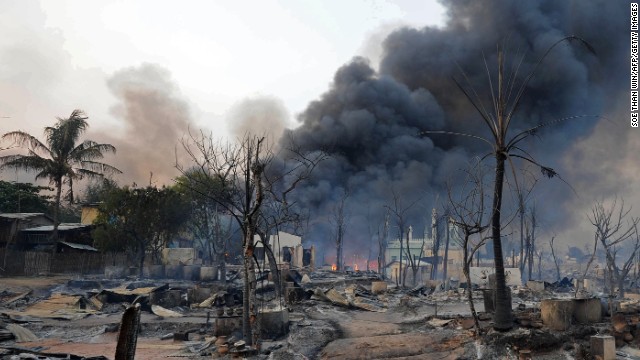
The situation in Burma -- where Buddhist monks are accused of inciting violence against ethnic Muslims that has killed 43 people, destroyed or damaged 992 buildings, including five mosques, and displaced 12,000 people in a town of 100,000 -- is heartbreaking, not just because of the suffering but because it is perpetrated by Buddhists.

Hatred never defeats hatred, the Buddha said. Only love overcomes hate.

For those of us who study Buddhism, it's mind-boggling that practitioners -- who take the precepts to refrain from killing, to not take what is not freely offered, to not use harsh speech -- would be involved in this:

Yangon, Myanmar (CNN) -- Buddhist monks and others armed with swords and machetes Friday stalked the streets of a city in central Myanmar, where sectarian violence that has left about 20 people dead has begun to spread to other areas, according to local officials. (Read more here)

The Buddha was clear:

Whoever, with a rod, harasses an innocent man, unarmed, quickly falls into any of ten things: harsh pains, devastation, a broken body, grave illness, mental derangement, trouble with the government, violent slander, relatives lost, property dissolved, houses burned down. At the break-up of the body this one with no disconcernment, reappears in hell.
- Dhammapada, 137-140

Time reported Tuesday that sources say Muslims are terrified to go out after dark and are not able to visit the town’s market to trade or collect supplies. The report goes on to say that monks have "unparalleled moral authority in traditional Burmese society." Various news reports say the unrest has been spurred by Ven. Wirathu, an outspoken monk who was jailed in 2003 for inciting religious clashes in the northern city of Mandalay. He's called himself “the Burmese bin Laden” in reference to the jihadi leader Osama bin Laden’s religious fervor, despite his hatred of all things Islamic, and is the leader of a movement known as 969. The 45-year-old posted an inflammatory speech online last week that warned “once these evil Muslims have control and authority over us, they will not let us practice our religion” and accused Muslims of accumulating “money to get our young Buddhist women.”

None of this is consistent with any Buddhist teachings that I've learned about. How is it possible that a Buddhist monk could lead a deadly campaign of hatred? How is it possible that Buddhists would follow him?

An opinion piece in the Irrawaddy, a news site that covers southeast Asia, says:

To the campaigners, 969 is about protecting race and religion by peaceful means. In practice, it is explicitly an anti-Muslim campaign, not about preaching people the Buddha-nature of all beings, as taught and practiced by Lord Buddha himself. In many townships across Burma, including capital regions, there are local 969 committees that organize events and religious sermons and distribute anti-Muslim materials such as CDs, books and leaflets.
The 969 campaign targets economic aspects by alleging that Muslims are dominating the Burmese economy, and that therefore Buddhists must not trade with Muslims. Instead, the campaigners recommend that Buddhists buy and sell at Buddhist shops that display 969 signs and stickers. In Karen State, Buddhists are even forced to trade only with Buddhists. There are local reports about Buddhists being beaten by members of 969 civilians and monks for trading with Muslims.

Obviously there are political and socio-economic aspects that I don't know. Burma, or Mayamar, is in the process of emerging from years of military rule. I know that I don't know the nuances of the situation. But I do know that this is not what Buddhism teaches.

Psychologist Jeffrey Rubin wrote a post on the Interdependence Project blog about how sex scandals involving Buddhist teachers develop. Maybe this is similar, just on a larger societal scale. A deluded person who stops seeing his lust for power, a population that wants to be handed a way out.

ETA: Meanwhile The Saffron Monk Network issued a statement warning the public not to take part in any violent events following the riots between the Buddhist and Muslim communities in Meikhtila town last week. Ashin Awbartha (Nagar) from Shwewayoung Pyinyardana monastery, a member of the Saffron Monk Network, told Karen News that the intention is to to keep innocent people out of riots like those that happened in Meikhtila.
The Saffron Monk Network’s statement said that it is sad to see religion and ethnic based issues used to stimulate and create conflicts. The statement also warned that the violence could set back the country and lead to loss of support from the international community.


To read more:

Burmese Neo-Nazi Movement Rising Against Muslims

Burmese Monk fomenting violence against Muslims

Saffron monks stalk streets with machetes

Burmese Bin Laden: Is Buddhist Monk Behind Violence in Myanmar?


Another CNN story:


Burma's monks calls for Muslims to be shunned