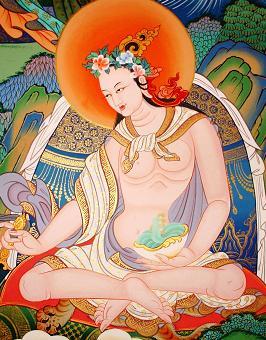
In the Buddhist tradition I've studied in since 2006, there's a lineage chant listing the line of enlightened beings who handed down teachings. I've said that list -- which includes the name Yeshe Tsogyel -- hundreds of times, but I didn't know much about her, other than that she associated with Padmasambhava, founder of the Nyingma lineage, until I recently read a couple of books by Buddhist feminists.
This account is from "Buddhism After Patriarchy" by Rita M. Gross:
Born in 8th century Tibet, it's said thatYeshe Tsogyel's mother had visions at her conception and throughout pregnancy. Her birth was said to be auspicious, but her parents were mainly concerned with finding her a husband. With suitors threatening to go to war over her beauty, Yeshe Tosgyel was sent into the wild, and the man who found her would be her husband.
She wasn't interested in the plan and resisted her captor, giving in only after her back had been beaten to a bloody pulp. She escaped when they were passed out drunk. She was found by an emperor, who took her as his consort, then gave her to the guru Padmasambhava as an offering. This suited her, as she desired to study the dharma, but he soon sent her to Nepal to find a consort of her own. She did, then went into a three-year retreat before returning to Padmasambhava, who confirms her realizations.
She worked extensively to study and spread Buddhism, gaining many disciples, male and female, and bringing them to high levels of realization. She also wrote down many teachings, hiding many of them to be found later at appropriate times.
Her final practice was exchanging her karma for others', taking on their suffering and giving them what would relieve it. She fed the hungry, gave medicine to the sick, and made the poor wealthy. She made emanations that helped people in many locations.
After 12 years of this, she died, leaving many signs of her greatness.
Gross notes two things:
-- The prevalance of her abuse by males throughout the story, whch include being treated as property, beaten, and raped. She twice converted men to the dharma by giving "aggressive depraved men insights into the roots of their aggression and keys to handling that more effectively."
-- Her relationships with women, including other of Padmasambhava's consorts. Four of her 11 root disciples were women, and two were recognized, as she was, as emanations of Vajravarahi. At the end of her life, Yeshe Tsogyel was visited by Mandarava, the other main consort. "We exchanged and tightened our precepts, making endless discussions on the dharma," it is said.
Gross offers these two contrasting accounts:
From Yeshe Tsogyel:
I am a woman --I have little power to resist danger.
Because of my inferior birth, everyone attacks me.
If I go as a beggar, dogs attack me.
If I have wealth and food, bandits attack me.
If I do a great deal, locals attack me.
If I do little, gossips attack me.
If anything goes wrong, they all attack me.
Whatever I do, I have no chance for happiness.
Because I am a woman, it is hard to follow the Dharma
It is hard even to stay alive.
from Padmasambhava:
Wonderful yogini, practitioner of the secret teachings
The basis for realizing enlightenment is a human body
Male or female -- there is no great difference.
But if she develops the mind bent on enlightenment,
A woman's body is better.
Showing posts with label women's history. Show all posts
Wednesday, March 6, 2013
Monday, March 4, 2013
Women in Buddhism: From the beginning
March is Women's History Month. Friday, March 8, is International Women's Day.
How many women in Buddhist history can you name -- not contemporary practitioners, but historical figures?
Unless you've made a deliberate effort to study this subject, you probably can't get to five..
We don't know the stories of women in Buddhism, and this is a problem. We like stories. That's how we build culture; that's how we communicate norms. And when the norms are told by men and about men, we're getting only half the story.
Roshi Joan Halifax says that she's the 82nd person in her lineage -- and the first woman.
That is not because there are no women. Their stories were simply not deemed worthy of recording by the people who kept the records. The stories are there. I'm going to tell some. If you know of some, tell me more.
Interestingly enough, there is a record of the earliest Buddhist women to wake up (reach enlightenment), the Therigatha.
The following account is from "The First Buddhist Women: translations and commentary on the Therigatha" by Susan Murcott.
The first woman of note is Mahapajati Gotami, the Buddha's aunt, who raised him after his mother, Maya, died seven days after he was born. After Siddhartha became enlightened -- and the Buddha -- she became one of his lay followers. Other women came to her for advice, support, and direction.
After her husband died and her son became a monk, she became a woman on her own, cut off from the connections that brought her identity and security. Other women -- members of Siddhartha's harem who lost their status when he went out on his own and women whose husbands abandoned them to become monks -- came to her. The Therigata says the number was "more than 500," which means a great many. "The longing of these women became their spiritual aspiration," writes Murcot.
It is reported in the Cullvaga that Mahajapati went to the Buddha, "stood at a respectful distance," and said:"It would be good, Lord, is women could be allowed to renounce their homes and enter into the homeless state under the Dharma and in the discipline of the Tatagatha. He replied: "Enough, Gotami. Don't set you heart on women being allowed to do this."
This happened twice more. Then the Buddha moved on to Vesali, and the women, dressed in Saffron robes, followed him, 150 miles, walking barefoot. Ananda saw Mahajapati outside the hall. He went to the Buddha:
"Pajapati is standing outside under the entrance porch with swollen feet, covered with dust, and crying because you do not permit women to renounce their homes and enter into the homeless state. It would be good, Lord, if women were to have permission to do this."
The Buddha gives the same answer he gave to his aunt, and this exchange also happens twice more.
Then Ananda takes a new approach. He asked if women can become enlightened. The Buddha says yes. So Ananda says, "If women are able to realize perfection and since Pajapati was of great service to you -- she was your aunt, nurse, foster mother; when your mother died she even suckled you at her own breast -- it would be good if women could be allowed to enter into homelessness."
The Buddha then agrees, provided the women accept the Eight Special Rules.which relegated them to secondary status. "(1) A nun who has been ordained even for a hundred years must greet respectfully, rise up from her seat, salute with joined palms, do proper homage to a monk ordained but that day." The Buddha later made an exception for six monks who lifted up their robes and showed their thighs to the nuns, according to the Vinaya, indicating that only monks deserving of respect should be treated with respect. Later, Mahajapati asked the Buddha to eliminate the gender distinction and go solely by seniority, with novice monks bowing to more senior nuns. He rejected that request.
Pajapati died at 120. When she was very sick, she asked that the Buddha come to her. He died -- although the rules forbid a monk from visiting a sick nun. When she died, is said, miracles occurred that were equaled only by those that took place when the Buddha died.
How many women in Buddhist history can you name -- not contemporary practitioners, but historical figures?
Unless you've made a deliberate effort to study this subject, you probably can't get to five..
We don't know the stories of women in Buddhism, and this is a problem. We like stories. That's how we build culture; that's how we communicate norms. And when the norms are told by men and about men, we're getting only half the story.
Roshi Joan Halifax says that she's the 82nd person in her lineage -- and the first woman.
That is not because there are no women. Their stories were simply not deemed worthy of recording by the people who kept the records. The stories are there. I'm going to tell some. If you know of some, tell me more.
Interestingly enough, there is a record of the earliest Buddhist women to wake up (reach enlightenment), the Therigatha.
The following account is from "The First Buddhist Women: translations and commentary on the Therigatha" by Susan Murcott.
The first woman of note is Mahapajati Gotami, the Buddha's aunt, who raised him after his mother, Maya, died seven days after he was born. After Siddhartha became enlightened -- and the Buddha -- she became one of his lay followers. Other women came to her for advice, support, and direction.
After her husband died and her son became a monk, she became a woman on her own, cut off from the connections that brought her identity and security. Other women -- members of Siddhartha's harem who lost their status when he went out on his own and women whose husbands abandoned them to become monks -- came to her. The Therigata says the number was "more than 500," which means a great many. "The longing of these women became their spiritual aspiration," writes Murcot.
It is reported in the Cullvaga that Mahajapati went to the Buddha, "stood at a respectful distance," and said:"It would be good, Lord, is women could be allowed to renounce their homes and enter into the homeless state under the Dharma and in the discipline of the Tatagatha. He replied: "Enough, Gotami. Don't set you heart on women being allowed to do this."
This happened twice more. Then the Buddha moved on to Vesali, and the women, dressed in Saffron robes, followed him, 150 miles, walking barefoot. Ananda saw Mahajapati outside the hall. He went to the Buddha:
"Pajapati is standing outside under the entrance porch with swollen feet, covered with dust, and crying because you do not permit women to renounce their homes and enter into the homeless state. It would be good, Lord, if women were to have permission to do this."
The Buddha gives the same answer he gave to his aunt, and this exchange also happens twice more.
The Buddha then agrees, provided the women accept the Eight Special Rules.which relegated them to secondary status. "(1) A nun who has been ordained even for a hundred years must greet respectfully, rise up from her seat, salute with joined palms, do proper homage to a monk ordained but that day." The Buddha later made an exception for six monks who lifted up their robes and showed their thighs to the nuns, according to the Vinaya, indicating that only monks deserving of respect should be treated with respect. Later, Mahajapati asked the Buddha to eliminate the gender distinction and go solely by seniority, with novice monks bowing to more senior nuns. He rejected that request.
Pajapati died at 120. When she was very sick, she asked that the Buddha come to her. He died -- although the rules forbid a monk from visiting a sick nun. When she died, is said, miracles occurred that were equaled only by those that took place when the Buddha died.
Subscribe to:
Posts (Atom)