Saturday, August 11, 2012

Contemplate this:


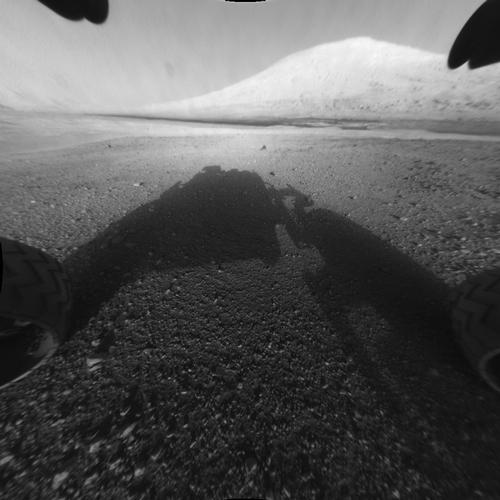
This is Mars. This is a photo taken by the Mars rover. Curiosity, of the surface of the planet and sent back here. (photo credit: NASA-JPL)


This is Mars, as seen from Earth in June 2003, through an 8-inch telescope.

And here is a picture of Earth from Mars, helpfully marked up.


Rest with the idea that it is possible to see Earth and Mars from each place. That each is a tiny dot of light in a sky that is filled with tiny dots of light.

Resist your mind's effort to add a story about how much it cost, to label it as worthwhile or a waste, to compare the mundane photos to a sci-fi fantasy of the Red Planet.

Just rest your mind in space. Notice feelings that come up -- excitement, fear, disgust, curiosity -- but try not to get carried away. Rest in that space.

Being but men, we walked into the trees
Afraid, letting our syllables be soft
For fear of waking the rooks,
For fear of coming
Noiselessly into a world of wings and cries.

If we were children we might climb,

Catch the rooks sleeping, and break no twig,
And, after the soft ascent,
Thrust out our heads above the branches
To wonder at the unfailing stars.

Out of confusion, as the way is,

And the wonder, that man knows,
Out of the chaos would come bliss.

That, then, is loveliness, we said,

Children in wonder watching the stars,
Is the aim and the end.

Being but men, we walked into the trees.

--Dylan Thomas

Thursday, August 9, 2012

Ben Bernanke wants to know if you're happy

Want to know if you're happy? There's an app for that.

It could be useful information -- and not just for your own amusement. No less than Federal Reserve Chairman Ben Bernanke wants to know.

The Associated Press reports that Bernanke told economists this week that gauging happiness can be as important for measuring economic progress as determining whether inflation is low or unemployment high. Economics isn’t just about money and material benefits, Bernanke said. It is also about understanding and promoting “the enhancement of well-being.”

Bernanke and Fed policymakers rely on reports on hiring, consumer spending and other economic data when making high-stakes decisions about the $15 trillion U.S. economy. The Fed’s dual mandate is to maintain low inflation and full employment.

“We should seek better and more-direct measurements of economic well-being,” Bernanke said Monday in a video-taped speech shown to a conference of economists and statisticians in Cambridge, Mass. After all, promoting well-being is “the ultimate objective of our policy decisions.”

Here's where the confused vajra copy editor perks up. While the news reports have all remarked on Bernanke's interest in Americans' happiness, he uses the term "well being," which actually is closer to what Buddhism considers a positive state.


We put a LOT of emphasis on happiness. I have a shelf of Buddhist books with happiness in the title, and I've seen a number of teachers referred to as "the happiest man alive," among them Mathieu Richard, Ajahn Amaro, and Yonge Mingur Rinpoche. Ponlop Rinpoche said that when Tibetan Buddhist teachers gather, they tell jokes.

But they have a non-western understanding of what happiness is. Happiness, in Buddhist terms, is a sense of ease in the world -- outer and inner. They are aware of suffering, but they aren't caught in it. There's no anxiety clinging to the hem of their robes, no grasping for something else.

Matthieu Ricard, in his book "Happiness," defines happiness as "a deep sense of flourishing that arises from an exceptionally healthy mind." It's more a sense of well-being -- of being well despite circumstances and conditions -- than what westerners call happiness. We think of happiness as all giggles and glitter, neon yellow smiley faces with no space for sadness or grief. All good all the time.

For westerners, happiness is seen as something we deserve -- it's written into our Declaration of Independence that we have the right to pursue it. Because it's not something we inherently manifest; it's something we have to chase after and hunt down. And when we catch it, it quickly slips away.

Or we suspect that it has. Because other people look happier. Especially the people in advertisements. And if we had what they had, we'd be having that much fun. We're like hamsters on a wheel, thinking that if we run fast enough we'll get to happiness. Instead we become exhausted and discouraged.

Which is why we need an app to measure whether we're happy.

Or maybe we don't. I'd sent my most app-happy friend a link to an article about an app used by Harvard researchers to study happiness.

She replied: I don't need an app to tell me I'm generally happy. Although I think I
will download it for, ahem, scientific research purposes.

She went on to say that she'd recently watch "Happy," a movie, with her spouse, who asked if there was anything that would make her happier. "I told him that all I'd need is to meditate
more. ... It has made me happier."

Bernanke's talked before about the economics of happiness.

“As your parents always said, money doesn’t buy happiness,” Bernanke said in a May 2010 commencement address at the University of South Carolina, noting that research has found that once basic material needs are met, more wealth doesn’t necessarily make people happier.

In his latest remarks, Bernanke turned to the more practical — and difficult — task of measuring a subjective emotion. So far, most efforts have involved surveys in which people are asked about whether they are happy and what contributes to their happiness. Those surveys have found some consistent answers: physical and mental health, the strength of family and community ties, a sense of control over one’s life, and opportunities for leisure activity. Bernanke on Monday laid out a few other questions: How secure do Americans feel in their jobs? How confident are Americans in their future job prospects? How prepared are families for financial shocks?

Bernanke’s own definition of happiness might baffle some, AP reporter Chrisopher S. Rugaber writes, although not most Buddhists. He called it a “short-term state of awareness that depends on a person’s perceptions of one’s immediate reality, as well as on immediate external circumstances and outcomes.”

In other words, happiness is an impermanent state that depends on the mind's perceptions of external circumstances.

Well-being, however, is closer to Ricard's definition of happiness as "an optimal state of being."

He continues: Happiness is also a way of interpreting the world, since, while it may be difficult to change the world, it is always possible to change the way we look at it.
Monday, July 30, 2012

Do You MakeYour Bed?


Want to know how to be happier? Isn't that why we're here, looking at our minds, dissecting our reactions, dismantling habitual patterns?

Make your bed.

Gretchen Rubin, author of the bestselling book "The Happiness Project," says that making the bed was "the No. 1 most impactful change that people brought up over and over" as she researched her book on inspiring happiness.

What's the magic in pulling up the sheets and smoothing out the duvet?

Chogyam Trungpa Rinpoche
explains how to invoke magic -- or drala -- in your physical environment.
This may be as small and limited as a one-room apartment or as large as a mansion or a hotel. How you organize and care for that space is very important. If it is chaotic and messy, then no drala will enter into that environment.

According to Charles Duhigg, making the bed is a keystone habit, one that "helps other habits to flourish by creating new structures, and they establish cultures where change becomes contagious."

And you probably thought it was pointless.

Friday, July 27, 2012

Live. In. It.

I'm not telling you to make the world better, because I don't think that progress is necessarily part of the package. I'm just telling you to live in it. Not just to endure it, not just to suffer it, not just to pass through it, but to live in it. To look at it. To try to get the picture. To live recklessly. To take chances. To make your own work and take pride in it. To seize the moment.

And if you ask me why you should bother to do that, I could tell you that the grave's a fine and private place, but none I think do there embrace. Nor do they sing there, or write, or argue, or see the tidal bore on the Amazon, or touch their children. And that's what there is to do and get it while you can and good luck at it.

― Joan Didion


Salvation, if we can talk about it at all, is the end of ambition, which is when you become completely one with your experience. Knowledge becomes one with wisdom, which is called buddhahood or the awakened state of mind. You realize that you never needed to make the journey at all, because the journey and the goal are there already. It’s not so much that you are achieving liberation, but it is more that you realize that liberation is right there and that you needn’t have sought for it.

-- Chogyam Trungpa Rinpoche

Tuesday, July 17, 2012

Bearing witness to all the sorrows of the world

I've been thinking recently about how to bear witness to large-scale suffering -- like the suffering of those detained in tents in the Arizona desert, like the uninvestigated murders of women in Mexico State, the massacre of movie-goers, the conditions the convince Tibetans to set themselves on fire.
I know how to bear witness to individual suffering. Tell me your story, and I most often can hold compassionate space for it. I was a volunteer rape crisis counselor several years ago, and we were trained in non-reactive, compassionate listening. You give people power when you let them have their reactions without adding your own.

But I feel powerless -- defeated -- by stories of large-scale suffering.

My friend Josh Pawelek talked recently about bearing witness at the county jails in Arizona where those accused of being illegal immigrants are held -- in tents where the temperatures reach 140 degrees during the day, with severely limited access to water, and little ability to move around. Josh, who is the minister at the Unitarian Universalist Society: East, which my family attends, described attending a General Assembly in Arizona of the Unitarian Universalist Association. The participants heard from those affected by Arizona's strict anti-immigration laws and stood outside one of the jail camps.

On the final day, a man stood outside of the meeting place with a sign asking: UUs, what have you done? Their presence had not changed any of the conditions in Arizona, he said silently.

Bearing witness is a practice of patience. There is no immediate gratification. But there is an increase in awareness, in connections among groups with similar aspirations, in energy seeking an answer to the situation.

When I hear the words "bearing witness," I think of the Zen Peacemakers. The founder, Bernie Glassman, has run Bearing Witness retreats at Auschwitz for 17 years, where the participants meditate, chant the names of the dead, and conduct services in various religious traditions.

Another friend of mine described being in New York City at the time of the Stonewall riots and the birth of the gay rights movement. Although he's a not a person who seeks the spotlight, he marched, uncomfortably, in the first small gay pride parades -- only a small number of people marched and mostly tourists watched, he said. But if brave people had not marched in those first small parades, there wouldn't be huge celebrations today.

Awareness can lead to acceptance. Seeing what is wrong can lead to change. Maybe it can't be made right -- because who can agree on what right is? -- but suffering can be eased. Change doesn't happen unless you lay the groundwork for change.

The answer for me is to be aware of the mass suffering, not to ignore it on the grounds that it's too much for me to take in and I can't have an effect. It's disheartening to me that situations like the desert prisons exist, like the systemic rape of boys at Penn State, and are allowed to exist. How do people let this happen? Why do they treat people this way?

All beings want to be happy. And if they see someone else as a threat to their happiness or safety, they see a threat -- not a person.

It reminds me to watch for ways I d ehumanize peoplein my own life. The loud phonetalker is a human. The pair who stop to chat in the grocery store aisle are people, longing to connect. The cashier is making a living.

What we're bearing witness to, all the time, is the humanity of others.

It's really pretty simple: The more people you know, the more stories of suffering you hold in your heart. The more heartbreak you can hold in your heart and still function, the more you know what awakening is about. What a beautiful pain to know and love people. Sashtri Ethan Nichtern, founder of the Interdependence Project
May I be a protector of those without one -
a guide for all travelers on the way;
May I be a bridge a boat and a ship for all
who wish to cross the water!
May I be an island for those who seek one
and a lamp for those desiring light!
May I be a bed for all who wish to rest
and a servant to those in need.
May I be a wishing jewel a magic vase
a great mantra and potent medicine,
May I be a wish-fulfilling tree and
a cow of plenty for the world!
Just like the great elements such as earth
enduring as space itself,
May I always support the life
of boundless untold beings!
And until they pass beyond pain may I also be
the source of life for all the realms of varied
beings that reach unto the ends of space!
Shantideva, The Way of the Bodhisattva

Wednesday, July 4, 2012

You are the news


Look at this screenshot from early January. Enlarge it if you need to. Contemplate it. Just another day in the New York Times?

Well, no. The headlines here are from Fox News. (Screenshot for proof.) This faux home page was created by Dan Schultz, the MIT grad student also responsible for Truth Goggles, using his NewsJack point-and-click “remixer.” I've lifted it from Jonathan Stray at the Nieman Journalism Lab at Harvard's website.

Stray's blog post is titled "How Do You Tell When the News is Biased? It depends on how you see yourself."

Stray cites various studies that have been done that found that perception of bias in news reports had a lot to do with the news consumer's perception of the news source, not the content. Some, for example, involved showing Al Jazeera content under other banners.

This is of interest to me as a journalist and a Buddhist. Both involve trying to remove the filters from our perceptions that color our understanding. And both require detachment from praise and blame -- one pair in the Eight Vicissitudes -- to operate with integrity.

People I respect in the Buddhist community, who are working to see the world with clarity and compassion, often dismiss my profession as inherently unmindful. But maybe the mindfulness is in the mind of the perceiver.

Stray talks about "hostile media effort," in which both sides in a story think the story in attacking them.

Like a lot of experimental psychological research, the hostile media effect suggests we’re not as smart as we think we are. We might like to think of ourselves as impartial judges of credibility and fairness, but the evidence says otherwise. Liberals and conservatives can (and often do) believe the same news report is biased against both their views; they aren’t both right.

...Communications researcher Scott Reid has proposed that we can explain the hostile media effect through the psychological theory of self-categorization. This is a theory about personal identity and group identity, and it says that we “self-stereotype,” placing conceptual labels on ourselves just as we might make assumptions about other people. We all have multiple identities of this kind: gender, age, political preferences, race, nationality, subculture, and so on.


Here
are is more about Reid's experiments. Stray's article lays it out in more detail. There's even a chart.

For my purposes, this is the nut: Our perception of bias changes depending on the self-identity we currently have in mind.Those self-identities are insidious. In Buddhism, we generally just call it the Self. The Self is the thing that we create in our minds then treat as a solid, unchanging real thing that has to be dressed up and defended and credentialed and compared to all the other Selves out there. We feel good about our Self or bad about it, depending on how we think it's doing in regard to all the Other Selves.

That opposition between Self and Other creates suffering. It leads to feelings of inferiority or superiority -- or at best, separateness.

Stray suggests that the way for journalists to overcome accusations of bias from all sides is to downplay the divisions, to not pit one side against the other. (Obviously some journalists don't give a shit about this; I'd argue that they're not true journalists but propagandists.)

The trick would be to shy away from invoking divisive identities, preferring frames that allow members of a polarized audience to see themselves as part of the same group. ... Encouraging the audience to perceive itself as unified — this seems simplistic, or naïve. But the consideration of identity is foundational to fields like mediation and conflict resolution. Experimental evidence suggests that it might be important in journalism too.


In all of life, seeing life or society as "all" seems to me to be the best way to reduce complaints because it reduces suffering about problems that are only problems if you're protecting a Self.

Tuesday, July 3, 2012

Dancing with dragons


Equanimity -- the fourth of the Brahma Viharas or Divine Abodes -- doesn't mean only the ability to keep your balance as the worldly winds of samsara swirl around you. It also means being able to create a balanced life, one that has time for work, play, and idleness.

Maybe you've seen this New York Times article on how busyness plagues our lives. Maybe you're one of the dozen or so of my Facebook friends who linked to it. Busyness, it seems, is rampant.

Author and cartoonist Tim Kreider writes:
Busyness serves as a kind of existential reassurance, a hedge against emptiness; obviously your life cannot possibly be silly or trivial or meaningless if you are so busy, completely booked, in demand every hour of the day.
This is something I've been thinking about lately. I tend to be busy. My job is busy -- the work I do used to be done by 2.5 people, and some new obligations have been invented. I rarely stop working on my keyboard to talk to people with my full attention, and I work in a large room with a lot of other people talking to one another or on the phone or to themselves. I teach meditation. I meditate. I study and teach Buddhism. And I don't even live in New York, where people constantly announce that New Yorkers are SO busy (this is a pet peeve of mine as it makes it seem as if the rest of the world lazes around).

At one retreat I went to this year, a teacher talked about the importance of leading a balanced life, using the Four Dignities of Shambhala. The tiger, which is grounded and observant, represents work. The snow lion represents hobbies and activities, those things that are not part of making a living but that require discipline. Garuda, which flies and never lands, is our artistic endeavors, things where we create (similar to hobbies but looser). And the turquoise dragon is free time, idle time, time to dance in space with all possibilities.


On the flag that's displayed at my Shambhala center, the dignities occupy equal portions. In my life, not so much. I am heavy on the tiger-lion portion, with some garuda and a sliver of dragon. Energetically it's even more imbalanced, I fear.

So I'm declaring July to be Dragon Time. I have few obligations this month, and I'm trying not to add to them. Do I have plans this weekend? Yes, I plan to do nothing.

Back to Mr. Krieger:

Idleness is not just a vacation, an indulgence or a vice; it is as indispensable to the brain as vitamin D is to the body, and deprived of it we suffer a mental affliction as disfiguring as rickets. The space and quiet that idleness provides is a necessary condition for standing back from life and seeing it whole, for making unexpected connections and waiting for the wild summer lightning strikes of inspiration — it is, paradoxically, necessary to getting any work done.
I've got plans already for two weekends in August, so I can't get lost in space. But if you're looking for me this month, I'll be dancing with dragons.