Showing posts with label equanimity. Show all posts

Sunday, April 12, 2015

Is Buddhism's rep for tolerance deserved?

A new study reports that merely reading Buddhist terms in a word puzzle -- such as dharma, Buddha, and awakening -- increased the likelihood of "prosocial" behaviors among study participants, some of them familiar with Buddhism and others not.

Testing the theory of "subliminal priming," researchers found that introducing language associated with Buddhism decreased explicit prejudice against ethnic, ideological, and moral groups other than those of the person. The results challenge the idea that religion promotes prosocial behavior among its members but prejudice toward those outside the group, the authors said. Prosocial behaviors include having compassion and empathy, along with a sense of responsibility for others.

That doesn't mean Buddhism is better, the authors stressed.


"What we really want to argue is that Buddhist concepts are associated with tolerance, across cultural groups," Magalli Clobert, a post-doctoral student at Stanford and one of the study's authors, told The Huffington Post. "It means that, at least in people's mind, there is a positive vision of Buddhism as a religion of tolerance and compassion."
My immediate reaction is to list places where that's not true, a compendium of Buddhist behaving badly. That stems, in part, from my Buddhist training -- question everything, especially blanket perceptions. Ask yourself, when those perceptions arise: Is this true? Is it always true? Are there exceptions? Is this solid and permanent? Nope.

But after holding it for a while, I've decided that it's not untrue, either.

One of the beauties of Buddhism is that the Buddha doesn't mandate tolerance. He says, look into yourself and see what makes you intolerant. What makes you uncomfortable? Examine that -- if it is because the person is different, can you find areas of similarity? You both breathe, for starters. You both want to continue breathing. You both love things, maybe different things, but that feeling of love is the same. You're both humans in a confusing world. There's a common ground to start with, and if you dislike what the other person builds on that, you've still got that starting place to come back to so you can tolerate what does not harm your or the larger community and treat the other person with respect if you engage with them over their actions.

I saw this when I read a New York Times story about a woman who was asked to change her seat on an airplane because the man assigned to the seat next to her, an Orthodox Jew, was prohibited by his religion from sitting next to a woman who is not his wife.


I often use public transportation scenarios in equanimity meditation. I have a seat on a train. How do I feel if my BFF gets on and sits next to me? If an acquaintance I don't know much about takes that seat? If that talky, conservative co-worker gets it, or some smelly person?

My practice is about being OK with who other people are, not avoiding them. Seeing our shared humanity, even if we display it differently. Recognizing that we're all fighting our own battles and declining to escalate the war. Trying for tolerance and compassion -- and when I fail, knowing that I can keep trying, that small corrections lead to big changes.


Saturday, February 28, 2015

My Terrible, Horrible, Wonderful Night

I had plans last night to go into the city and meet a dear friend to see a very special performance. So many things went wrong that I could easily have had an terrible time. Instead -- thanks to practice -- it full of extraordinary lessons and beauty.

I left work early so we could meet before the show. Ten minutes later, I realized my phone was still charging in my office, and I knew I would need it. So I went back. "You're such an idiot," I said as I pulled back into the driveway. "And I love you." (That's a lesson taken directly from Sharon Salzberg's book on Lovingkindness.)

 The 20 minutes that took meant I'd miss the early train, but that was OK. The later train, though, was slow and got in 20 minutes late. I hadn't noticed because I was concentrated on a good book, avoiding the swirl of anxious thoughts.

Still time to get there before the show. I hopped onto a crowded subway train, standing in the aisle. I felt my bag bump the people sitting behind me and felt bad, but it was a crowded train and I couldn't move. A few minutes later, things emptied out and a seat opened up. The girl sitting in the seat near where I was standing smiled at me and went back to snuggling with her friend. A few minutes later, I noticed that the zippered compartment where I keep my Metrocard was open and the card was gone -- likely taken by the snuggling, smiling women.

Of all of the things that I carried, the Metrocard was the least important -- easily replaced and not needed until after the show. So I let it go.

When I got off, I still had 20 minutes to get to the show. But I got the address wrong and walked a half-mile past the venue, with encouragement from my phone map, before calling my friend to ask where I should be. I walked back and got there just after the show started. I picked up my ticket, stopped at the bathroom, got to the door and had no ticket. It was nowhere in my purse, where I'd put it; I retraced my steps and found it on the bathroom floor.

The performance had started.The usher offered to find me a seat; I showed her my friend's text that she'd saved me a seat in the fourth row. I expected the usher to tell me that there was no way I could take that seat and disrupt everyone -- instead she led me to it. I galumphed over people who weren't happy to let me through, but got to my seat. My friend squeezed my hand. I joined the audience and performers on a magical trip through the bardos.

So many things "went wrong" that night. Before I meditated, any one of them would have ruined my night. Since all of them were due to my own inattention -- forgetting my phone, not paying attention to where my bag was, not checking the address, walking in late -- I could have and would have beaten myself up, sending myself into a state where I could not have enjoyed a personal performance by Prince.

On this night, I didn't do that. On this night, I let it go and got beautiful and precious dharma teachings with clarity and grace. I let my friend love me even though I messed up. Being my dharma sister, she did.


Friday, May 23, 2014

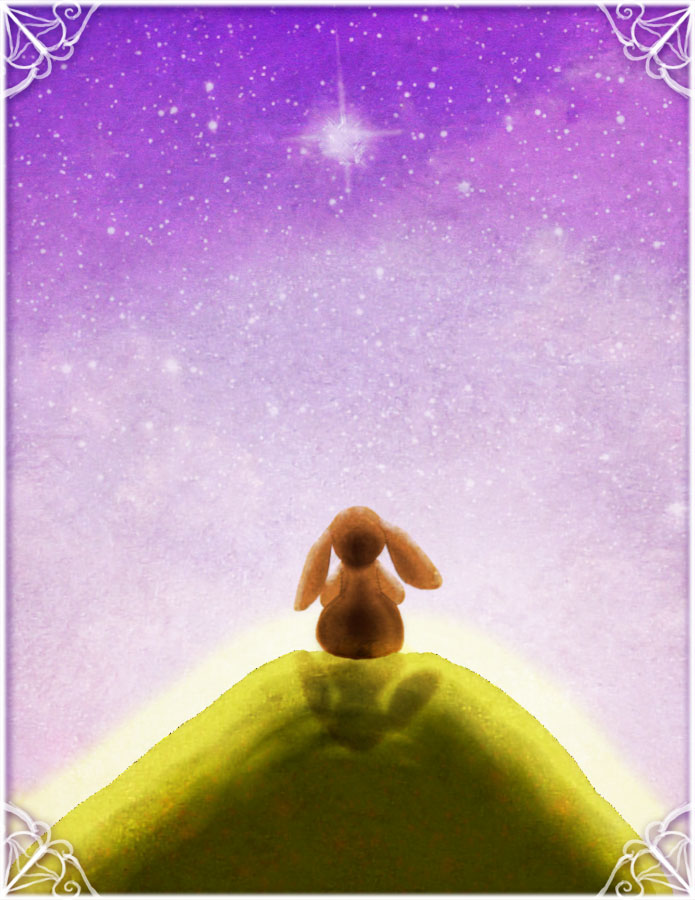
Becoming a Real Rabbit

Remember the story of the Velveteen Rabbit, the stuffed animal who was loved so deeply by a young boy that he became alive?

I've been playing with idea of that as metaphor for being  Externally, there's a form we present to the world -- generally pleasing, attractive to some, invisible to others. Like a Build-a-Bear for humans.

Right under that skin, like a layer of fat, is fear. Maybe it's fear of being abandoned or fear of death or fear of inadequacy -- but it's all fear. Terror, even. We maintain our plush exteriors to keep the fear hidden from ourselves and the world, and we work too hard for success or drink too much or obsess about our appearance or whatever we do to keep that fear from poking through the stitching that holds our exterior together. For some people, the fear layer may be tissue-thin, like Thinsulate. For others it's like blubber that keeps arctic animals warm.

But it's only a layer. Under that is our true nature, which is radiant and kind and loves unconditionally. This is our real rabbit. It too can leak out through the needle holes made by the stitches that hold us together, but only if we can poke holes in the fear.

And that is why we practice. Meditation and contemplation and study are the ways we wear through the fabric of our selves, the tools for poking holes in the fear, and letting the real rabbit inside us out so that it eventually becomes who we are.

In the Velveteen Rabbit, one of the older toys, the Skin Horse, tells the still-stuffed bunny about becoming Real through a child's love.

"Real isn't how you are made," said the Skin Horse. "It's a thing that happens to you. When a child loves you for a long, long time not just to play with, but really loves you, then you become Real."
"Does it hurt?" asked the Rabbit,
"Sometimes," said the Skin Horse, for he was always truthful. "When you are Real you don't mind being hurt."


from 'The Velveteen Rabbit', by Margery Williams
That last statement gets at equanimity, one of the Brahma Viharas, or Divine Abodes. Enlightened people may still be hurt, but they don't make it worse by interpreting it or projecting additional arrows. Equanimity creates space and balance for everything to be accommodated, painful and not. 

By RJDaae
In the book, the boy develops scarlet fever, and all of his toys have to be burned, including the Velveteen Rabbit. But since he has been so well loved, the rabbit becomes real.

A teacher once told me the Buddhist practice is about "loving the self to death." Rather than deeming our constructed selves as something deficient and wrong that must be stripped away and discarded, it's about loving our inner nature so much that the exterior we created at the Build-a-Human workshop can dissolve.

We love even the form, seeing it as a misguided attempt to protect that which we worried was too fragile to stand up to the world. When we love our defenses, they become redundant and fall away. The constructed skin wears out, and the buddhanature shines through.

For that to happen, we have to develop trust in our nature, just as the Velveteen Rabbit had to believe he could become Real.

And that is hard.


"You trust your impure nature more than your pure nature and yet talk about enlightenment. Enlightenment arises by not doing anything. Samsara arises because you have to do so many things. But you still see that – Samsara - as being easier than Nirvana. If this is not ignorance, what is?” Her Eminence Mindrolling Jetsün Khandro Rinpoche

Saturday, April 6, 2013

Equanimity and the Final Four


What what! Isn't sports all about passion, aggression, and achieving a goal (to defeat the other team)?

Not just. How about equanimity -- holding your (metaphorical) center in the most chaotic environment imaginable?

In the barely officiated first half of last weekend's Sweet Sixteen game between the University of Connecticut and the University of Maryland, things were getting rough.

Like our meditation practice, officiating can be too tight or too loose.In too tight, officials call every ticky-tack foul, and the game moves like a snail. In too loose, the officials call almost nothing and the game gets out of control. (You can apply the metaphor to your meditation practice: how's the officiating mind calling the session?)

Seconds from the end of the half, a Maryland player undercut a UConn player who was already jumping to make a shot, a dangerous move because the person in the air has less ability to control her body. We're not cats.

The announcers were incredulous. As the half ended, they started to discuss how players deal with a badly called game. If they talk back to the ref, they get called for a foul. If they react to the aggression, they can get ejected.

"Equanimity," Doris Burke said.

What?

"Equanimity," she repeated. She said something like, "You have to be able to stay in your center, play your game and not react."

"Equanimity," she said again. "I like saying that."

Basketball, especially as UConn plays it, is a fast game. There's set plays, but there's also unexpected bounces, slips, and crashes. You practice a lot so that your muscle memory takes over -- there's no time to think for a lot of the game. Sometimes you get to walk the ball up, to pass it around, to execute -- but then you shoot, the ball bounces, the bodies go up, and you respond.

That's where the rubber (or the chemically created rubber-like substance that's on the bottom of sneakers these days) meets the hardwood. Thousands of people watching, your coach screaming (it's UConn), bodies crashing, a game to be won, and you have to stay in your center and not lash out.

Take that metaphor into your meditation practice. Even if your thoughts are battling, even if they're crashing the boards or jumping over each others' backs to get to the prize -- your attention -- can you hold your center and rest in awareness of what's going without getting into the scrum?

Wednesday, February 6, 2013

Equanimity

Remember Weebles -- the children’s toy with the slogan “Weebles wobble but they don’t fall down”? Small, round, sort-of-human figures, they had a curved – but weighted—base so that young children could push them over, and they would spring back up. My friend, Ven. Lawrence Do’an Grecco, a Zen monk, sometimes brings Weebles to illustrate his talks on equanimity, the quality that allows you to roll back up when you get knocked down, whether by ill fortune or giddy joy.
Shinzen Young, a secular Buddhist, says that the word equanimity comes from the Latin word aequus, meaning balanced, and animus, meaning spirit or inner state. So it means a balanced inner state.
Shinzen, who takes a scientific approach to Buddhist teachings, offers a number of physical analogies for equanimity:

 Reducing friction in a mechanical system.
 Reducing viscosity in a hydrodynamic system
 Reducing resistance in a DC circuit
 Reducing impedance in an AC circuit
 Reducing stiffness in a spring.

When we have equanimity, he says, emotions flow through us, rather than getting stuck, which allows us to be with them without getting obsessed or fixated.
More poetically, Gil Fronsdal describes equanimity as “one of the most sublime emotions of Buddhist practice. It is the ground for wisdom and freedom and the protector of compassion and love. While some may think of equanimity as dry neutrality or cool aloofness, mature equanimity produces a radiance and warmth of being. The Buddha described a mind filled with equanimity as “abundant, exalted, immeasurable, without hostility, and without ill-will.”
Fronsdal says there are two Pali words that are often translated as equanimity, which reveal two aspects of it. (Pali is the language of the earliest Buddhist texts).
The first is upekkha, meaning “to look over.” It refers to the equanimity that arises from the power of observation, the ability to see without being caught by what we see. When well-developed, such power gives rise to a great sense of peace. It’s also translated as “to see with patience,” such as when we listen to criticism without getting defensive, or “grandmotherly love.”
The second meaning is literally “to stand in the middle of all this.” Fronsdal says that “being in the middle” refers to balance, to remaining centered in the middle of whatever is happening. This balance comes from inner strength or stability. The strong presence of inner calm, well-being, confidence, vitality, or integrity can keep us upright, like a ballast keeps a ship upright in strong winds. As inner strength develops, equanimity follows.”
Equanimity works with what the Buddha called the Eight Worldly Winds. They’re four pairs of states that represent the extreme points of a pendulum’s swing: Praise and blame, fame and ill-repute, success and failure, pleasure and pain. Often we classify our experiences as one or the other. We rarely sit exactly in between them – but that’s where equanimity (and sanity) lie.
My guess is that we can all agree this sounds like a good thing. It’s the eye of the storm, the ability to keep your head when everyone else is losing theirs.
Buddhism is a practical path, so how do we get there?
To some degree, equanimity is what’s known as a fruitional quality – the result of other practices. It is the fourth of the Four Brahma Viharas, or immeasurable states, and said to be the most difficult to attain. To dwell in equanimity, you have to accept impermanence and emptiness – the current situation, whatever it is, will not last. Nor will it define us. Emptiness says that states of being (and beings) are not solid, permanent, or independent. We change in response to circumstances; we adapt; we persevere. Life goes on.
We lose equanimity, and resilience, when we think that a situation has to be a certain way to be acceptable, that we can’t go on without whatever thing or circumstance we think is necessary. Then we suffer. If we can be flexible and work with what we have rather than insisting that things be a certain way, we can come back into balance.

We can experience this in meditation. When we lose concentration and get distracted, we come back. When the room is too hot or too cold, too loud, too quiet, with too many people or not enough, we watch thoughts arise and pass, pains arise and diminish, and emotions move through our minds like clouds across the sky. The sky is there no matter what is front of it – and when the clouds move or the storm clears or the bright sun sets, there it is. It doesn’t come back; it was always there, just obscured. Equanimity is always there; we just have to cultivate it and learn to access it.
Shinzen Young suggest specific ways to create equanimity in your mind and body in meditation:
Let's say that you have a strong sensation in one part of your body. As you focus attention on what is happening over your whole body, you notice that you are tensing your jaw, clenching your fists, tightening your gut, and squnching your shoulders. Each time you become aware of tensing in some area, you intentionally relax it to whatever degree possible. A moment later you may notice that the tensing has started again in some area; once again gently relax it to whatever
degree possible. If there are areas that cannot be relaxed much or at all, you try to accept the tension sensations and just observe them.
As a result of maintaining this whole-body relaxed state, you may begin to notice subtle flavors of sensation spreading from the local area of intensity and coursing through your body. These are the sensations that you had been masking by tension. Now that they have been uncovered, try to create a mental attitude of welcoming them, not judging them. Observe them with gentle matter-of-factness, giving them permission to dance their dance, to flow as they wish through your body.
He also suggests we notice when we spontaneously fall into equanimity. By
becoming familiar with it, we can extend it.
Pema Chodron says the traditional image for equanimity is a banquet to which everyone is invited. “Training in equanimity is learning to open the door to all ... inviting life to come visit,” she writes.

To cultivate equanimity, we practice catching ourselves when we feel attraction or aversion, before it hardens into grasping or negativity. She suggests training in equanimity by walking down the sidewalk, or through the mall, and noticing our feelings about each person we pass. We can use those feelings to develop empathy and compassion. Does that person look crabby? Sometimes I’m crabby too – can I make a mental wish for them to be happy? Do they look friendly? What feelings come up in us?
“When we have a feeling of spaciousness and ease that’s not caught up in preference or prejudice, that’s equanimity,” she says.
Traditionally, equanimity is developed by cultivating the seven factors that support it. Fronsdal describes them this way:
-- The first is virtue or integrity. When we live and act with integrity, we feel confident about our actions and words, which results in the equanimity of blamelessness. The ancient Buddhist texts speak of being able to go into any assembly of people and feel blameless.
--The second support for equanimity is the sense of assurance that comes from faith. While any kind of faith can provide equanimity, faith grounded in wisdom is especially powerful. The Pali word for faith, saddha, is also translated as conviction or confidence. If we have confidence, for example, in our ability to engage in a spiritual practice, then we are more likely to meet its challenges with equanimity.
--The third support is a well-developed mind. Much as we might develop physical strength, balance, and stability of the body in a gym, so too can we develop strength, balance and stability of the mind. This is done through practices that
cultivate calm, concentration and mindfulness. When the mind is calm, we are less likely to be blown about by the worldly winds.
--The fourth support is a sense of well-being. We do not need to leave well-being to chance. In Buddhism, it is considered appropriate and helpful to cultivate and enhance our well-being. We often overlook the well-being that is easily available in daily life. Even taking time to enjoy one’s tea or the sunset can be a training in well-being.
--The fifth support for equanimity is understanding or wisdom. Wisdom is an important factor in learning to have an accepting awareness, to be present for whatever is happening without the mind or heart contracting or resisting. Wisdom can teach us to separate people’s actions from who they are. We can agree or disagree with their actions, but remain balanced in our relationship with them. We can also understand that our own thoughts and impulses are the result of impersonal conditions. By not taking them so personally, we are more likely to stay at ease with their arising.
Another way wisdom supports equanimity is in understanding that people are responsible for their own decisions, which helps us to find equanimity in the face of other people’s suffering. We can wish the best for them, but we avoid being buffeted by a false sense of responsibility for their well-being.
One of the most powerful ways to use wisdom to facilitate equanimity is to be mindful of when equanimity is absent. Honest awareness of what makes us imbalanced helps us to learn how to find balance.
--The sixth support is insight, a deep seeing into the nature of things as they are. One of the primary insights is the nature of impermanence. In the deepest forms of this insight, we see that things change so quickly that we can’t hold onto anything, and eventually the mind lets go of clinging. Letting go brings equanimity; the greater the letting go, the deeper the equanimity.
--The final support is freedom, which comes as we begin to let go of our reactive tendencies. We can get a taste of what this means by noticing areas in which we were once reactive but are no longer. For example, some issues that upset us when we were teenagers prompt no reaction at all now that we are adults. In Buddhist practice, we work to expand the range of life experiences in which we are free.
Shinzen says:
Equanimity belies the adage that you cannot “have your cake and eat it too.” When you apply equanimity to unpleasant sensations, they flow more readily and as a result cause less suffering. When you apply equanimity to pleasant sensations, they also flow more readily and as a result deliver deeper fulfillment.

Shinzen Young, What is Equanimity?
Gil Fronsdal, Equanimity
Pema Chodron, The Places that Scare You: A guide to fearlessness in difficult times
Tuesday, November 6, 2012

Equanimity and the election


The Buddha’s First Noble Truth – dukkha – says that suffering exists, that we experience discomfort, that life feels like a bumpy ride at times.
 
The Second Noble Truth says that the cause of that discomfort, that dissatisfaction or sense of unease, is that we think things have to be a certain way in order to be happy. We need to have a drink or a piece of chocolate or electricity or our teddy bear to feel OK. 
Today, Election Day, that might translate to the feeling that we – and maybe the whole world – cannot function, let alone be happy, unless a certain person is elected president.
Are you feeling that?
And are you feeling the suffering – the anxiety, the discomfort – that comes from that?
We have strong feelings about this election. Maybe passionate ones – and passion is one of the three poisons that the Buddha identified, right? As Buddhists aren't we’re supposed to be above the storm? And the other two --aggression and ignorance—well, they’re out there in abundance too in this election cycle. 

Here’s the thing:
The Buddha doesn’t ask us not to have preferences, not to feel strongly, not to analyze and make wise decisions. The path is about liberation, not lobotomy. It’s about discovering and recognizing your innate wisdom and using that to discern the wise course of action. 
It suggests – and provides practices – to help us see what is true, to feel compassion rather the defensiveness toward those who take opposite positions (which allows us to have dialogue rather than arguments), and to work for the result that will be of the most benefit for all beings.
And then … to learn the result and to start over again in a new moment.
That doesn’t mean the result is “all good,” that’s we’re complacent about whatever happens. It doesn’t mean that we don’t rejoice or despair at the outcome, that we don’t shed tears of joy or sorrow. We do all that, and we’re present with it.
We see our response to the result – whatever it is – anger, gratitude, elation, astonishment, indifference – as a response, as a cloud that blocks the sun or a break in the clouds. We feel it fully, in our physical bodies, in our emotional and spirit bodies. But we know that it doesn’t alter the fundamental nature of what is.
And we know that tonight’s result, whatever it is, isn’t the end.
That’s equanimity – being able to stay grounded in your own wisdom and experience your emotions without getting swept away into giddy elation or deep discouragement that prevents you from acting. It’s knowing that this is a moment, which will be followed by myriad other moments, and in each one we need to respond to what’s there. Thicht Nhat Hahn describes equanimity as climbing to the top of the mountain and getting the panoramic view.
That’s what lets us keep moving forward.
This is a quote from bell hooks:


In my work, I am constantly grappling with ways to end dominator culture. I am constantly face to face with the suffering caused by the imperialist white supremacist capitalist patriarchy, describing and critiquing liberatory possibilities. Thinking outside the box of dualism and living a practice of equanimity gives my life balance. But more than that, spiritual practice is the circle surrounding this work, the force empowering me to open my heart, to be Buddha, to have a practice of compassion that joins rather than separates, that takes the broken bits and pieces of our damaged self and world, bringing them together. (Italics mine.)


To life in this way requires an understanding of impermanence and interdependence. Living from interdependence – the interconnected web of life – transforms us and therefor the world.


Seeing reality in this way, we are able to hold one another accountable for the positions we occupy in dominator culture without evoking a politics of blame or victimhood. An authentic middle way allows us to recognize multiple intentionalities. We can easily move past either/or notions to both/and. To me, the middle way is the space of radical openness, the space that invites true communication.
(bell hooks again)


What is true communication? 
To me, it’s the recognition that we’re all in this together, it’s bringing our genuine selves – our wise selves – to the table, not our constructed, defensive selves. It’s possible – look at President Obama and New Jersey Gov. Chris Christie a few days ago, coming together from opposite sides of the political realm to work on hurricane relief efforts.
This gives me hope that it’s possible to build a culture that values kindness and compassion, that sees beyond individual politics to societal benefit. Obviously, there’s a long way to go. There’s work to be done, no matter who gets elected.
In the short term – tonight – enjoy the ride. I’m guessing there’ll be a roller-coaster of thrills and scares as results roll in, with feelings changing from second to second. Roar your terrible roars, gnash your terrible teeth, whoop for joy. Be fully there in each moment.
And tomorrow – or whenever you recover – roll up your sleeves and get back to work. Equanimity is what lets you do that, with wisdom and kindness toward all.

Tuesday, July 3, 2012

Dancing with dragons


Equanimity -- the fourth of the Brahma Viharas or Divine Abodes -- doesn't mean only the ability to keep your balance as the worldly winds of samsara swirl around you. It also means being able to create a balanced life, one that has time for work, play, and idleness.

Maybe you've seen this New York Times article on how busyness plagues our lives. Maybe you're one of the dozen or so of my Facebook friends who linked to it. Busyness, it seems, is rampant.

Author and cartoonist Tim Kreider writes:
Busyness serves as a kind of existential reassurance, a hedge against emptiness; obviously your life cannot possibly be silly or trivial or meaningless if you are so busy, completely booked, in demand every hour of the day.
This is something I've been thinking about lately. I tend to be busy. My job is busy -- the work I do used to be done by 2.5 people, and some new obligations have been invented. I rarely stop working on my keyboard to talk to people with my full attention, and I work in a large room with a lot of other people talking to one another or on the phone or to themselves. I teach meditation. I meditate. I study and teach Buddhism. And I don't even live in New York, where people constantly announce that New Yorkers are SO busy (this is a pet peeve of mine as it makes it seem as if the rest of the world lazes around).

At one retreat I went to this year, a teacher talked about the importance of leading a balanced life, using the Four Dignities of Shambhala. The tiger, which is grounded and observant, represents work. The snow lion represents hobbies and activities, those things that are not part of making a living but that require discipline. Garuda, which flies and never lands, is our artistic endeavors, things where we create (similar to hobbies but looser). And the turquoise dragon is free time, idle time, time to dance in space with all possibilities.


On the flag that's displayed at my Shambhala center, the dignities occupy equal portions. In my life, not so much. I am heavy on the tiger-lion portion, with some garuda and a sliver of dragon. Energetically it's even more imbalanced, I fear.

So I'm declaring July to be Dragon Time. I have few obligations this month, and I'm trying not to add to them. Do I have plans this weekend? Yes, I plan to do nothing.

Back to Mr. Krieger:

Idleness is not just a vacation, an indulgence or a vice; it is as indispensable to the brain as vitamin D is to the body, and deprived of it we suffer a mental affliction as disfiguring as rickets. The space and quiet that idleness provides is a necessary condition for standing back from life and seeing it whole, for making unexpected connections and waiting for the wild summer lightning strikes of inspiration — it is, paradoxically, necessary to getting any work done.
I've got plans already for two weekends in August, so I can't get lost in space. But if you're looking for me this month, I'll be dancing with dragons.