Friday, April 17, 2015

Compassion requires action

Compassion is the heart of the Buddhist teachings. The Dalai Lama, head of one of the lineages of Tibetan Buddhism and the face of Buddhism to much of the world, says that the purpose of life is to be happy, and the way to attain that is to develop compassion.

"The more we care for the happiness of others, the greater our own sense of well-being becomes. Cultivating a close, warm-hearted feeling for others automatically puts the mind at ease. This helps remove whatever fears or insecurities we may have and gives us the strength to cope with any obstacles we encounter. It is the ultimate source of success in life," he says.

Compassion is listed as one of the Brahma Viharas, or Divine Abodes, along with lovingkindness, empathetic joy, and equanimity. While lovingkindness is defined as the wish for all beings -- ourselves and others -- to be happy, compassion goes a step further, seeing suffering and aspiring to end it.

Looking deeply at others' suffering may sound depressing, but the Dalai Lama says it's what gives us the ability to face our difficulties without getting swamped:
As long as we live in this world we are bound to encounter problems. If, at such times, we lose hope and become discouraged, we diminish our ability to face difficulties. If, on the other hand, we remember that it is not just ourselves but every one who has to undergo suffering, this more realistic perspective will increase our determination and capacity to overcome troubles. Indeed, with this attitude, each new obstacle can be seen as yet another valuable opportunity to improve our mind!
Thus we can strive gradually to become more compassionate, that is we can develop both genuine sympathy for others' suffering and the will to help remove their pain. As a result, our own serenity and inner strength will increase.

Compassion develops on three levels: aspiring (we see others' suffering and wish it could be removed); active (we take action to alleviate the suffering); and absolute (we see no difference between ourselves and others, and every action we take is for the benefit of beings).

How do we develop compassion? We allow our hearts to be touched. Compassion is sometimes described as being tender-hearted -- it's the "aw" we feel watching cat videos on the Internet or looking at pictures of babies; the tears that fall when we hear another's pain; even the anger at injustice. (Using anger as skillful means is a topic all its own.) There are specific practices in which we imagine exchanging places with another person or taking their suffering into our own hearts and transforming it.

By developing an attitude of compassion -- of seeing suffering rather than ignoring or denying it or blaming the person who is suffering -- we behave differently in the world. That's important. That's world-changing.

The 17th Karmapa, head of another of the Tibetan Buddhist lineages, is touring the U.S. for three months and has spoken frequently about the need to act to protect the environment. Intellectual knowledge of the threat to the planet has not produced action because our heartfelt awareness, known as bodhicitta, hasn't kept pace. We care more for consumer goods than the Earth.

His Holiness the 17th Karmapa plants a tree in New Haven. (Karmapaamerica.org)
“The weakness of our compassion, and the weakness or outright lack of our bodhicitta has placed this world in grave danger," he said. "We know this, it is all around us and we are responsible for it. And yet we lack enough compassion to care. We lack enough bodhicitta to do anything about it. We need to work on that.”

Compassion depends on a personal, felt connection. When we act from that deep level, we respect the interdependent web of existence, cherishing all life as much as our own.

Sunday, April 12, 2015

Is Buddhism's rep for tolerance deserved?

A new study reports that merely reading Buddhist terms in a word puzzle -- such as dharma, Buddha, and awakening -- increased the likelihood of "prosocial" behaviors among study participants, some of them familiar with Buddhism and others not.

Testing the theory of "subliminal priming," researchers found that introducing language associated with Buddhism decreased explicit prejudice against ethnic, ideological, and moral groups other than those of the person. The results challenge the idea that religion promotes prosocial behavior among its members but prejudice toward those outside the group, the authors said. Prosocial behaviors include having compassion and empathy, along with a sense of responsibility for others.

That doesn't mean Buddhism is better, the authors stressed.


"What we really want to argue is that Buddhist concepts are associated with tolerance, across cultural groups," Magalli Clobert, a post-doctoral student at Stanford and one of the study's authors, told The Huffington Post. "It means that, at least in people's mind, there is a positive vision of Buddhism as a religion of tolerance and compassion."
My immediate reaction is to list places where that's not true, a compendium of Buddhist behaving badly. That stems, in part, from my Buddhist training -- question everything, especially blanket perceptions. Ask yourself, when those perceptions arise: Is this true? Is it always true? Are there exceptions? Is this solid and permanent? Nope.

But after holding it for a while, I've decided that it's not untrue, either.

One of the beauties of Buddhism is that the Buddha doesn't mandate tolerance. He says, look into yourself and see what makes you intolerant. What makes you uncomfortable? Examine that -- if it is because the person is different, can you find areas of similarity? You both breathe, for starters. You both want to continue breathing. You both love things, maybe different things, but that feeling of love is the same. You're both humans in a confusing world. There's a common ground to start with, and if you dislike what the other person builds on that, you've still got that starting place to come back to so you can tolerate what does not harm your or the larger community and treat the other person with respect if you engage with them over their actions.

I saw this when I read a New York Times story about a woman who was asked to change her seat on an airplane because the man assigned to the seat next to her, an Orthodox Jew, was prohibited by his religion from sitting next to a woman who is not his wife.


I often use public transportation scenarios in equanimity meditation. I have a seat on a train. How do I feel if my BFF gets on and sits next to me? If an acquaintance I don't know much about takes that seat? If that talky, conservative co-worker gets it, or some smelly person?

My practice is about being OK with who other people are, not avoiding them. Seeing our shared humanity, even if we display it differently. Recognizing that we're all fighting our own battles and declining to escalate the war. Trying for tolerance and compassion -- and when I fail, knowing that I can keep trying, that small corrections lead to big changes.


Tuesday, April 7, 2015

You can't win meditation

We're entering heavy sports season here in the U.S., with the month-long college basketball championships wrapping up -- March Madness that now extends into April -- and playoffs looming for professional basketball and hockey, even as baseball opened its season Monday.

In a world where ambiguity muddies most situations, sports offer blessed certainty: Someone wins and someone loses. There's comfort in that. (Of course, if you look into the elements that go into those wins and losses, it can get fuzzy. Someone used performance-enhancing drugs. Someone violated recruiting rules.)

We'd like to be able to apply that certainty in our lives -- remember when Charlie Sheen 
popularized the "Winning" as a description of his life -- but life's not like that. You could see it as a series of games, I suppose, but there's no championship to end the season, declare a winner, and let everyone go home to rest. Life is about getting up and doing it again.

We'd really like to bring the game dynamic to our meditation practice -- we'd like a score, a quantifiable result that says we've won (or at least made the shot, hit the pitch, touched the rim).


The 17th Karmapa, who's touring the U.S. for three months, touched on this attitude in a talk over the weekend. Asked about ngondro, the preliminary practices students of Tibetan Buddhism undertake to get ready for vajrayana practices, Karmapa noted that attention tends to focus on the uncommon practices: 100,000 prostrations, 100,000 purifications mantras, 1 million or more devotional mantras. Students like to count, he said. Numbers make them feel like they've achieved something.

But in truth, it's the common practices, the ones that don't require any particular initiations, that are most important, Karmapa said. Those include contemplations of the Four Reminders that turn the mind to the dharma: Precious human birth, impermanence, karma, and the suffering inherent in all six realms of samsara.

The problem with those contemplations is that there's no way to quantify the results, Karmapa said. Your mind and your personality improve through those contemplations, he said. But there's no score, no stat line, no trophy that tells you that you've done it right or that you're the best in the league at appreciating your precious human birth, you know impermanence better than anyone. There's just you and those around you experiencing how you live your life.

We find that "boring," Karmapa said, interrupting his translator to say that precise English word. (He speaks in Tibetan, but he occasionally corrects his English translators.)

Those who play sports, who aren't just fans following the hot team, know the truth of what he says, though. Games aren't about the score -- they're about the practices, about building muscle memory so that the body knows what to do. Breanna Stewart doesn't have time in a game to think, now I'm going to block that shot by jumping up; she's well-trained and reacts. Games are about showing up for every play, being present in the moment, no matter what the score. If you're focused more on the score than on the play, you'll screw up and let the opponent win. You need, as the sports cliche says, to keep your head in the game -- and out of dreaming about the victory trip to Disney World.

In shamata meditation, each breath is the only breath. In walking meditation, each step is the only step. In ngondro, every prostration is the only one. Each day starts fresh with no score.

Maybe someday, as secular meditation becomes more popular, there will be meditation competitions and there will be a meditation champion, just as there are yoga competitions now. But there is no outside acclamation or accumulation that can tell you when you're doing it right or doing it better than everyone else.

You'll know you're winning at meditation when that no longer matters.

Saturday, March 28, 2015

When life gives you mushy peas

As a child I was often told that starving children in China would be happy to have the mushy peas I carefully picked out from the Campbell's vegetable soup and left in the bowl. I felt bad for the starving children and guilty, but that wasn't going to make me like the mushy peas -- or the occasional lima beans that kept them company after everything else was gone.

I thought of that this week because of a couple of unexpected events that caused some strong shifts in the family Force. Nothing awful -- a car given a terminal diagnosis, a recurring expense that the new health insurance covers far less of than the previous policy. Unexpected. Unpleasant. Inconvenient. But not tragic.

It's interesting to watch where your mind goes when the earth shifts. There's a moment when you feel it, and then the mind starts to scramble. Uneven ground is uncomfortable. So the mind seeks level ground again. It looks for someone to blame -- or absorbs the blame itself. What was done? What was not done? Who did or didn't do it? What should have been done? What should happen now? What might happen next? Can I ignore it? Pretend it didn't happen? Assure myself it isn't important -- after all, there are children starving somewhere, buildings exploding, wars being fought, and I'm upset about a car.

And while there's value in putting our suffering into perspective, I think it's important to acknowledge the shock to the system, to be disconcerted, surprised, and confused. To accept the feelings that arise before deciding they're inappropriate.

Knowing that other people have it worse, that my problems are mushy peas while others deal with massive boulders, can convince me to disallow my feelings. And I fear I'm even worse when I'm dealing with other people's feelings. I want them to feel OK, and I may jump into telling them why they're OK before letting them be not OK with what's happening.

But the feeling isn't really about the car; it's about the loss, about change, about impermanence. It's a reminder of the inevitable breakdown of everything, the truth of impermanence. And that's universal. It's a connection with all of the humans who are discovering that. Change is scary, loss hurts. Touching that in myself opens me up to touching it in others; denying it in myself, even if it's because I see it as less legitimate than others' pain, closes me off to all of it.

It's OK to hate the mushy peas, even if someone else would like them or is so hungry that they'd appreciate them even if they didn't like the taste or texture. Let those feelings remind you that everybody is faced with things they don't much like to varying degrees -- and make the aspiration that all beings have good things that bring them happiness, that all beings don't have the things that bring them unhappiness, and that all beings have the equanimity to sit with both.

And do what you can to share what you have. Donate to a food bank. Hold a friend's sadness with love before cheering them up. Don't tell a serious-faced person to smile -- just smile at them.

Friday, March 20, 2015

The lotus and the mud

You often see lotuses in images of Eastern religions or philosophies. They stand for beauty, peace, purity -- in Tibetan Buddhist iconography, the buddhas sit on lotuses with as many as 100,000 petals, symbolic of their great wisdom and compassion.

But lotuses, as lovely as they are, grow in unlovely mud, not pristine pools. They live in the mud and the muck; they thrive there. They don't transcend the mud. They exist together, inseparable. As Thich Naht Hanh says, they inter-are. No mud, no lotus.

Merriam-Webster defines transcendent as "going beyond ordinary experience." But Buddhism celebrates the ordinary as the path to liberation. Zen teacher Charlotte Joko Beck started the lineage of Ordinary Mind Zen. Popular teacher Pema Chodron advises us to "start where you are." You work with what you have -- emotions, fears, irritations, pleasures -- and use that to wake up to the way habitual patterns rule your life and keep your from directly experiencing the world. "When nothing is special, everything can be," Beck writes.

Our tendency is to avoid those feelings, to pretend the lotus exists independently of the mud. That leads to suffering, as we blindly follow habits, doing the same things over and over to distract ourselves and wondering why it doesn't make us feel good. Buddhist psychologist John Welwood coined the term "spiritual bypassing," which refers to that tendency to use spiritual practices and beliefs to avoid dealing with the discomfort of life. Denying suffering or bypassing it without examining it, processing it, loving it, leaves it there, and you're likely to find yourself back there.

The Buddha taught that nirvana -- or liberation -- is not separate from samsara, the world of habit and struggle. They exist together, like the mud and the lotus. It's about all in how you see and understand it.  If we see the mud as an unacceptable, unpleasant aspect of life that needs to be cleaned up or covered over, we're creating suffering, trying to do what can't be done. If we accept it, we can appreciate fully the beauty of the lotus.


Sunday, March 15, 2015

Bearing witness to the body

We create the world with our thoughts, the Buddha taught, but we experience it with our bodies. That's one of those fun conundrums of Buddhism.

It's an issue I work with a lot, particularly since my practice now involves visualizations. How do I keep from becoming a brain on a stick, a mind that observes sensations without feeling them? Where is my body if my mind is projecting the consciousness elsewhere?


Ruth Denison, a Buddhist teacher who expanded the teachings on mindfulness of the body, describes its value like this:
It is tangible right away, it makes sense, it is giving a bridge to modern physics, to modern science, and it gives you a personal touch with yourself. It is all spiritual and enlightenment. So it was not something to believe in or to bow to,you didn't need to pray to it. It brought me into daily life, where I know that everything is having this impermanence.
Denison, who studied body awareness before coming to Buddhist teacher U Ba Khin, describes the process with exquisite awareness, in her biography, Dancing in the Dharma:

When I breathe in and feel a deeper breath and allow that, then I feel a relationship between the breath energy and the body energy. The breath moves into the body and changes the sensations, that aliveness, and it is recharged with the in breath. Then it goes out and comes in again. I also discovered that when I am allowing more deeply the breathing that I have deeper access to the body sensations, because I can witness or feel that every part of the body is in my attention, like it is enlivened with the breath. It is always so, but now because of my attention I could experience that directly. So it was not anymore anything I have to worship or ask how to understand. I just thought, 'Aha, this is this.'
Denison's witness is embodied, engaged, embedded in her being. It's not sitting by, watching the breath flow by -- it is feeling it, down to the exchange of oxygen between the breath and blood. And in that observation of the smallest details, the whole of the universe is revealed.

Saturday, March 7, 2015

Ruth Denison, Dharma Elder

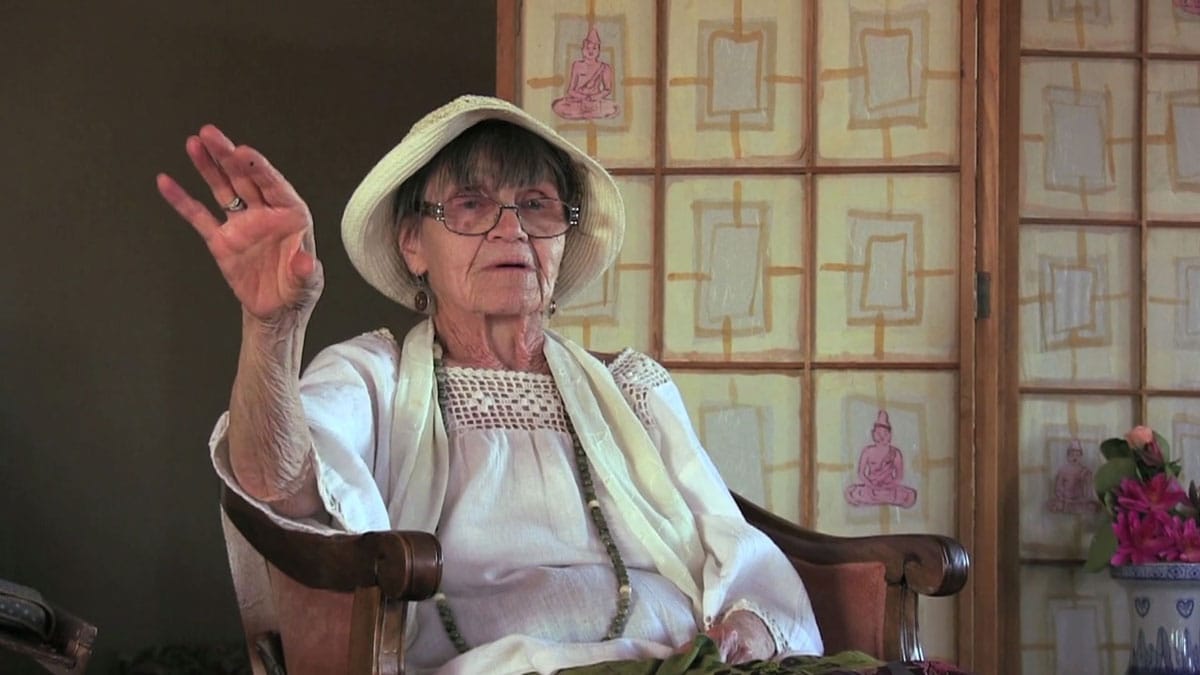
I've been reading about Ruth Denison, a Buddhist teacher who died Feb. 26. I'd picked up a book about her, Dancing in the Dharma, because I liked the title. I had not heard of her. That's a shame, because Denison's work deeply influenced how Buddhism is taught in the west.

I'm deeply grateful for her work, even though I didn't know it was her work, that it wasn't always this way. I don't think I'm alone in that -- her Wikipedia entry is seven sentences.

Denison was among the first wave of westerners who went east, a contemporary of Jack Kornfield, Sharon Salzberg, and others whose work formed the bones of Insight Meditation. She taught at their centers, at Spirit Rock and Insight Meditation Society, but in her own idiosyncratic way. She was not popular with students who wanted a traditional experience, Salzberg says in the book.

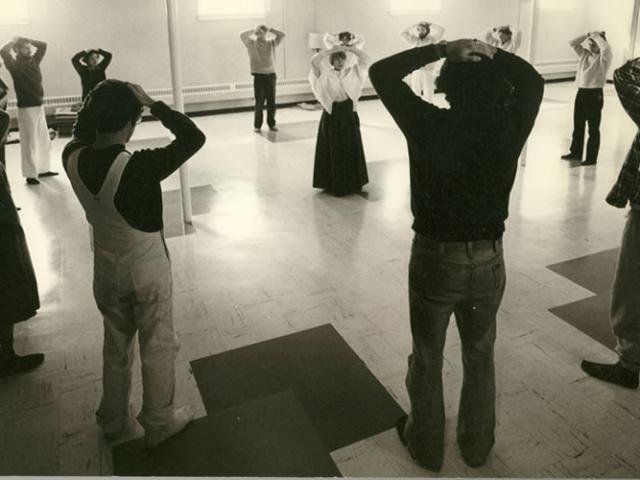
Denison's gift to the dharma and its students was to introduce and integrate body practices. Having studied in Zen before finding her teacher in U Ba Khin, she taught walking meditation. She taught students to ground in their bodies, to use sensation to integrate body and mind. When her contemporaries were experimenting with psychedelics and meditation, Denison was known as a person who could help those having a bad trip by keeping them anchored in their bodies. After she opened a dharma center, Dhamma Dena, she was known as a teacher who could work with students who had mental illness or other difficulties.

She also worked with women, creating the first retreat for women practitioners, and brought a strong feminine presence to Buddhism.

Dancing in the Dharma is written by one of Denison's longtime students, but it's unusually clear-eyed and straight forward, not sentimental or cloying. In that, it seems to be a fair reflection of Denison. She had a fascinating life, growing up in Germany between the wars, living through horrific experiences, and coming west to join the counter culture and then Buddhism. But she seems not have been particularly impressed by any of it, going about her life.

In her teaching and in her life, Ruth acts spontaneously; she is so fully committed to this moment that she may lose track of what she promised yesterday, or even the prescribed schedule of events at a retreat. At first this evoked little fits of exasperation in me -- until I discovered the obvious, that it was my own mind that was causing me to suffer. Then I began to understand that this was a great teaching for me: to get go of expectations, to not hold so tightly to my own precious agenda, to break the form and stay with the interest and joy of the present moment. -- Sandy Boucher, Dancing in the Dharma