Friday, May 23, 2014

Becoming a Real Rabbit

Remember the story of the Velveteen Rabbit, the stuffed animal who was loved so deeply by a young boy that he became alive?

I've been playing with idea of that as metaphor for being  Externally, there's a form we present to the world -- generally pleasing, attractive to some, invisible to others. Like a Build-a-Bear for humans.

Right under that skin, like a layer of fat, is fear. Maybe it's fear of being abandoned or fear of death or fear of inadequacy -- but it's all fear. Terror, even. We maintain our plush exteriors to keep the fear hidden from ourselves and the world, and we work too hard for success or drink too much or obsess about our appearance or whatever we do to keep that fear from poking through the stitching that holds our exterior together. For some people, the fear layer may be tissue-thin, like Thinsulate. For others it's like blubber that keeps arctic animals warm.

But it's only a layer. Under that is our true nature, which is radiant and kind and loves unconditionally. This is our real rabbit. It too can leak out through the needle holes made by the stitches that hold us together, but only if we can poke holes in the fear.

And that is why we practice. Meditation and contemplation and study are the ways we wear through the fabric of our selves, the tools for poking holes in the fear, and letting the real rabbit inside us out so that it eventually becomes who we are.

In the Velveteen Rabbit, one of the older toys, the Skin Horse, tells the still-stuffed bunny about becoming Real through a child's love.

"Real isn't how you are made," said the Skin Horse. "It's a thing that happens to you. When a child loves you for a long, long time not just to play with, but really loves you, then you become Real."
"Does it hurt?" asked the Rabbit,
"Sometimes," said the Skin Horse, for he was always truthful. "When you are Real you don't mind being hurt."


from 'The Velveteen Rabbit', by Margery Williams
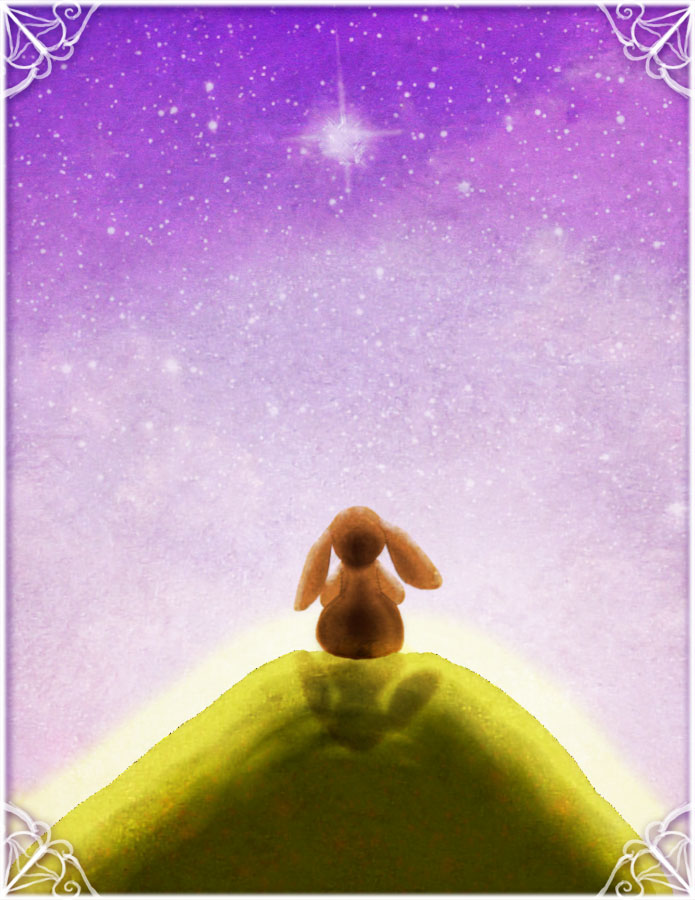
That last statement gets at equanimity, one of the Brahma Viharas, or Divine Abodes. Enlightened people may still be hurt, but they don't make it worse by interpreting it or projecting additional arrows. Equanimity creates space and balance for everything to be accommodated, painful and not. 

By RJDaae
In the book, the boy develops scarlet fever, and all of his toys have to be burned, including the Velveteen Rabbit. But since he has been so well loved, the rabbit becomes real.

A teacher once told me the Buddhist practice is about "loving the self to death." Rather than deeming our constructed selves as something deficient and wrong that must be stripped away and discarded, it's about loving our inner nature so much that the exterior we created at the Build-a-Human workshop can dissolve.

We love even the form, seeing it as a misguided attempt to protect that which we worried was too fragile to stand up to the world. When we love our defenses, they become redundant and fall away. The constructed skin wears out, and the buddhanature shines through.

For that to happen, we have to develop trust in our nature, just as the Velveteen Rabbit had to believe he could become Real.

And that is hard.


"You trust your impure nature more than your pure nature and yet talk about enlightenment. Enlightenment arises by not doing anything. Samsara arises because you have to do so many things. But you still see that – Samsara - as being easier than Nirvana. If this is not ignorance, what is?” Her Eminence Mindrolling Jetsün Khandro Rinpoche

Sunday, May 11, 2014

Mothers and metta

It's said, in traditional Buddhism, that over the course of our many lifetimes every being has been our mother. In traditional Asian societies, this was meant to help us see with the eyes of love and compassion.

From the poems of Shabkar Tsokdruk Rangdrol ~

All living beings have been your kind mothers . . .
Just as you feel love for your mother of this life,
Generate love for all beings, your mothers from the past . . .


In contemporary society, after more decades of blaming deficient mothering for all of our psychological ills, the idea of looking at every being as your mother may not generate feelings of deep,appreciative love. For some, it's more like a feeling of horror. And then there's that moment when you speak and hear your mother's voice come out of your mouth saying something that you always hated hearing ...

But here's the thing -- every parent wants the best for their children. Their ideas of what's best may not coincide with what the child needs, but they're likely unaware of that. Every parent I know would gladly take all of their children's suffering on themselves, but you can't do that. As a parent, you can only try to help them learn how to reduce their own suffering. And you don't always do that skillfully. For one thing, you can't pass on skills you don't have.

The Buddha, who was skilled at presenting his message in ways that people could hear it, also offers the inverse of seeing every being as a kind parent from a previous life:

Even as a mother protects with her life
her child, her only child,
so with a boundless heart
should one cherish all living beings:

Radiating kindness over the entire world
spreading upwards to the skies
and downward to the depths,
outwards and unbounded,
freed from hatred and ill will.

See all beings, even your parents, as your children. Happy Mother's Day.


Saturday, May 3, 2014

What are you expecting?

For many years, I thought the best way to get through life was to be prepared for the worst. Going into a situation, I'd envision the worst thing that could happen and how I would deal with it. I would be ready -- even if it rarely, if ever, came to that.

The problem with that, of course, is that you walk into every situation defended, tensed, ready for battle. That leaves you unprepared to see the best thing that could happen. If you walk into an unfamiliar room full of people you've never met in a configuration you've never seen prepared to be ignored and out-of-place, you give off that energy, almost guaranteeing that will happen.

One of the gifts of Buddhist practice is learning to trust that you can work with whatever happens, best or worst or somewhere in-between. In fact, best and worst are just labels. Life just is.

That's more advanced practice. The first step is figure out what your view is -- what is the undercurrent to the attitude you bring to the day? What are the words beneath the words you speak to yourself? When you know that, you can -- if you choose -- play with shifting that.

"At some point, we need to stop identifying with our weaknesses and shift our allegiance to our basic goodness. It’s highly beneficial to understand that our limitations are not absolute and monolithic, but relative and removable. The wisdom of buddha nature is available to us at any time."
Pema Chodron
The Women in Buddhism Group at the Interdependence Project will be exploring Right View at its May 17 meeting. What is your view?

Thursday, May 1, 2014

Forgive everyone everything, starting today

Human Journey, an initiative of Desmond Tutu, is challenging us to use the month of May to ingrain our forgiveness practice.

The Forgiveness Challenge is based on the idea that forgiving can bring peace and love to your life -- and therefore to the world. "With each act of forgiveness, whether small or great, we move toward wholeness" - Desmond and Mpho Tutu (his daughter) write in The Book of Forgiving.

In Buddhist terms, forgiveness is about letting go -- of resentment, of anger, of the belief that we can control other's actions, of the small, finite, damaged self who is acted upon, of the evil Other who acts. It's a way of extending lovingkindness and compassion, of seeing that we're all human and that hurtful actions are carried out by hurt people.

While we don't condone harmful actions, we recognize that those who carry them out have a confused and deluded view. We can never know all the causes and conditions that make people do things, but we can know that even when their actions are aimed at us, they arise from another person's thoughts.

As we do with lovingkindness, we extend forgiveness to ourselves. At first this may feel strange -- but over time, as with lovingkindness, it becomes liberating. We're no longer holding onto a picture of ourselves as the person who blurts out the wrong thing or is mean or angry or selfish. Because we are human and confused, we do those things. Because we are human and confused, we forgive ourselves -- letting go of the fixed, solid, rigid sense of self that says "I always ..." and opening up to the possibility that we can do it differently.

We accept all parts of ourselves, even the ones we've hidden in the basement. And we accept that we are not condemned to repeat those mistakes -- we can behave more wisely.

Who can you forgive today? Can it be yourself?

Tuesday, April 22, 2014

Enlightenment takes effort

When I lead meditation, I start by asking people to feel the floor under them, to notice where their
hard places come into contact with the building's hardness -- to feel the strength and stability of that solidness, and to think about how the building connects to the earth. It's easiest to notice where hard places come in contact -- it's one of the first places we notice discomfort.

And feeling the evidence of that connection to the building and its connection to the earth, I ask them to trust that, to relax into it, to let it hold them. There's a relaxation that comes with being held by something or someone you trust.

I thought of that recently when I heard a teacher use the phrase "being held by the dharma." It struck me and stuck with me, so I contemplated it.

Being held by the dharma is like relaxing into the ground -- you can let go completely, trusting that it will be big enough and strong enough to hold whatever weight you carry. You are not too heavy
for the earth and nothing is too big for the dharma, which is limitless.


I think this is the quality -- this trust, this safety -- that Stacey D'Ersamo is referencing in  her New York Times essay, Is God Just Not That into Me? The essay is about her relationship with the man she lives with, who is a Zen Buddhist priest.

She's jealous of his trust in buddhanature, in the ultimate OK-ness of reality, which she compares to falling in love with God. "How come he got access to all that divine unconditional love? What am I to the universe? What do I have to do to get the good stuff?" she writes. Her monk, as she calls him, reads this. “You already have it,” he said. “You are it.” He paused. “By the way, we need coffee.”

How come he got access to all that divine unconditional love? What am I to the universe? What do I have to do to get the good stuff?
You have to work at it. Maybe some people are born with that. Most question, test, examine. And when they find the thing that can hold them, they relax into it.

The Buddha lists Wise Effort as a step on the Eightfold Path, and exertion as one of the paramitas, or perfections of the heart (ie practices we can do to cultivate perfect heart). There's no switch that turns on enlightenment. You move toward it with your effort. It's an effort that might be unrecognizable to those who think "effort" mean trying hard. You have to try soft -- to be curious and open to whatever it is that results. Effort doesn't mean gritting your teeth and pushing through to the other side; it means sitting where you're stuck and not running away.

It means being present and lifting the mucky veils to see clearly -- which means, Ms. D'Erasmo, understanding and using appropriate words, not ones that amuse you. Your Zen priest, who is not a monk, gets access to "unconditional stuff" because he's worked at seeing causes and conditions that cloud the mind and block access to buddhanature.

Being held by the dharma isn't a passive stance. Relaxing and trusting isn't easy. It takes effort not to tighten up, to expect certain results, to demand that an outcome be as anticipated. You can't grab the dharma and shake it until you get what you want.

You can't hold onto the dharma and be held by it. You have to let go. And then it will be there.

"Give up the mind that wants to meditate and calm down. Focus on nothing at all. Disturbing thoughts and lazy indifference are not liberation. Remain unstained by thoughts and circumstances. Rest relaxed in the uncontrived nature of mind, free of elaboration or alteration. For the benefit of one and all, simply preserve peerless awareness."
~ Wisdom Dakini Sukhasiddhi

Friday, April 11, 2014

What does gentle look like?

I was on retreat last fall with a teacher whose message is to meet everything with compassion. "Enlightenment is when you meet all the pain in life with compassion," he said.

I don't know what that means, I said. Let's say I have pain in my knee sitting here. I know how to be present with the pain, how to observe the sensation, to not get caught up in the stories about what I might have done or the congenital structural defects I'm cursed with, to not wander off into thoughts about whether I need a knee replacement and how I can fit six months of rehab into my life and and complications from surgery and ...

I know Shinzen Young's equation: suffering = pain x resistance. I can (and have) worked with all that.

But I don't know where compassion comes in. I don't know how to move from bare attention to kind attention. "Seeing what's happening is preliminary," he says. "You first learn to tolerate it, then move toward love and compassion."

How do I do that? I beg. Out loud, I ask the question, but internally I hear my pleading. It is a mystery to me. Tell me how.

The answer is the heart practices, the brahmaviharas, the divine abodes. Lovingkindness. Compassion. Appreciative joy. Equanimity.

I have done those, and I do those, and I appreciate their effects. I'm a nicer person. Really. Less defended, less rigid, more flexible. I see the inherent dignity of others, and I remind myself that I am equally worthy. But I don't know how to be that, to realize it, to embody it. And I want that. I see that I can't find equanimity in the world without finding it in myself.

The advice is to be gentle.

It's not the first time I've heard this piece of advice. It is something of a theme in my Buddhist life. The Bodhisattva name I was given translates to "gentle dawn," and when it was spoken people in the room -- who knew I had cried through most of the previous week of silent meditation -- went "awwww," the audible sound of the quivering heart.

I've been told that I'm hard on myself when I think I am merely stating things as they are, dispassionately.

What does it mean to be gentle to myself? I wrote in my journal. What does that look like?

Then I came home from the retreat and picked up with my life. The question lingered in the back of my mind: What would gentle look like?

Then this week, a video surfaced in my Facebook newsfeed. Pema Chodron had posted it in 2010, but it was circulating as if it were new.

Are you willing to commit to being gentle to yourself? Working on that for the next year? she asks.

Oh, a challenge.

Ani Pema didn't explain how to be gentle to myself. It's not like walking 10,000 steps with a FitBit to tell you every day that you've hit your milestone. You'll have to figure out what that means, she said.

So that's what I'm doing, making my next 12 months my year of living gently.

As an added incentive, in a recently published paper in Brain, Behavior and Immunity, Brandeis University researchers found a connection between a self-compassionate attitude and lower levels of stress-induced inflammation.

According to Medical Press,

It's long known that can trigger biological responses similar to the effects of illness or injury, including inflammation. While regulated inflammation can help stave off infection or promote healing, unregulated inflammation can lead to cardiovascular disease, cancer and Alzheimer's.
Self-compassion describes behaviors such as self-forgiveness or, more colloquially, cutting yourself some slack. A person with high levels of self-compassion may not blame themselves for stress beyond their control or may be more willing to move on from an argument, rather than dwelling on it for days.
Participants in the study took stress tests and had their levels of a particular stress marker measured. Researchers were surprised to find that people with low self-compassion continued to show high levels of the stress hormone after the stressors had ended.


"The high responses of IL-6 (the stress marker) on the first day and the higher baseline levels on the second day suggest that people with low self-compassion are especially vulnerable to the adverse effects of this kind of stress," a researcher said.

The research illustrates how easy it is for stress to build over time and how a seemingly small daily stressor, such as traffic, can impact a person's health if they don't have the right strategies to deal with it.
Another teacher suggested that self-compassion is being willing to forgive yourself. Forgive everyone everything, including yourself, yet another teacher suggests.

Yeah, I'm on a quest. I'm going to find that gentle and bring it home?

Does that sound aggressive?

Friday, April 4, 2014

Only love stops hate

When a cookie company launched an ad campaign with the tagline "This is wholesome," the response was anything but.

The ad showed a variety of families, including some with two fathers and some with male-female parents of different races. Some people complained. Some of them used hateful speech.

This was how the company responded:


Hatred can never defeat hatred. Only love stops hate. The Buddha said that.

This is wholesome way to respond to haters.