Saturday, April 6, 2013

Equanimity and the Final Four


What what! Isn't sports all about passion, aggression, and achieving a goal (to defeat the other team)?

Not just. How about equanimity -- holding your (metaphorical) center in the most chaotic environment imaginable?

In the barely officiated first half of last weekend's Sweet Sixteen game between the University of Connecticut and the University of Maryland, things were getting rough.

Like our meditation practice, officiating can be too tight or too loose.In too tight, officials call every ticky-tack foul, and the game moves like a snail. In too loose, the officials call almost nothing and the game gets out of control. (You can apply the metaphor to your meditation practice: how's the officiating mind calling the session?)

Seconds from the end of the half, a Maryland player undercut a UConn player who was already jumping to make a shot, a dangerous move because the person in the air has less ability to control her body. We're not cats.

The announcers were incredulous. As the half ended, they started to discuss how players deal with a badly called game. If they talk back to the ref, they get called for a foul. If they react to the aggression, they can get ejected.

"Equanimity," Doris Burke said.

What?

"Equanimity," she repeated. She said something like, "You have to be able to stay in your center, play your game and not react."

"Equanimity," she said again. "I like saying that."

Basketball, especially as UConn plays it, is a fast game. There's set plays, but there's also unexpected bounces, slips, and crashes. You practice a lot so that your muscle memory takes over -- there's no time to think for a lot of the game. Sometimes you get to walk the ball up, to pass it around, to execute -- but then you shoot, the ball bounces, the bodies go up, and you respond.

That's where the rubber (or the chemically created rubber-like substance that's on the bottom of sneakers these days) meets the hardwood. Thousands of people watching, your coach screaming (it's UConn), bodies crashing, a game to be won, and you have to stay in your center and not lash out.

Take that metaphor into your meditation practice. Even if your thoughts are battling, even if they're crashing the boards or jumping over each others' backs to get to the prize -- your attention -- can you hold your center and rest in awareness of what's going without getting into the scrum?

Friday, April 5, 2013

Non-self interviews for a non-job

The truth of the fluidity of existence -- that nothing is permanent, solid, and independent-- shows up in the strangest ways sometimes.

Last week I had a job interview -- or interviews  (I met separately with two people). It was the second interview, so my basic credentials had put me in the final four. One of the interviewers expressed concern that I was too thoughtful and not quick enough; the other wondered whether I was thoughtful enough and said perhaps I was too speedy.

I, of course, was the same person in both interviews. But the two interviewers saw opposite things.

The job, presumably, was the same job, though each person had a different conception of it. Both described the same functions for the position but saw them in a different context.

There was no solid "Me" there. I mean, I was there, in my creative but serious interview clothing, but each person saw a different Me. And I'm sure the interviewers I saw were not the same ones that the Interviewers experienced.

Even the job was not a singular Job but was shaped by the view of the speakers.

I haven't heard from the company, but I assume that I didn't get the job -- it's been more than a week. There's an "ouch" of rejection, or non-selection; there's also an Ah of relaxation. I am fortunate to have a job that I like, and I don't want to take one I won't like just to make more money. I want it to be a job where I can be of benefit, not suffer more and create suffering.

Everything is ephemeral -- certainly jobs are in the current economy. Maybe, especially, ones at newspapers, like mine. So I will continue to be open to possibilities.

In the beginner's mind, there are many possibilities; in the expert's, only one, it is said. The ground of being is a fertile place.

Why I write

If you can show your mind it reminds people that they have got a mind. If you can catch yourself thinking, it reminds people they can catch themselves thinking. If you have a vivid moment that’s more open and compassionate, it reminds people that they have those vivid moments.

By showing your mind as a mirror, you can make a mirror for other people to recognize their own minds and see familiarity and not feel that their minds are unworthy of affection or appreciation. Basically, poetics is appreciation of consciousness, appreciation of our own consciousness.

-- Allen Ginsberg

The Vomit of a Mad Tyger: The Spiritual Autobiography of Allen Ginsberg

Thursday, April 4, 2013

The 'Burmese Bin Laden' and the emptiness of labels

The situation in Burma -- where Buddhist monks are accused of inciting violence against ethnic Muslims that has killed 43 people, destroyed or damaged 992 buildings, including five mosques, and displaced 12,000 people in a town of 100,000 -- is heartbreaking, not just because of the suffering but because it is perpetrated by Buddhists.

Hatred never defeats hatred, the Buddha said. Only love overcomes hate.

For those of us who study Buddhism, it's mind-boggling that practitioners -- who take the precepts to refrain from killing, to not take what is not freely offered, to not use harsh speech -- would be involved in this:

Yangon, Myanmar (CNN) -- Buddhist monks and others armed with swords and machetes Friday stalked the streets of a city in central Myanmar, where sectarian violence that has left about 20 people dead has begun to spread to other areas, according to local officials. (Read more here)

The Buddha was clear:

Whoever, with a rod, harasses an innocent man, unarmed, quickly falls into any of ten things: harsh pains, devastation, a broken body, grave illness, mental derangement, trouble with the government, violent slander, relatives lost, property dissolved, houses burned down. At the break-up of the body this one with no disconcernment, reappears in hell.
- Dhammapada, 137-140

Time reported Tuesday that sources say Muslims are terrified to go out after dark and are not able to visit the town’s market to trade or collect supplies. The report goes on to say that monks have "unparalleled moral authority in traditional Burmese society." Various news reports say the unrest has been spurred by Ven. Wirathu, an outspoken monk who was jailed in 2003 for inciting religious clashes in the northern city of Mandalay. He's called himself “the Burmese bin Laden” in reference to the jihadi leader Osama bin Laden’s religious fervor, despite his hatred of all things Islamic, and is the leader of a movement known as 969. The 45-year-old posted an inflammatory speech online last week that warned “once these evil Muslims have control and authority over us, they will not let us practice our religion” and accused Muslims of accumulating “money to get our young Buddhist women.”

None of this is consistent with any Buddhist teachings that I've learned about. How is it possible that a Buddhist monk could lead a deadly campaign of hatred? How is it possible that Buddhists would follow him?

An opinion piece in the Irrawaddy, a news site that covers southeast Asia, says:

To the campaigners, 969 is about protecting race and religion by peaceful means. In practice, it is explicitly an anti-Muslim campaign, not about preaching people the Buddha-nature of all beings, as taught and practiced by Lord Buddha himself. In many townships across Burma, including capital regions, there are local 969 committees that organize events and religious sermons and distribute anti-Muslim materials such as CDs, books and leaflets.
The 969 campaign targets economic aspects by alleging that Muslims are dominating the Burmese economy, and that therefore Buddhists must not trade with Muslims. Instead, the campaigners recommend that Buddhists buy and sell at Buddhist shops that display 969 signs and stickers. In Karen State, Buddhists are even forced to trade only with Buddhists. There are local reports about Buddhists being beaten by members of 969 civilians and monks for trading with Muslims.

Obviously there are political and socio-economic aspects that I don't know. Burma, or Mayamar, is in the process of emerging from years of military rule. I know that I don't know the nuances of the situation. But I do know that this is not what Buddhism teaches.

Psychologist Jeffrey Rubin wrote a post on the Interdependence Project blog about how sex scandals involving Buddhist teachers develop. Maybe this is similar, just on a larger societal scale. A deluded person who stops seeing his lust for power, a population that wants to be handed a way out.

ETA: Meanwhile The Saffron Monk Network issued a statement warning the public not to take part in any violent events following the riots between the Buddhist and Muslim communities in Meikhtila town last week. Ashin Awbartha (Nagar) from Shwewayoung Pyinyardana monastery, a member of the Saffron Monk Network, told Karen News that the intention is to to keep innocent people out of riots like those that happened in Meikhtila.
The Saffron Monk Network’s statement said that it is sad to see religion and ethnic based issues used to stimulate and create conflicts. The statement also warned that the violence could set back the country and lead to loss of support from the international community.


To read more:

Burmese Neo-Nazi Movement Rising Against Muslims

Burmese Monk fomenting violence against Muslims

Saffron monks stalk streets with machetes

Burmese Bin Laden: Is Buddhist Monk Behind Violence in Myanmar?


Another CNN story:


Burma's monks calls for Muslims to be shunned

Sunday, March 31, 2013

Women's Buddhist History: Text Written by Woman

An important Theravadan Buddhist text that was thought to be written by a prominent monk was most likely written by a Thai woman, scholars say.

Thammanuthamma-patipatti is a set of dialogues, supposedly between two prominent Thai monks last century.
It had been attributed to one of them - Venerable Luang Pu Mun Bhuridatta.
But scholars believe it was really by a female devotee, making her one of the first Thai women to write such a text.
Printed in five parts between 1932-1934, initially without a named author, Thammanuthamma-patipatti (Practice in perfect conformity with the Dhamma) is viewed in Thailand as a valuable and profound Buddhist text which deals with Buddhism's different stages of awakening.
Dr Martin Seeger from the University of Leeds believes he has traced the authorship of the text to one Khunying Yai Damrongthammasan - a wealthy and extremely devout woman who developed an impressive knowledge of Buddhist scriptures during her lifetime. 
 None of Luang Pe Mun's biographies claimed he had written it, Seeger notes, while the woman's son, a monk, said in her biography that she had written it.

Justin McDaniel, a professor of Asian Studies at the University of Pennsylvania, said it could be so.
"At that time and in the present day, women were seen as having the same capability when it came to Buddhist scholarship as men, especially in the realms of meditation and scholarly study. ... I think it's actually a lot more common than people realise, that students of monks - and especially women who tend to focus more on scholarship - would be writing."
Seeger, however, says that her achievements -- being able to read and write and her knowledge of canonical scripture -- were "very rare for a woman at that time." Seeger says only one other woman  in 1928 wrote a similar text, Seeger says it does not achieve the same level of profundity as this work.


Saturday, March 30, 2013

Memories ... of the way we are

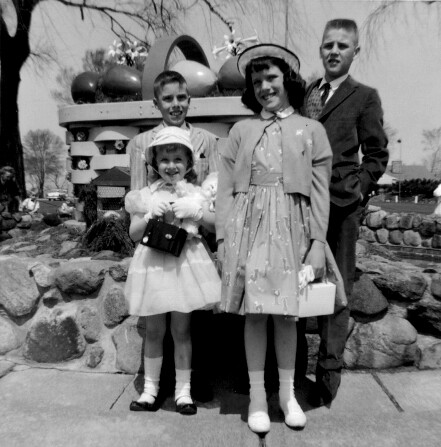
In my childhood, Easter was a days-long banquet of ritual, religious and cultural. Things start with Ash Wednesday and Lent, 40 days before. It was crucial to determine whether Valentine's Day would fall in that time period before deciding to give up chocolate. Then on Palm Sunday we received palm fronds on the way out of church, ensuring that any palm-frond duels would take place in the back seat of the car on the way home -- leading to the confiscation of the palm fronds by my mother, who made them into crosses that hung on the walls.

Thursday, the night of the Last Supper, meant visits to seven churches, easily accomplished in my heavily Catholic hometown. Good Friday was a solemn day -- no school, more church, but with a twist: all the statues were shrouded in purple robes except for a gory-to-my-eyes, life-like crucifix laid on the steps to the altar. Adults would kiss the hands and feet, where nails pierced the wooden flesh. I stayed far away.

Things lightened up on Saturday for the blessing of the food. We went -- again -- to church, this time cradling baskets containing my grandmother's homemade kielbasa, horseradish, colored eggs, a butter lamb, and other items whose names I could pronounce but can't begin to spell. The odor of the food blended with residue of musky incense for a festive traditional stink. No chocolate, jelly beans, or Peeps; those made their appearance on Sunday after we hunted them down in the places the Easter Bunny had hidden them.

Hats. We had hats. Women (and girls) had to cover their heads in church, so Easter outfits included hats. And corsages. My mother picked out my hat; my dad got the corsages. My corsage would have a pipe-cleaner bunny among the carnations.

I remember it well.

Or do I?

Many people think of memory as a video recorder, an incontrovertible record of events. Science, however, says that's not the case. In a recent study, more than 5,000 participants were presented with doctored photographs representing fabricated political events, with around half claiming to remember the false scenarios. The study, part of a decades-long program of research by psychologist Elizabeth Loftus, provides "a neat demonstration of how our memories are created in the present rather than being faithful records of the past," Time reports.


Memory is a complex mental function, tied to imagination, and there are many ways it can go wrong, scientists say. The bigger question is, why are we so attached to our idea of memories as fixed, unchanging possession? Time writes:
There are many reasons, but one is that memories are foundational for our sense of self. This is particularly true for early childhood memories (which the scientists tell us are the most unreliable of all). In her striking description of lying as a small child in her cot at St. Ives, Virginia Woolf noted that this wasn’t just her earliest memory; it was the moment she became the person (and the writer) she was. It is no wonder that we resist the idea that our memories are collages of disparate sources of information, assembled and reassembled long after the event.

Buddhists have long known that memories are ineffable and ephemeral. Mindfulness meditation -- as taught by the Buddha and updated by any number of scientists in the last 40 years -- is a practice to help us stay in the present moment, knowing that ruminating over the past or worrying about the future leads to suffering.

“Do not dwell in the past, do not dream of the future, concentrate the mind on the present moment.” -- Buddha

And yet, Buddhism also proposes that we carry the effects of past actions in our karma. Our
unexamined actions create habitual patterns, and we react from habit, not from what we see before us. Our view of the world -- whether it is safe, friendly, satisfying, beautiful -- is formed in large part by the views of our parents and caregivers, and the culture we grow up in. If we are raised to be suspicious of strangers, we carry that with us into encounters -- unless we examine our habitual thoughts pattern and practice changing them.  (Teacher Tyler Dewar details ways karma can be purified in this article.)

We also carry around the idea that a self, an independent and unchanging being, was forged by these memories. But if we simply look closely at the people we were in those photographs and compare them to who we are now, we can see that we've changed. We're bigger. Our likes and dislikes have changed.  Time writes:
Bracing as it might be, this new way of thinking about memory does not have to lead to self-doubt. It simply requires that we take our memories with a pinch of salt, and forge new relationships with them. They may be a kind of fiction, but the manner of their making speaks volumes about those who create them....  Whether the events happened or not, your biases and beliefs shape the kind of memories you form, and thus reveal the kind of person you are.

I am the kind of person who believes that memories are stories we tell ourselves and examining them can be revealing. Our selves are not solid but fluid, endlessly adaptable to the container we put them into. And our nature is ephemeral -- vast and clear as the sky, with wispy clouds of constructed selves that float and dissolve.

I'm also the kind of person who plays with Peeps. This is my time to stock up!

PS. Easter Monday is Dyngus Day. In my youth, it was said that the boys would tap the girls with pussy willow branches, and the girls would hit the boys with socks filled with flour in a bastardized version of an ancient fertility rite. Today, it's gender neutral.



Sunday, March 24, 2013

Important women in Tibetan Buddhism

While iconic archetypes of feminine enlightenment (dakinis in the ancient language of Sanskrit) were erected on shrines, few women in Asia were actually emboldened to follow in their footsteps. That women participate equally is probably the single biggest change with Buddhism being established in the West. Here are ten extraordinary female teachers of Tibetan Buddhism, who have transformed the way Buddhism is viewed in America. Michaela Hass 


1. Jetsun Khandro Rinpoche
"If being a woman is an inspiration, use it. If it is an obstacle, try not to be bothered by it."
2. Dagmola Kusho Sakya
First Tibetan woman ever to immigrate to America.
3. Jetsunma Tenzin Palmo (Diane Perry):
"I took the vow to attain enlightenment in a female body."
4. Pema Chödrön (Deirdre Blomfield)
Most successful female Western Buddhist teacher.
5. Ven. Thubten Chödron (Cherry Greene)
An innovative abbess.
6. Ven. Karma Lekshe Tsomo (Patricia Zenn)
Surfing to realization.
7. Sangye Khandro (Nanci Gustafson)
"Enlightenment is a full-time job."

8. Lama Tsultrim Allione (Rosmanière Ewing)
The enlightened feminist.

9. Chagdud Khadro (Jane Dedman)
A perfect example.
10. Elizabeth Mattis-Namgyel
The power of open questions.