Saturday, August 20, 2011

Producing enlightenment


The truth is you're already a cook.
Nobody teaches you anything,
but you can be touched, you can be awakened.
When you put down the book and start asking,
"What have we here?" you come to your senses.
Though recipes abound, for soups and salads,
breads and entrees, for getting enlightened
and perfecting the moment, still
the unique flavor of Reality
appears in each breath, each bite,
each step, unbounded and undirected.
Each thing just as it is,
What do you make of it?

-- Edward Espe Brown
The Complete Tassajara Cookbook

At the "Touch the Earth" party in April, IDP handed out seed packets as parting gifts. My spouse planted and cared for them, growing tomatoes, radishes, carrots, and beets. We have salad.

Last summer he made fruit wines, which are now ready to drink. Pictured is a peach-raspberry, I believe. (There was pear, peach, blueberry, sour cherry, sweet cherry, and mead. All but the mead are quite nice.)

Karma is often described metaphorically as planting a seed, or bija. When you plant tomatoes, you get tomatoes, not peas. When you plant seeds of craving, jealousy, anger in your mind, they blossom into attitudes that color your life. You can walk around wearing a skunk cabbage corsage or carrying a bouquet of roses. Your choice. As Roshi Bernie Glassman said, in his earthy way, "He who walks around with a piece of shit under his nose thinks the whole universe stinks."

Remember too that lotus flowers grow in cesspools. Great beauty can grow out of stinky circumstances.

Seeds require care to grow. So if you attend to those that create ease and harmony, you get more of that. If you don't pay attention to how your mind works, you get weeds.
How does your garden grow?

On the non-metaphorical front, if you're interested in food and cooking as practice, pick up any of Edward Espe Brown's books. He was the chef at Tassajara, a Zen retreat, and an affiliated restaurant in San Francisco. I don't read recipes for fun, but his reflections are down-to-earth yet enlightening.

He's got tons of great recipes. But for tomatoes -- a little olive oil, a little basil, maybe garlic. You don't need to dress up tomatoes.


Thursday, August 18, 2011

A mother’s non-attached affectionate appreciation


This week my younger child headed back to school, bringing home the impermanence of summer vacation.

Children do an excellent job of reminding you that everything is constantly changing. They grow, seeming at times to move through clothing sizes faster than the speed of light. They change from tiny people who writhe in agony if you try to put clothing on them that is not pink and fit for a princess to crust punks. You not only don’t recognize the shirt they’re wearing; you’re not sure you recognize the kid. Oh, wait – there’s gramma’s nose.

And emptiness – the lack of inherent identity – is constantly reinforced. I had a friend who would introduce her preschoolers by saying, This is my son, and he’s going to Harvard to be a doctor. This is my daughter; she’s going to Yale to be a lawyer. You don’t need me to tell you, do you?

My view is that it is the parent’s job to train them to live in the world, to figure out what they need and why they need it, to see there are many paths and that how you get there is as important as where you’re going.

It’s a view that can be hard to hold onto, especially when they’re leaving.

The cause of suffering, the Buddha taught, is attachment. The cessation of suffering results when we let go of that attachment, that grasping, that craving.

Talk about the emptiness of words – when you’re a mother, craving is what happens when your hormones go wild as your body takes care of the new being growing there. (Friendly’s Jubilee Rolls were the staple of this child’s gestation.) Grasping is what those tiny fingers do, an entire hand wrapping itself around your extended finger. Attachment – uh, umbilical cord. Can it get more visceral?

How do you experience the very ordinary magic of parenting without compounding the suffering that is part of life?

Compassionate equanimity, my teacher advises. Throw in loving kindness and sympathetic joy, inherent aspects of parenting, and you’ve got all four brahma viharas, the heavens on earth.

Put it another way: Affectionate non-attachment.

Loving kindness is radiant warmth and openness, an unattached appreciation with no sense of duty or obligation. … Loving kindness is the natural and heartfelt wish for this person to be happy. Ken McLeod “Wake Up to Your Life”

Dharma Punx founder Noah Levine illustrates this beautifully with his colorfully tattooed hands. (these illustrations are my non-tattooed, arthritic hands.)

Not grasping. (Hands clasped together, fingers intertwined.)


Not distanced. (Hands parallel, a slight distance apart.)


But connected. (Hands in anjeli mudra.)


Non-attachment does not mean detachment. Detachment means “from”-- to detach is to pull away , to disengage. Nonattachment, on the other hand, is a fully engaged and connected experience of being in the middle of whatever is going on, without clinging to or trying to control it. Noah Levine “The Heart of the Revolution.

Connection without clinging.

I recently heard Judith Simmer Brown, an acharya in the Shambhala tradition, talk about romantic love, using the movie "Titanic" as her text, deconstructing the stereotypes and conventions. A lot of what she had to say applies also to the parent-child relationship.

Babies are pretty much a blank screen for parents' projections -- although they come into this world with certain ways of doing things, the result of genetics or the training received in past lives. Some people see their kids as a do-over of their lives: Relive the good parts, avoid or correct the bad. The kid makes you proud or makes you cringe.

But the kid doesn't make you anything. You can choose to be proud or embarrassed or disappointed. Or you can choose to interact with the person in front of you -- while helping them learn how to live in society.

The love of a real person is more wonderful than any fantasy, to paraphrase Simmer Brown.

You have to be willing to see through the fantasy that this kid will be THE ONE. And when you realize that this kid will not be all that you dreamed, that, to quote directly from Simmer Brown, "is the moment to step out of the fantasy and have a relationship with a real person."

That person is pretty amazing. You and yet not you. Self in flux.

And then they go away to college. Oh, yeah. That impermanence thing again.


Sunday, August 7, 2011

The wisdom of boredom


Boredom is essential to Buddhist practice. When our minds aren’t occupied with something else – planning or playing games or talking or buying – we have the space to see our thoughts. What do you think about when you have nothing to think about? And what does that say to you?

Chogyam Trungpa Rinpoche differentiated between at least two kinds of boredom – hot boredom, the restless jittery I-can’t-sit-still-another-minute kind, and cold boredom, the zoning out kind. Both indicate our mind's desperation to escape the present moment.

We don’t like to be bored, of course. We like to be entertained. We carry smartphones and personal games systems so that we never have to be without something to occupy our minds. Or books -- some of us still carry books.


In this excellent essay, Scott Adams argues that boredom also is essential to creativity.

http://online.wsj.com/article/SB10001424053111903454504576486412642177904.html?mod=rss_Technology

I make my living being creative and have always assumed that my potential was inherited from my parents. But for allowing my creativity to flourish, I have to credit the soul-crushing boredom of my childhood.

Adams, the creator of the Dilbert comic strip, also credits his time in corporate meetings, “which felt like a play date with coma patients.”

Now let's suppose that the people who are leaders and innovators around the world are experiencing a similar lack of boredom. I think it's fair to say they are. What change would you expect to see in a world that has declining levels of boredom and therefore declining creativity?.

In that world, he says, people would be more dogmatic, adopting positions laid out for them rather than thinking things through themselves. Movies would be derivative or sequels; TV would show more “reality” shows. The economy would “flat-line for lack of industry-changing innovation,” and the news would sound repetitive. People would have difficulty understanding new ideas.

You might find that bloggers are spending most of their energy writing about other bloggers. Uh, touché.

You know how sometimes a theme emerges in your life, and everywhere you look, something wakes you up to an aspect of your life? Here’s a sample of what I’ve discussed/highlighted/shared in the past week of my personal life:

"Dunbar was lying motionless on his back again with his eyes staring up at the ceiling like a doll's. He was working hard at increasing his life span. He did it by cultivating boredom. Dunbar was working so hard at increasing his lifespan that Yossarian thought he was dead." Joseph Heller, Catch 22.

“We would like apple juice, orange juice, cottage cheese, ice water – anything to avoid boredom. Through shamata, we discover that we do not need to jump to conclusions or act purely out of impulse. All those impulses are canceled out by the process of mental discipline”. Chogyam Trungpa Rinpoche, “The Truth of Suffering and the Path of Liberation.”

"The mind that needs to be entertained hunts for modes of engagement that sedate it, rendering it dull and numb. And once we're tranquilized this way, our reality becomes little more than a giant cocoon of ambient experience." Ethan Nichtern, One City

I’m talking to a friend about how busy we are. She notes that when free time does appear, it’s hard to shift into neutral and just idle. I agree, saying it’s been hard to find time to read. She gently points out that reading is doing something. Ahhh-ha!

On the other side, we have Fritz Perls the inventor of Gestalt Therapy, who said, “If you are bored, you are not paying attention.”

Next time you find yourself casting about for something to pass the time, see if you can let that impulse go and just be in the moment. What is happening within you and without you, right now? What attracts your attention or makes you want to turn away? What are you not seeing?

http://www.amazon.com/gp/product/0300141106?tag=beliefnetauto-20

Tuesday, August 2, 2011

Chicken: egg = Brain structure: meditation

Why do you meditate? Because you recognize the truth of suffering and want to find your way off the wheel of samsara? Because you want to get to know how your mind works? Or because your brain predisposes you to such investigations?

Yet another scientific study shows that meditators have better brain function (along with lower blood pressure, more happiness, and better sex. (No citation for the last one, but c'mon. Ask Sting and Trudy.)

One of the study's co-authors, Eileen Luders, a visiting assistant professor at the UCLA Laboratory of Neuro Imaging, suggests that there may be other factors at play when looking at the relationship between meditation and brains.

“It’s possible that meditators might have brains that are fundamentally different to begin with,” Luders said. “For example, a particular brain anatomy may have drawn an individual to meditation or helped maintain an ongoing practice — meaning that the enhanced fiber connectivity in meditators constitutes a predisposition toward meditation, rather than being the consequence of the practice.”

Wow -- so perhaps it's my brainmind that wants my mind to examine how it functions.

The study, in current online edition of the journal NeuroImage, suggests that people who meditate have stronger connections between brain regions and show less age-related brain atrophy. Having stronger connections influences the ability to rapidly relay electrical signals throughout the brain. This follows a study two years ago that found increases in specific areas of meditators’ brains.

There are more technical descriptions here
http://newsroom.ucla.edu/portal/ucla/is-meditation-the-push-up-for-210549.aspx

Luders is a meditator herself, which is nice. And I liked this: “It is possible that actively meditating, especially over a long period of time, can induce changes on a micro-anatomical level.”

It is also possible that meditating over a long period of time can make changes on a macro-social level, affecting how you function in the world and how the world functions with you in it.

White fiber. Lovingkindness. Electric impulses in the brain. Smiling at a stranger on the street. Sitting. Walking gently in the world. Interdependence of the body systems. Interdependence of beings. Neurons set to stun the self with the ordinary magic of connections beyond conception. At least for now.


Saturday, July 30, 2011

Tinkers by Paul Harding


"How can I not wonder what it would be like to sit in that cold silver water, that cold stone water up to my chin, the tangled marsh grass at the level of my eyes, sit in the still water in the still air, bright day behind me lighting the face of everything under the dark millstone cloud lid in front of me, watching the storm coming from the north? There is my father whispering in my ear, Be still, still, still. And yet you change everything. What was the marsh like, waiting for the storm before you came and kneeled in the water? It was like nothing. Watch after you leave the water, now cold and regretful, miles from home, certain of the belt on your backside, the cold shoulder, the extra chores; watch. Watch the water heal itself of your presence -- not to repair injury but to offer itself again, should you care to risk another strapping, because instead of the sky being dark and the trees and stones bright, the next time the sky will be bright but the world gloomy. Or there will be rain with no wind. Or wind and sun. Or a starry sky laced with clouds that look like cotton thread. You could not do better if you passed a thousand acts of Congress."

Tuesday, July 26, 2011

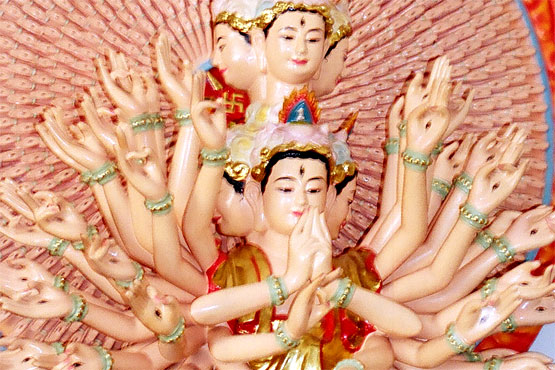
1,000 arms are not nearly enough


You’d have to be Avaloketeshvara – the Buddha of Compassion, with his 11 heads to hear the cries of the suffering beings in the world and 1,000 arms, with an eye in the center of each palm, to see the suffering and reach out to the multitudes – to comprehend this week in the world.

Seventy-six people killed in Norway by one man with confused views. A famine is declared is southern Somalia; the U.N. children’s agency -- one of the few groups that does operate in the area -- said Friday that nearly 800,000 children are at risk of dying without urgent assistance and that tens of thousands of people may have already have died in the country's famine, which has prompted Somalis to walk for days in hopes of reaching a refugee camp in neighboring Kenya.

Amy Winehouse died at age 27, after a brief career of song and conspicuous consumption of substances. She choose – famously – not to go to rehab, not to face her problems rather than try to wash them away, but society celebrated that.

So much sorrow in the world. Not an unusual week, perhaps – a gunman instead of an overcrowded, unsafe ferry in southeast Asia; a famous singer instead of the addict on the corner; the famine is not new this week. But it hits me in the heart, maybe because a friend writes that he has moved into his father’s hospital room maybe because a 23-year-old girl who had played on grade school soccer teams with my son died in a car crash. Every person who died in Norway, everyone who dies in Africa after walking for miles to try to survive, is dear, is important.

A thousand arms can’t begin to take in all the suffering.

Then comfort comes in an unlikely source – an emailed link from a non-Buddhist friend to an interview in Rolling Stone (not a place I often look for wisdom) with the man who’s said to be the reincarnation of Avaloketeshvara: The Dalai Lama. (Note: The Karmapa also is considered by many to be a reincarnation.)

Conducting the interview – is Melissa Mathison who was the screenwriter for “Kundun,” a film about the DL’s life, and has known him since 1990.

Does evil exist in the world? she asks. He replies:

The seed of evil, from my viewpoint, is hate. On that level, we can say that everyone has that seed. As far as sort of potential of murder is concerned, every person has that potential. Hatred. Anger. Suspicion. These are the potentials of negative acts.

There is also the potential for mercy. Forgiveness. Tolerance. These also, everyone has this potential.

Evil means that the negative potential has become manifest. The positive remains dormant.

Dormant, but there. This is how the bodhisattvas keep going, keep trying to fulfill their vows to bring all sentient beings to Nirvana before going there themselves.

We reap what we sow. Hatred breeds hatred. If we cultivate the seeds of anger and aggression, that’s what we get. If we instead tend gardens or mercy and tolerance, we’ll have a different environment.

How do we create mercy and tolerance, and avoid the clinging vines of anger and aversion?

I often tell people that this century should be century of dialogue. Peace will not come from thought or from Buddha. Peace must be built by humans, through action. So that means, whenever we face problem — dialogue. That's the only way. For that, we need inner disarmament. So our work should make a little contribution to materialize a peaceful, compassionate world later this century. That's my wish. It will not come immediately. But we have to make the effort. This moment, it looks only like an idea. But every corner must make the effort. Then there is possibility. Then, if we fail in spite of that effort, no regret.

Is there an effort you can make in your corner to cultivate the seeds of peace and contentment? Can you wait patiently for a slow store clerk? Not snap back at a co-worker’s snide comment? Catch the ball of impatience and intolerance that’s rolling down the hill, gathering steam and growing bigger as it passes along a chain of interaction, each person adding his or her frustration and sending it down the line? Smile? At no one in particular?

I can’t comfort grieving parents – or children. I can’t figure out a way to get food to starving people. All the metta meditation in the world won’t change their circumstances.

But I can try to act with care and compassion for those people I do have contact with. I can donate to my local food bank, which is struggling to collect enough food to feed my neighbors. I can listen, without judgment, to the problems of those around me. I can offer a gentle response.

The best way to solve these problems is in the spirit of reconciliation. Talk. Listen. And discuss. That's the only way.

**The photo of the Somali woman and her child is by Brendan Bannon, taken from Doctors Without Borders. For more photos and details on what you can do visit

http://www.doctorswithoutborders.org/news/articlefull.cfm?id=5470&cat=slideshow

all other photos by the Associated Press

http://www.rollingstone.com/politics/news/a-conversation-with-the-dalai-lama-20110721?page=1


Thursday, July 21, 2011

How to beat the heat, Buddhist-style.

It’s late July, and it’s hot. Sing along now -- Real Hot. In the Shade. I’m dripping sweat onto my zabuton as I meditate. I try to find the stillness under the sweat, to let the heat be like a fever dream, to not get attached to the idea that I would be happier if the weather were cooler.

I am not miserable. I’m good. The weather is not miserable. It is the weather. Yet somehow being bathed in sweat is less than pleasant.

I need some help here:

One summer when I was teaching at Shambhala Mountain Center, we had an incredible heat wave. In the midst of it, my uncle Damcho Rinpoche, my cousin Karma Sengay Rinpoche, and two monks arrived on their first trip out of Tibet. Day and Night they wore the same heavy clothes, the Tibetan equivalent of a woolen suit. At one point, I asked Damcho Rinpoche, “Don’t you feel hot?” He answered, “Well, apart from the feeling of heat, I am okay.” I understood him to be saying, “There’s this feeling, and I could be attached to it or I could not be attached to it. If I were attached to it, then how would my life be? I would be taking off or putting on clothes all day long, spending most of my time trying to get comfortable. Instead, I could just sit here and enjoy what is happening.” So that is what he was doing. “People are always saying, “I’m happy to be here,” but he really meant it. That’s equanimity. Sakyong Mipham Rinpoche

Last night, I was lying on my bed, bathed in sweat from the searing heat. At a certain point, the ordinary discomfort turned into blazing hot flashes across my entire body. Everywhere was running water – my forehead, my neck, my legs. …Lying there I became utterly intolerant of my experience, and before I knew it I was defiantly standing, almost expecting I would encounter an enemy lurking. As if catching myself in a mirror, I stopped and looked at what was happening inside of me – the raging heat as well as the familiarity of discontent. As my attention dropped down and in, I simply felt the firm ground under my feet, sticky sweat pouring down my belly, and the heavy warm air all around me. Without planning it, I had dropped into awareness of sensations, the First Foundation of Mindfulness.

As I simply watched all this, I became aware my angst had effortlessly slipped away and I was now feeling calm and present. I erupted in laughter at my familiar response to discomfort. … I lay back down noticing that the next experience was no less fiery, yet my inner attitude had shifted. My experience of the sweltering heat had changed simply because my attention had shifted from resistance to observation.” Sarah Powers

In other words, don’t flame the fires of discontent. Be curious about your response to the heat, both mental and physical.

You might as well meditate. Experts recommend that you renounce strenuous exercise in extreme heat (sitting still works well), drink plenty of fluids, and wear loose, light-colored clothing. Seek out air-conditioning if the heat is affecting your physical ability to function. Avoid alcohol and caffeine, which dehydrate you, and strong sunlight.

And listen to music

96 degrees

Link http://youtu.be/6cGOMPYPVu0

Meklit hadera

http://youtu.be/HbVL8dWhSNA

Summertime

http://youtu.be/Ud2o38cJtDY