The Buddha said that if you practice lovingkindness, or metta, meditation, you will experience scores of benefits (well, 11 specific ones). His list did not mention that you will have a better time at parties. Add that.
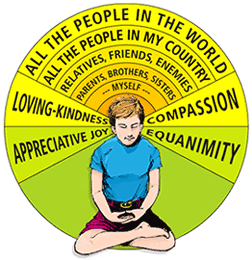
In the version of the Four Immeasurables practices that I do, you work with three people for each one: Someone you love, someone who irritates you, someone you don't really notice and have to cast around to bring into your meditation. Chances are these are the three types of people you will meet at a party (or really anywhere).
I like to get a head start. In the days before a social event, I bring people who are likely to be there into my meditation. Who will make my heart light up when I see them? That's the person I love. Who will make me sidle away from a group when they join? That's the irritating one. And who else was at last year's version of his party, standing next to someone who stands out in my memory? Oh, yeah. What's-his-name.
One by one, I offer them the aspirations of lovingkindness: May you be happy. May you be safe. May you be healthy. May you live with ease.
And a warmth develops -- toward all of them. The irritating person just wants to be happy. In fact, they are not irritating. I am irritated.That background person is also a human, with things that make her happy or sad. I wonder what they are? Maybe I will ask.
Extend that feeling of warmth and kind attentiveness to everyone in the room. Feel the judgments about their outfits or how much weight they've gained or the food they brought fall away. Here we are, just humans, just dancing each other home once again. How fortunate to have each other.
And extending the wish to everyone in the city, on the continent, on the planet. May we all be free from fear and know the happiness that brings.
When you get to the actual event, you will feel warm-hearted and curious, open and attentive. You will have a pleasant expression on your face, and people will be happy to see you. You will be happy to see them. Heck, devas will love you.
And if there are moments where that's not the case, you can stealthily emanate lovingkindness, silently making the wishes as you gaze around the room. Or extend it to yourself and leave, if it's that bad. Kindly, attentively, gently.
May you be happy. And may your days be merry and bright.
Showing posts with label lovingkindness. Show all posts
Saturday, December 13, 2014
Friday, October 10, 2014
Right Speech Applies to Self Talk
In one of my favorite passages in one of my favorite dharma books, "Loving Kindness," Sharon Salzberg talks about how she'd been practicing metta, loving kindness meditation, and wasn't sure it was having any effect -- until one morning when she broke something, said to herself what she always said, "You're such a klutz," and then surprised herself with, "But I love you anyway."
Wise or skillful speech is one of the steps on the Buddha's Eightfold Path to liberation from suffering. While it's often looked at as relational -- how we speak to others -- it also applies to how we talk to ourselves. Is it kind? Is it useful? Does it need to be said?
It's been a loud, short-tempered week in the office. Blame it on the full moon, Mercury in retrograde, new-and-not-yet-up-to-speed staff, a dozen other things. When I hear people talk meanly to others, I try to consider that they also talk that way to themselves. I know how uncomfortable it is to experience it coming from someone else. I suspect it sounds just as harsh directed at yourself.
NPR this week had a story on self talk as it's used in therapy for people with eating disorders. It quotes David Sarwer, a psychologist and clinical director at the Center for Weight and Eating Disorders at the University of Pennsylvania, says that one of the first things he does with new patients is stand them in front of a mirror and coach them to use gentler, more neutral language as they evaluate their bodies. The goal, he says, is to remove "negative and pejorative terms" from the patient's self-talk.
It also matters how you address yourself, the report says. Psychologist Ethan Kross of the University of Michigan studied the pronouns people use when they talk to themselves silently, inside their minds.
This is interesting from a Buddhist perspective. Since the self is only a collection of constantly changing constituent elements -- the skandhas of form, feeling, perceptions, mental formations, and consciousness -- when we speak to our selves as "I," it's our confused mind talking to our confused mind. When we speak from awareness, from our innately clear and confident buddhanature, it has a different quality.
I just gave this a run-through. Looking in the mirror, "I" told myself I looked like I had gotten dressed out of the lost-and-found bin at the yoga studio. Awareness said, "Pay no attention. You look fine."
The practice -- and practicing it in meditation helps -- is to notice the self-talk before you act on it and question it. "I look fat," I say. "Really? By what standard? The irrational one in your head?" Well, yes.
Ask the magic questions: Is it kind? Is it useful? Is this the time to bring it up?
Kindness to yourself inevitably spills over into kindness to others -- genuine kindness, not indulgence. Covering up self-hatred in designer clothes doesn't actually make you feel any better. A person who feels at home in their skin does have to cover it in status symbols to prove their worth.
Try it. You, as much as anyone in the world, are deserving of your kindness.
Wise or skillful speech is one of the steps on the Buddha's Eightfold Path to liberation from suffering. While it's often looked at as relational -- how we speak to others -- it also applies to how we talk to ourselves. Is it kind? Is it useful? Does it need to be said?
It's been a loud, short-tempered week in the office. Blame it on the full moon, Mercury in retrograde, new-and-not-yet-up-to-speed staff, a dozen other things. When I hear people talk meanly to others, I try to consider that they also talk that way to themselves. I know how uncomfortable it is to experience it coming from someone else. I suspect it sounds just as harsh directed at yourself.
NPR this week had a story on self talk as it's used in therapy for people with eating disorders. It quotes David Sarwer, a psychologist and clinical director at the Center for Weight and Eating Disorders at the University of Pennsylvania, says that one of the first things he does with new patients is stand them in front of a mirror and coach them to use gentler, more neutral language as they evaluate their bodies. The goal, he says, is to remove "negative and pejorative terms" from the patient's self-talk.
It also matters how you address yourself, the report says. Psychologist Ethan Kross of the University of Michigan studied the pronouns people use when they talk to themselves silently, inside their minds.
"What we find," Kross says, "is that a subtle linguistic shift — shifting from 'I' to your own name — can have really powerful self-regulatory effects."
... He asked volunteers to give a speech — with only five minutes of mental preparation. As they prepped, he asked some to talk to themselves and to address themselves as "I." Others he asked to either call themselves "you," or to use their own names as they readied their speeches."It's almost like you are duping yourself into thinking about you as though you were another person," he says.
Kross says that people who used "I" had a mental monologue that sounded something like, " 'Oh, my god, how am I going do this? I can't prepare a speech in five minutes without notes. It takes days for me to prepare a speech!' "
People who used their own names, on the other hand, were more likely to give themselves support and advice, saying things like, "Ethan, you can do this. You've given a ton of speeches before." These people sounded more rational, and less emotional — perhaps because they were able to get some distance from themselves.
This is interesting from a Buddhist perspective. Since the self is only a collection of constantly changing constituent elements -- the skandhas of form, feeling, perceptions, mental formations, and consciousness -- when we speak to our selves as "I," it's our confused mind talking to our confused mind. When we speak from awareness, from our innately clear and confident buddhanature, it has a different quality.
I just gave this a run-through. Looking in the mirror, "I" told myself I looked like I had gotten dressed out of the lost-and-found bin at the yoga studio. Awareness said, "Pay no attention. You look fine."
The practice -- and practicing it in meditation helps -- is to notice the self-talk before you act on it and question it. "I look fat," I say. "Really? By what standard? The irrational one in your head?" Well, yes.
Ask the magic questions: Is it kind? Is it useful? Is this the time to bring it up?
Kindness to yourself inevitably spills over into kindness to others -- genuine kindness, not indulgence. Covering up self-hatred in designer clothes doesn't actually make you feel any better. A person who feels at home in their skin does have to cover it in status symbols to prove their worth.
Try it. You, as much as anyone in the world, are deserving of your kindness.
Labels:
Eightfold Path,
i-you,
lovingkindness,
npr,
right speech,
Self,
self talk,
sharon salzberg,
talk
Saturday, August 16, 2014
Kindness in the news
We crave stories of kindness. How else can you explain why a photo of a grocery store worker tying an elderly man's shoelace goes viral?
There are scary things happening all around the world today, from Ferguson, Missouri, to Iran and Syria and, seemingly, everywhere.
But there are also good things happening. Often those things are small actions performed by an individual -- like the grocery clerk -- while the scary things are big, like thousands of people trapped on a mountain or an angry crowd facing police cloaked in padded gear.
If you look only at the big things, it's easy to be overwhelmed by anger and despair.
If you look only at the small things, you can become a delusional Pollyanna, radically accepting the status quo when wisdom sees that the situation needs to change.
To me, Buddhist teachings often come back to balance -- finding the pivot point that holds the awareness that people and the situations they create are both kind and mean, avoiding the traps of despair and elation, seeing the good and how to mobilize it to work with the bad.
Anger is a contagion. It spreads in a flash. When met with anger, it roils and builds.
When met with kindness, it dissipates. The situation in Ferguson changed dramatically when the militarized police were taken out of the equation. Hugs replaced hate when highway patrol officers with visible faces and no body armor took over from the padded, helmeted local police.
Of course, the situation is more complicated than that in Ferguson and there are many things to be looked at and addressed. It's impossible to do that in the confusion of anger, which locks everyone into their own view.
Robin Williams' death also stirred up lots of emotions this week, not just grief but anger and hurt over the comments around suicide, addiction, and depression. And it brought stories of his great kindness behind the scenes, like this tribute from Norm Macdonald.
Kindness is all around. When you practice metta, you train your mind to notice it. And you train yourself to respond kindly. Practice in meditation is all about training your reflexes to respond in the post-meditation world.
Kindness is contagious. Here is a story, a true poem, by Naomi Shahib Nye, of what kindness can do. It's describes what happens at an airport gate during a flight delay when passengers and crew became a community rather than adversaries:
And I looked around that gate of late and weary ones and I thought, This is the world I want to live in. The shared world. Not a single person in that gate--once the crying of confusion stopped--seemed apprehensive about any other person. They took the cookies. I wanted to hug all those other women, too. This can still happen anywhere. Not everything is lost.
Friday, August 8, 2014
Release your heart
Today is a full moon. I could tell even before I checked the calendar, based on the phone calls that came in to the newspaper where I work. That's not unusual -- the callers range from those with tomatoes that resemble Richard Nixon to ones who tell you they're wearing tinfoil on their heads while they talk on the phone about conspiracies.
Friday's calls had a different quality than the usual lunacy, though. The callers wanted to tell me about kindnesses they'd experienced. And they simply wanted to share their gratitude and joy -- they didn't even launch into the usual rant about how we only report bad news and how about writing something good for a change.
One was a big deal: A woman was lying on a downtown sidewalk in May, and another woman stopped to check on her, then called 9-1-1, saving her life. The woman didn't remember any details but wanted to thank her unknown helper. She couldn't write a letter to the editor because, she said, she had a stroke and "all I can do is talk."
Another caller praised a newspaper customer service worker, who had driven to her disabled brother's home to hand him a newspaper after a delivery snafu. Getting the newspaper is the highlight of his day, she said (giving me a highlight for my day), and getting a special delivery gave him great joy.
The calls reminded me of the importance of developing an attitude of kindness, seeing the small ways that the world supports us rather than focusing on the insults.
The magic of metta practice is not that it makes us more loving toward the person we love or tolerant of the annoying person. It is that it turns our mind. We begin to see everything with the wide eyes of compassion rather than the narrowed eyes of judgment.
The Buddha identified 11 benefits of lovingkindness (speaking to monks, so Buddha says "he"):
What if you looked for the kindness in the world instead of the meanness? What if you realized the ground-floor gratitude of being able to take in breath? How would that change your life?
Friday's calls had a different quality than the usual lunacy, though. The callers wanted to tell me about kindnesses they'd experienced. And they simply wanted to share their gratitude and joy -- they didn't even launch into the usual rant about how we only report bad news and how about writing something good for a change.
One was a big deal: A woman was lying on a downtown sidewalk in May, and another woman stopped to check on her, then called 9-1-1, saving her life. The woman didn't remember any details but wanted to thank her unknown helper. She couldn't write a letter to the editor because, she said, she had a stroke and "all I can do is talk."
Another caller praised a newspaper customer service worker, who had driven to her disabled brother's home to hand him a newspaper after a delivery snafu. Getting the newspaper is the highlight of his day, she said (giving me a highlight for my day), and getting a special delivery gave him great joy.
The calls reminded me of the importance of developing an attitude of kindness, seeing the small ways that the world supports us rather than focusing on the insults.
The magic of metta practice is not that it makes us more loving toward the person we love or tolerant of the annoying person. It is that it turns our mind. We begin to see everything with the wide eyes of compassion rather than the narrowed eyes of judgment.
The Buddha identified 11 benefits of lovingkindness (speaking to monks, so Buddha says "he"):
1. "He sleeps in comfort. 2. He awakes in comfort. 3. He sees no evil dreams. 4. He is dear to human beings. 5. He is dear to non-human beings. 6. Devas (gods) protect him. 7. Fire, poison, and sword cannot touch him. 8. His mind can concentrate quickly. 9. His countenance is serene. 10. He dies without being confused in mind. 11. If he fails to attain arahantship (the highest sanctity) here and now, he will be reborn in the brahma-world.These advantages "are to be expected from the release of heart." What a beautiful phrase. If you released your heart from its constrictions, from its limits, from its cages, where would it go?
What if you looked for the kindness in the world instead of the meanness? What if you realized the ground-floor gratitude of being able to take in breath? How would that change your life?
Labels:
benefits of metta,
lovingkindness,
metta,
newspapers
Thursday, May 1, 2014
Forgive everyone everything, starting today
Human Journey, an initiative of Desmond Tutu, is challenging us to use the month of May to ingrain our forgiveness practice.
The Forgiveness Challenge is based on the idea that forgiving can bring peace and love to your life -- and therefore to the world. "With each act of forgiveness, whether small or great, we move toward wholeness" - Desmond and Mpho Tutu (his daughter) write in The Book of Forgiving.
In Buddhist terms, forgiveness is about letting go -- of resentment, of anger, of the belief that we can control other's actions, of the small, finite, damaged self who is acted upon, of the evil Other who acts. It's a way of extending lovingkindness and compassion, of seeing that we're all human and that hurtful actions are carried out by hurt people.
While we don't condone harmful actions, we recognize that those who carry them out have a confused and deluded view. We can never know all the causes and conditions that make people do things, but we can know that even when their actions are aimed at us, they arise from another person's thoughts.
As we do with lovingkindness, we extend forgiveness to ourselves. At first this may feel strange -- but over time, as with lovingkindness, it becomes liberating. We're no longer holding onto a picture of ourselves as the person who blurts out the wrong thing or is mean or angry or selfish. Because we are human and confused, we do those things. Because we are human and confused, we forgive ourselves -- letting go of the fixed, solid, rigid sense of self that says "I always ..." and opening up to the possibility that we can do it differently.
We accept all parts of ourselves, even the ones we've hidden in the basement. And we accept that we are not condemned to repeat those mistakes -- we can behave more wisely.
Who can you forgive today? Can it be yourself?
Friday, October 4, 2013
Applying kindness
You can get smartphone apps to share photos with friends, tell your friends where you are, find out where they are, let them know when you're about to meditate so they can sit down too.
Now you can get an app to send them random compliments.
Kindr is an iPhone app that "users can send pre-crafted or original compliments to their friends and earn points along the way. Ready-to-use compliments include things like: 'Who always sees the glass half full?' 'Who do you admire for their dedication to their fitness?' and our favorite, 'Who's so smart that if they were turned into a zombie, they'd just seem like a normal person?" the Huffington Post reports.
The story doesn't explain why the compliments are worded as questions, which seems oddly impersonal. Or say what good the points are. Is it a competition -- the nicest person is the one with the most points? Can you redeem them for a whining binge? (It does say HuffPo will be providing content. It also provides the image at right)
The Kindr website includes a link to studies the document the benefits of kindness.
Of course, the Buddha listed them 2,500 years ago.The most ancient extant Buddhist collection of texts, the Pali Canon, identifies a number of benefits from the practicing of metta meditation, including:
One sleeps easily, wakes easily, dreams no evil dreams. One is dear to human beings, dear to non-human beings. The devas protect one. Neither fire, poison, nor weapons can touch one. One's mind gains concentration quickly. One's complexion is bright. One dies unconfused and – if penetrating no higher – is headed for the Brahma worlds.
If you're interested in practicing kindness, you could do metta, or lovingkindness, meditation. It's described here.
And if you want to get digital with it, you could just set an intention to text one compliment every day -- maybe after your metta meditation session. Make it one that you write yourself, from your heart. You'll feel good. The recipient will feel good. (Although I once, in a metta haze, texted my son, who wrote back, "Is this a generic text?") And if enough people feel good ... it'll be a movement.
Labels:
auto compliments,
benefits of metta,
compliments,
foursquare,
instagram,
iphone,
kindr,
lovingkindness,
metta,
social apps
Friday, August 2, 2013
What's kindness got to do with it?
Metta,
the first of the Buddha's Four Immeasurable Qualities, is a Pali word
generally translated as lovingkindness (or loving-kindness). Why isn't
it just love? What's kindness got to do with it?
We
tend to use the word "love" a lot. We love coffee, kittens, summer
days, dry white wine, walks on the beach at sunset, and "The Daily
Show." In the old but still relevant "Annie Hall," Woody Allen tells
Diane Keaton that he doesn't just love her, he "lurves" her to distinguish
his feelings from the generic
"love" we express toward those things we like.
Adding
the suffix "kindness" changes things in a fundamental way. Kindness is
not a word that we throw around lightly. We might use "nice" in its
place -- when someone brings us coffee or chocolate, you might say, "Oh,
that's so nice of you." And it is nice. But it's also kind. And because
kindness is a word that's not in our everyday vocabulary, throwing it
in stops our minds, which gives them time to undo the auto reply and
think about what we're saying.
My
first experience with metta was at a weekend retreat. In the traditional teachings, you practice metta by starting
with yourself and going through a succession of people ending with
everyone in the whole wide world (and beyond, if you think that way).
But
we started with someone dear to us,
someone we love, someone it's easy to send the wishes that they be
happy, safe, healthy, and live with ease. Then, we were told, to let our
sense or image of that person dissolve -- while keeping that loving
feeling -- and put ourselves in that place.
For
me, and many others in the room, the engine fell out of the metta
machine at that point and came to a dead stop. That lovin' feeling? Now
it's gone gone gone. Like many people, I was not raised with the idea
that I should love myself or be kind to myself. Much was expected of me,
and I expected even more. Kindness was not on the rubric.
For
me, one of the radical ideas of Buddhism is that I should love myself
as I love my (metaphorical) neighbor, that I was as deserving of
kindness as anyone else. That, in fact, if I cannot treat myself with
love and kindness, what I offer to others may appear to be
metta-phorical but, in fact, is meant to appease or win favor and is
based in fear or pity.
What
we call "love" is often attachment -- maybe, if you're close enough to
adolescence or adolescents, you've heard the phrase, "If you love chocolate so
much you should marry it." "I love coffee" means "I want coffee" and the
more of it the better.
Real
love, the kind meant by metta, isn't grasping; it's generous. Think of a
being you really love -- you want them to have the best, you give them
the corner piece of the cake with all the frosting, and you take a
center piece. You care for them.
Once
I was on retreat, and I was so tired that I couldn't handle the slow,
circular walking meditation; I felt like I would crash into a wall or
fall over. I left the room (which is how in it's done in this tradition)
and met the teacher coming down the hall. I told him how I felt and
said I was going to lie down on the couch in the common room and I was
really sorry, I knew I should be walking, but ... He cut me off. "That would be the kind thing to do,"
he said.
And the kind thing is always the loving thing. We just need to be reminded of that.
Labels:
Annie Hall,
attachment,
david nichtern,
generosity,
grasping,
kindness,
loving kindness,
lovingkindness,
lurve,
metta
Subscribe to:
Posts (Atom)