Monday, June 4, 2012

Don't believe everything you think


Say you smell the odor of a hamburger cooking. That's just a sensation. Quickly you have a reaction -- you're hungry and you like it; in fact you want one. Or you're a vegetarian and you're repulsed. Or things are fine the way you are and it doesn't make much of an impression.
The pure sensation is mindfulness of body.
The unpleasant-pleasant-neutral overlay is mindfulness of feeling tones.
And the thought about the sensation is mindfulness of mind.
Why does this matter?
These are the components of experience. This is how we interpret the world and how we respond to the world.
As with most of the Buddha’s teachings, the foundations form a logical progression.
We practice mindfulness of body to see what our experience is in this moment in a real, tangible way. Our form, our body, is what we experience as reality. We are with the sensations of what’s happening within the moment, rather than through ideas we have of it. When we are present with our body in this moment – without visualizing or interpreting or worrying – we are meeting reality with full integrity.
The experience of sensation usually is followed by a feeling tone, a subtle mental experience that’s present in every moment. It precedes conscious thought or emotion – no matter how much we think that emotional reaction just happens, the feeling tone comes first.
If it’s pleasant, we want more or we want it to stay as it is, and we manipulate experience or reality to try to make that possible. This leads to grasping and craving, which leads to suffering. Unpleasant and we run from it or push it away or push it down, or bring in something else, something we perceive as pleasant, to try to dislodge it. This gives rise to fear and anger and other negative reactions. Neutral and we look elsewhere – or go to sleep.
Seeing the link between attraction or aversion and the mind’s immediate response is liberating, the Buddha says. And liberation is the path to nirvana.
The Buddha says that an “untaught, worldly person” – most of us – who experiences an unpleasant body sensation, such as pain, worries about it, grieves, gets upset, gets resistant, gets angry. When we do that we actually experience two kinds of unpleasant feelings – the physical pain and the mental pain. In the Buddha’s example, the physical pain is like being struck by an arrow; then when you react with anger and resistance, it’s as if you’ve been struck by a second arrow: the unpleasant mental feeling.
An awakened being will still feel unpleasant sensations, but that person recognizes that it’s an unpleasant feeling and dodges the second arrow, the self-inflicted one of worry and anger and resistance. When you can just be with things as they are, there’s freedom and ease.
Or let’s say the original sensation is like a string around your wrist that’s gotten tangled and is too tight and becomes uncomfortable. When you stay with that discomfort, you notice it, you may notice it changes, and you may decide that the skillful action is to unwrap it or cut it off. But when you’re caught in your reaction, it’s like wrapping more string around your wrist so that it gets tighter and tighter and you panic or become paralyzed, unsure how to get out of the trap.
Which leads to the third foundation, mindfulness of mind, or consciousness of consciousness. In Buddhist terms, consciousness is the sixth sense; it is a moment of knowing – seeing, hearing, smelling. When consciousness arises with a particular mental factor, an emotion or quality, the mental factors color it. So in Mindfulness of Mind, we’re talking about knowing a moment of consciousness AND what’s coloring it.
The traditional teaching, taken from the Sattipattana Sutta, is about mindfulness of mind states. The Buddha outlines a bunch of specific ones.
A monk knows the consciousness with lust as with lust; the consciousness without lust as without lust; the consciousness with hate as with hate; the consciousness as without hate as without hate …
Through lust, hate, ignorance, the shrunken state of consciousness, the distracted state, the concentrated state, the freed state, and their opposites.
Note that the Buddha doesn’t judge the value of the mind states. He doesn’t talk about hating the mind with lust and loving the mind free from lust, or even seeking to develop the mind free from lust. He talks only about knowing what is there. The mind is contracted or the mind is spacious; the mind is full of ill will or free from it.
Think of being in love. Particularly newly in love. The world is bright and shiny. Everything is beautiful. Has everything changed? No. Your mind state has.
Think of when you are grieving or sad. The world is dull. Sunlight is too bright and washes out the colors instead of enhancing them. In the cartoon strip "Mary Worth," there’s a story line about a young woman who’s boyfriend has broken up with her and who has a new girlfriend. In every panel that she appears, this young woman is lying on the couch saying, “Life is brutal.”
If we’re not aware of the mind states that are coloring our perceptions, we think that our perceptions are true.
Contemporary western teachers often teach this as Mindfulness of Thoughts, rather than mind states. The thoughts are the signs that point us to the mind states.
(Think of the mind as bartender or an ice cream store clerk, and thoughts are the customers – the mind welcomes thoughts, observes them, hears what they want, takes care of them, and move on. Do they come in a big rowdy group? Alone? You can’t spend all night waiting on one customer, but that’s what we do with our thoughts, stay with one and worry it to death.)
Most of the time we don’t see our thoughts as visitors. We just believe them.
“Nobody likes me.”
“I can’t do this.”
“This is too hard.”
And then we act from those thoughts.
If you believe the thought that no one likes you, you’re less likely to open up to others and your life becomes contracted. You become isolated.
If you believe you can’t do something or that it’s too hard, you won’t try. You give up – or you don’t start.
There is a real difference between the thought “my back is killing me” and the sensation of back pain.
When we watch the quality of mind, we become less identified with the thought or the emotion. We still feel anger arising, but we don’t leap to the judgment that we are angry people – and therefore always act with anger. We feel fully angry, in body and mind, but we know that it’s not who we are. Because we pay attention to the state of consciousness, we see that it changes. We may experience conflicting emotions coming up very rapidly.
The terrible, horrible, very bad day does not have only negative things in it, if you pay attention moment by moment. There’s something good there – the smell of coffee, the quality of light, the one person who smiled at you. Every state of mind is transitory. It’s only by noticing them in detail that we truly appreciate it and let go of our tendency to identify with any particular one. Then we can be with whatever happens without becoming so tightly wound that we can’t move.

Thursday, May 31, 2012

Worthy to be

Meditation addresses the basic sense of feeling worthy to be. - Sakyong Mipham Rinpoche at "Being Brave," a Shambhala sangha retreat.

Tuesday, May 29, 2012

Just. Be.

One day, when Osel Rangdrol was a boy -- when he was still Osel Rangdrol -- his father called him over. "Come here," he said. The boy, who was around 10 then, hesitated, expecting that he would be drilled on homework or assigned work to do. "Come here," his father said again, with no hint of what would be asked.

The boy waited, then gave in to the inevitable and walked to his father's side.

"Let's just be," his father said.


Just be? the boy wondered, accustomed to being instructed. But there were no more instructions, just a boy and his dad sitting together with no tests, no pressure, just a moment.

Sakyong Mipham Rinpoche told that story at the Being Brave Shambhala Sangha Retreat at Karme Choling. He was the boy; his father was the venerable Buddhist teacher Chogyam Trungpa Rinpoche, founder of the Shambhala Buddhist lineage.

The Sakyong gave many teachings during the five-day retreat, but I was especially touched by this one -- which he described as his first transmission from his father. He's received many more complicated transmissions, he said, but none more profound.

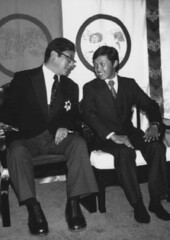
(The photo shows Chogyam Trungpa and Sakyong Mipham, date uncertain.)

Perhaps this struck me as particularly poignant because I think a lot of us received similar transmissions. I know I did. My dad used to sit on the front porch on summer evenings, smoking cigarettes and observing the world. Being. Sometimes my grandfather, who lived upstairs in the house where we lived downstairs, would join him. Maybe they'd talk politics or baseball. But the talk wasn't the point. Being was.

The neighborhood kids were part of the passing scene, rolling back and forth with the flow of our games. When the streetlights came on and we headed home, he would just be there.

Often on summer evenings, as the light begins to change, as the heat sinks into the asphalt, I wander out onto my front steps. My hands ache for the ritual of taking a cigarette from a pack, lighting it, and watching the smoke and the day dissipate. I don't smoke; my dad died from cancer that showed up first in his lungs -- I recognize the longing for what it is.

I sit, sometimes on the porch steps, more often on my cushion upstairs. The quality of light changes. The day dims.


Let's just be.


Monday, May 28, 2012

Retreating to bliss and staying present in the world


I want to tell you about Being Brave, The Shambhala Sangha Retreat I just finished. Really, I want to report on it. That's what I do, professionally. I want to tell you about what we did, how many people were there, how close the cushions were set. I want to tell you about one-bowl meals and quote pithy quotes from Sakyong Mipham Rinpoche and the archaryas and shastri. There were many memorable quotes.

But being brave is not about reporting on external circumstances -- it's about connecting with our very human feelings, whatever they are, without judgment. "The first part of being brave is simply being," Acharya Suzanne Duquette said in the first talk.

"We're welcoming in humanity," Acharya Duquette said later. "We're not retiring into bliss."

That may have surprised some people who came to Vermont for a long weekend because, face it, a weekend in Vermont sounds a lot like retiring into bliss. When you lead a busy life there's a delight in leaving it behind temporarily. The wifi rarely worked, and to get cellphone reception, you had to walk to the far end of the parking lot near the recycling tent. No TV. Outside of meals, food was limited. We were there, and many of the usual means of escape were not.

Of course, many of our escape routes are mental -- daydreaming, planning, replaying old memories, anticipating new ones. Just because you look like you're meditating doesn't mean that you are.

"I've seen a lot of people practicing next to themselves, watching themselves meditate," the Sakyong said. "It's time to just be."

Just being is hard. We think we have to be something or be someone. Anxiety, the Sakyong said, comes from not being sure who we're supposed to be. We're Buddhists -- we're supposed to be peaceful, calm, accepting. We don't get annoyed.

Oh, but we do. I do. Steamed tofu cubes. Again. Woman in front of me who is inching back on her zabuton, which is jammed up next to my zabuton. Judging the woman in front of me, who is pretty much the only person I can see enough of to judge. Judging myself for judging.

I've learned in mindfulness meditation to note all that. Be aware of it. Let it go.

At the Being Brave retreat, we were instructed to not only see our feelings but to embrace them, to be with them, to feel the humanness of our feelings -- and the connection they contain to all humans and to our basic goodness.

We think of meditation as something that separates us from the world, that takes us, perhaps, to Vermont for a long weekend. Allowing feelings to simply be, to connect us with our humanness, gets at the basic sense of feeling worthy to be, the Sakyong said.

Often we start meditating because we think there's something wrong with our experience, that meditation can fix that and make it right, Acharya Adam Lobel said. But there's nothing wrong with our experience. And if we accept that and fully accept our experience, it changes the practice.

"Meditation is abiding in a space that is infused with care no matter what arises," he said.

Even when you've got your own personal meditation fly.


Sunday, May 13, 2012

Whose shirt is it anyway?


The clothes you left behind
are fair game.
House rules:
What you choose not to take
can be worn by those who stay.
So, yes, I am wearing your shirt.
It was on the floor
in the closet,
rolled into a ball.
I like the colors –
They are my colors.
Not surprising.
You have my jaw, my voice, my heart.
I have your shirt.

Saturday, May 12, 2012

Stories R Us


Stories are not abstractions from life, but how we engage in it. We make stories, and those stories make us human. -- David R. Loy, The World is Made of Stories

I wonder what it would have been like if someone had come along and in a quite friendly manner had asked, 'Well, young one, what do you think you are, a boy or a girl?' What would it have been like not to have been afraid of getting hit for giving some wrong answer? -- Kate Bornstein, "Gender Outlaw"

Instead of getting rid of stories, one can liberate them: storying more flexibly, according to the situation. Shunyata, "emptiness," is a heuristic device to free us from wherever we are stuck. -- Loy

The culture may not simply be creating roles for naturally gendered people, the culture may be in fact creating the gendered people. ... In other words, the culture may be creating gender. -- Bornstein

Friday, May 11, 2012

Buddhamom Says 'Enough'

Time magazine threw hot wax on the "mommy war" construct, making it blaze up in pretty colors and keep flaming long after there was any actual fuel to burn with a headline that asks: Are You Mom Enough?

Thanks to a provocative photo of a mother breast-feeding a preschooler, the subsequent discussion has focused on breast-feeding. But that's a sideshow.

What does it mean to be "mom enough?"Are there degrees of "mom"ness?

In ancient times, "mother" was a useful concept in teaching. Everyone knew what a mother was and that she was indisputably good. Now you could debate endlessly whether the term goes to the originator of the genetic material, the body that grows a baby, the one who is legally responsible for it, the one who cares for it, and whether the mom can be a man.
And that's even before we get to part about "enough."

So the classic instruction to "regard all beings as your mother" or the realization that you've lived through so many lifetimes that every being has been your mother at some point and therefore is worthy of love and respect doesn't work today like it did 2,500 years ago. If you didn't feel cared for or nurtured by your "mother," you might want to envision all beings as your cat instead. Our love for our cats is far less conflicted than our feelings about our mothers.

From the mother side of things, it's easy to feel -- in a culture that asks things like "Are You Mom Enough?" -- that you are failing, that you are an inherently bad parent even as you hold the awareness that you are a basically good being.

What to do?

Try this:

Meditate. Settle in. Bring your attention to your heart center.. Visualize your child or your mother, at any stage of life that presents itself. Note what you note -- and let it go. Let go of the jammy hands, the fussing, the magenta hair, the questions, the silence, the demands for attention or that you go away. Let go of worries about the future or their grades or their weight or their friends. Note the things you adore and the things that irritate and let them go. Keep peeling off layers of self and social constructs until there's nothing there but your two warm hearts, nothing but the wish for this being to be happy --without holding onto any definition of what that means, what would make them happy. Or you happy. Only the wish.

That's the pure unconditional love all beings deserve. And if you can touch it, then the next time they call/don't call/complain/whateversetsyouoff, see if you can respond from that place, not the place that tells you what you should do.

And if that doesn't work, regard all beings as a cow does its calf. Or as you do your cat.