Showing posts with label intention. Show all posts

Saturday, November 16, 2013

For the benefit of which beings?

I remember the first time I saw a headline touting "mindfulness" on the cover of O, the Oprah
magazine, which also extolls the benefits of a $250 french fry maker and $300 Ugg boots. I was disconcerted. This was several years ago, and I was fairly new to Buddhist study and protective of the teachings, which didn't seem to belong in a bible of conspicuous consumption and body image. It seemed to be a misappropriation of the teachings.

But Oprah's helped popularize teachers like Pema Chodron and Sharon Salzberg, and I've come to believe that mindfulness is a good thing, no matter how it comes about. That's beneficial since mindfulness has only become more ubiquitous.


Mindfulness, it seems, has become a thing unto itself. The New York Times reports that everyone from techies to celebrities to CEOs to the Marines are practicing mindfulness, which it calls "a loose term that covers an array of attention-training practices. It may mean spending 10 minutes with eyes closed on a gold-threaded pillow every morning or truly listening to your mother-in-law for once."

The Times credits Thich Nhat Hanh, as "the Vietnamese Buddhist leader who introduced mindfulness to westerners (Google got first dibs on him as a guest speaker)" but focuses on how technology companies are using mindfulness.

Walter Roth, 30, chief executive of a tech start-up called Inward Inc. ... (said) mindfulness has made him more competitive. “Not only do I put fewer things on my to-do list but I actually get them done and done well. It’s like I’ve learned that to be more successful and accomplish more, I must first slow down.”
In response, the Buddhist Peace Fellowship points out that the Buddha didn't intend mindfulness to be divorced from ethics and wisdom. It also quotes Thich Nhat Hanh, noting that he called for people
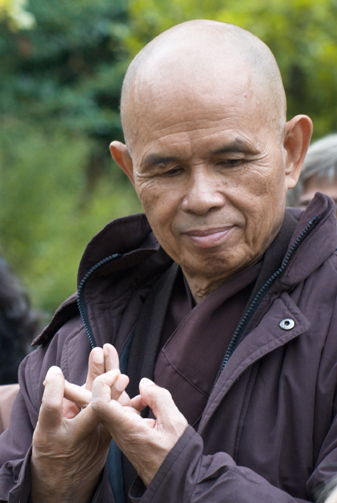
to use mindfulness as a basis for engaging in the world. "When bombs begin to fall on people, you cannot stay in the meditation hall all of the time… You have to learn how to help a wounded child while still practicing mindful breathing," he is quoted as saying.

(What that seems to prove is the emptiness of Thich Nhat Hanh -- there is no single, unchanging TNH.)

What is the right view of mindfulness?

Is there one?

David McMahan, a professor of religion at Franklin and Marshall College, says mindfulness may be becoming "a folk religion of the secular elite in Western culture." McMahan, who studies the role of social and cultural context in meditation, tells Tricycle magazine:

Right now, for the first time ever, we have contemplative practices derived from the Buddhist tradition that are being practiced completely independently of any Buddhist context. Secularization has filtered out what we would call “religious elements.” It is those religious elements, those ethical elements, and those intentions that have always formed the context of meditation and that have made meditation make sense. Otherwise, what sense does it make to sit down for half an hour and watch your breath? Somebody has to explain to you why that matters, why it is a good idea, and what it is actually doing in the larger scheme of things.

When meditation comes to the West completely independently of that, it is like a dry sponge; it just soaks up the cultural values that are immediately available. So it becomes about self-esteem. Or it might be about body acceptance or lowering your stress. It might be about performing lots of different tasks efficiently at work. It might be about developing compassion for your family. A whole variety of new elements now are beginning to form a novel context for this practice, which has not only jumped the monastery walls but has broken free from Buddhism altogether.
Whether this is good or bad remains to be seen, he says.

That's true with everything. We can't ever know with certainty what will happen. We may be able to predict the result of a particular action, but interdependence means that ripples out and has consequences that may be far beyond what we expect. Which is why, as a Buddhist, I try to live with the intention of non-harming. Intention is paramount because it sets the direction for actions.

One practice is to start the day by setting an intention: to be patient, to be kind, to be generous -- and to focus on that area. That makes it more likely that actions will incline in that direction by at least making us aware. And that's where mindfulness comes in. Having set an intention, we become more mindful about how we bring that into a situation.

For me, mindfulness practice inevitably leads to ethics and compassion. If you pay attention to what
you're doing, you must see how that affects others. And if you see how it affects others, your heart opens to them.

The vast intention, in Buddhism, is to be of benefit to all beings. That sounds overwhelming at first, but when you practice the intention becomes natural. Does that mean it's easy to make every action support that? No, but it's more likely than if you don't try.

Some of the secular mindfulness training seems to be aimed at benefiting individuals or corporations. Will that inevitably lead to ethics and compassion?


Wednesday, January 2, 2013

Know your intention

This is the time of year when a lot of people make resolutions. As the year ends, we look back over what’s happened in the last 12 months, what we liked, how we’d like to change in the New Year. That’s important stuff, and it’s in line with Buddhist practice – we’re using awareness, contemplation, and discernment.

But often people struggle to stick with their resolutions. A few days in, and old habits are calling us back to a comfortable way of doing things. Why is that and what can we do about it?

We can look at the intention that guides our action.

In Buddhism, intention is crucial. Karma is connected with intention, not just the action. If you kill a bug unintentionally, by stepping on it in the grass without knowing, there’s no karma. If you deliberately choose to kill that same bug, it may have consequences down the road. (One of those may be that you develop the idea that it’s OK to kill things.)

But you don’t have to believe in karma and rebirth to see the value of intention. If you set an intention, that leaves open many possible actions rather than limiting you to one right or wrong way of doing things.

Say that you have resolved to lose weight. You start a restrictive diet, an exercise plan. Soon you feel beleaguered, and it’s difficult to keep up.

If you look at the intention rather than the action, there’s space. Why do you resolve to lose weight? To look better? To be healthier? And why do you want to look better or be healthier – to attract a mate, get a new job, be able to do more things with your children or grandchildren, live with less pain or stress so you can enjoy life and be more pleasant? Knowing your intention helps you see your true goal. If it’s health, then it’s not just a matter of depriving yourself of fattening foods, it opens up the positive possibilities of eating good food, finding an enjoyable form of exercise, entering into any meal or exercise session with the thought that it is of benefit, rather than a chore.

It turns your mind toward the positive and away from punishment.

In Buddhist study, I learned the idea of framing things according to the ground, path, and fruition.

The ground is the view, the intention. Let’s say, I am a kind person and my intention is to be kind.

The path is the action, how you put that view into practice. Instead of yelling at people or speaking sarcastically, I speak gently and with kindness. I still make my point, but without attacking.

And the fruition is the result. When you act with kindness, others respond more kindly. Not always and not immediately. But I have found that they do.

This framework applies to any action you carry out – what is the ground, the intention? How do I manifest that? And is the result what I anticipated, or should I modify?

The Buddha included Wise Intention as the second step on the Eight-fold Path. Classically, he explains wise intention as the intention of renunciation, the intention of goodwill, and the intention of harmlessness.

Our intention, in the moment-to-momentness of daily life, isn’t always to be of benefit. It may be greed – to get the last doughnut before someone else snags it – or anger, to show up that driver who cut us off, or ego-clinging, to make ourselves appear to be benevolent in order to win the approval of others.

To know your intention requires awareness of your mind. For example, the intention of renunciation involves seeing that you are about to do something unskillful and rejecting that action, choosing instead to do the skillful thing.

Perhaps you’ve heard the Buddha’s advice to ask yourself before you speak: Is what I am about to say true, is it kind, is it necessary? That’s the teaching on intention in action. Is it true/renounce lies. Is it kind/have an attitude of goodwill. Is it necessary – is this the appropriate time and am I the appropriate person to say it/will someone be harmed by this.

Being mindful of our intentions and acting upon those which lead to harmlessness and wholesomeness help train the mind to gradually drop those intentions that are driven by anger, greed, desire, and attachment. Exploring our intentions can lead to deeper insights concerning insecurities, a need for attention, jealousy, or attachment to views.

Examining our intentions begins a natural process of building a foundation of ethics, and mindfulness is the tool that helps us see what we need to work on, what we need to let go of, and to act responsibly instead of reacting harshly or foolishly.