Wednesday, October 22, 2014

lululemon and the Dalai Lama are in a relationship

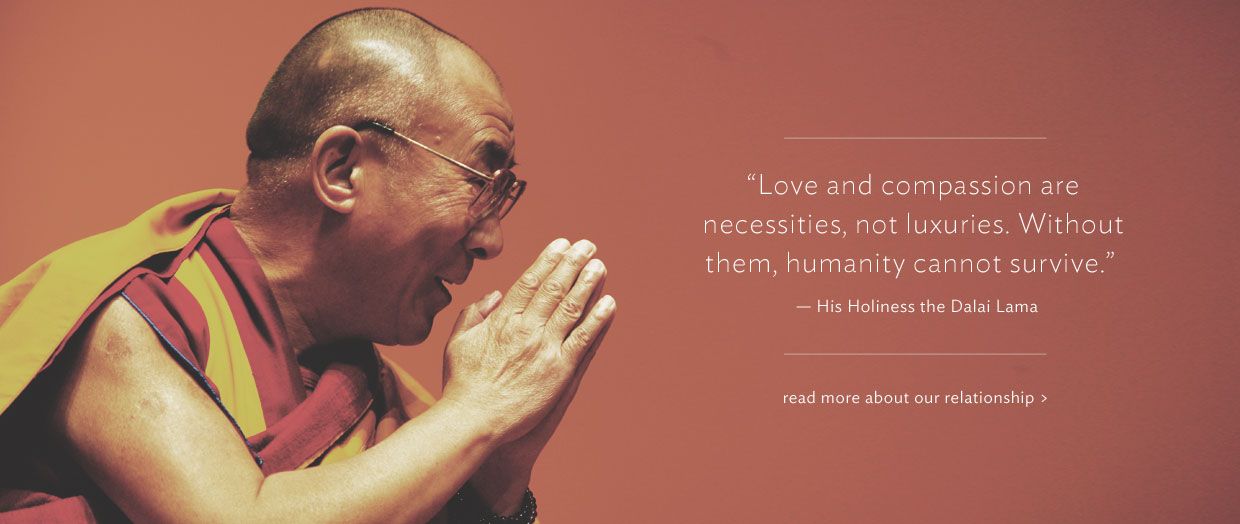
If you were to go lululemon.com today, you'd see a photo of the Dalai Lama with a quote from His Holiness: "Love and compassion are necessities, not luxuries. Without them, humanity cannot survive." Presumably, pricey yoga clothes are not in the same category.

Am I being snarky? Yes. lululemon athletica inc. on Tuesday announced that it is partnering with the Dalai Lama Center "on a variety of initiatives including researching the connection between mind-body-heart, sharing the work globally, and expanding the reach of the Center's Heart-Mind education initiatives."

The company will donate $250,000 Canadian in each of the next three years to support the center's work.

Is that a good thing? Quite likely.

"At the Dalai Lama Center, our mission is to educate the hearts of children by informing, inspiring, and engaging the communities around them. We...look forward to working together to promote 'education of the heart,' which results in more peaceful, secure, engaged and compassionate children," said Fiona Douglas-Crampton, president and CEO of the Dalai Lama Center for Peace and Education.
The center, a secular, non-political, not-for-profit organization, was established in 2005, cofounded by HHDL and Victor Chan.

Still, seeing the Dalai Lama on a website identified as "yoga clothes and running gear for sweaty workouts" gives me pause. There's no indication that they'll be offering a line of running tights with HHDL's face on the butt, or that he'll start showing up in slightly see-through yoga pants, but it feels icky to have his image, bowing, on shop.lululemon.com. Click on the "learn more about our partnership" link and you get to a page headlined, "psst! we're in a new relationship."

lululemon is a company in need of good will. Its co-founder stepped down last year after saying that the company's clothes weren't intended to work on women with large thighs. But the way they're handling their "new relationship" doesn't make me like them more.

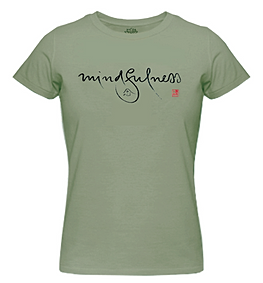
I don't think a straight-out donation would have bothered me. It's the "partnership," combined with HHDL's image, bowing, and a quote that includes the word "luxury." All of that creates a certain impression that helps to sell clothes, for lululemon. Thich Nhat Hahn's Foundation sells T-shirts with TNH's calligraphy to raise money. That's straightforward fundraising, not filtered through a for-profit company that's made some questionable choices in the past.

It reminds me of the corrupt Thai police official in John Burdett's books who makes donations at the local temple to buy merit so he can go on behaving badly.

What do you think?

Saturday, October 18, 2014

That is for you

One of my first encounters with Tibetan Buddhism was a weekend program with a lovely lama from Ohio. She was wise and funny and relatable. It was spring, and she brought in a chocolate Easter bunny to put on the shrine. I liked the idea of the chocolate bunny up there -- the gold foil made it fit in -- but I wasn't so sure about some of the other items. Relics? Really? The Buddha's fingernails or some such thing? C'mon.

I left the dharma center with a 10-page handout on how to set up an altar, what to put on each of the many levels and so on. It seemed overwhelming and suspiciously similar to Roman Catholicism, the altar and the gold and the relics and all that. As a former Catholic, I preferred the simplicity of Japanese Zen settings.

In another moment that tickled the dusty back realms of my brain, she recommended a practice of offering everything to the buddhas and bodhisattvas -- the beautiful day, the new grass, the chocolate bunny.

It was an interesting practice of noticing things to offer up, finding beauty in the world, but who was offering and what was the offered and who was it being offered to? How was this different from giving all glory to God because I was unworthy of it?

On the surface, not much. But, oh, there is so much below the surface. There is no offerer or offering or offered to. Nothing is permanent, you can't hold onto it, and you can't really give it away.

But you can let it go.

This probably was explained to me by the lama from Ohio, but I couldn't comprehend it at the time. When you give away the day, the light, the fluorescent orange maple leaves to the buddhas and bodhisattvas, you're relaxing your grasping mind, the one that wants to preserve the leaves, hang onto the day, save time in a bottle. You're seeing the impermanent, transitory nature of things, accepting that the satisfaction things bring is fleeting. And that you don't exist just as the buddhas and bodhisattvas don't exist -- but you do exist just as they do.

The deities in Buddhism are not separate from you; they are you. All beings have the same inherent, clear, compassionate nature -- buddhanature. In our human form, though, that's covered up by our humanity: Our fears, foibles, and judgments.

When you offer something to the buddhas, you're offering to your self and all beings rather than holding it in your grasp. 
“Look at the sky: that is for you. Look at each person’s face as you pass on the street: those faces are for you. And the street itself, and the ground under the street and the ball of fire underneath the ground: all these things are for you. They are as much for you as they are for other people. Remember this when you wake up in the morning and think you have nothing. Stand up and face the east. Now praise the sky and praise the light within each person under the sky. It’s okay to be unsure. But praise, praise, praise.”
-- Miranda July, No One Belongs Here More than You

Friday, October 10, 2014

Right Speech Applies to Self Talk

In one of my favorite passages in one of my favorite dharma books, "Loving Kindness," Sharon Salzberg talks about how she'd been practicing metta, loving kindness meditation, and wasn't sure it was having any effect -- until one morning when she broke something, said to herself what she always said, "You're such a klutz," and then surprised herself with, "But I love you anyway."

Wise or skillful speech is one of the steps on the Buddha's Eightfold Path to liberation from suffering. While it's often looked at as relational -- how we speak to others -- it also applies to how we talk to ourselves. Is it kind? Is it useful? Does it need to be said?

It's been a loud, short-tempered week in the office. Blame it on the full moon, Mercury in retrograde, new-and-not-yet-up-to-speed staff, a dozen other things. When I hear people talk meanly to others, I try to consider that they also talk that way to themselves. I know how uncomfortable it is to experience it coming from someone else. I suspect it sounds just as harsh directed at yourself.

NPR this week had a story on self talk as it's used in therapy for people with eating disorders. It quotes David Sarwer, a psychologist and clinical director at the Center for Weight and Eating Disorders at the University of Pennsylvania, says that one of the first things he does with new patients is stand them in front of a mirror and coach them to use gentler, more neutral language as they evaluate their bodies. The goal, he says, is to remove "negative and pejorative terms" from the patient's self-talk.

It also matters how you address yourself, the report says.  Psychologist Ethan Kross of the University of Michigan studied the pronouns people use when they talk to themselves silently, inside their minds.
"What we find," Kross says, "is that a subtle linguistic shift — shifting from 'I' to your own name — can have really powerful self-regulatory effects."
... He asked volunteers to give a speech — with only five minutes of mental preparation. As they prepped, he asked some to talk to themselves and to address themselves as "I." Others he asked to either call themselves "you," or to use their own names as they readied their speeches.
Kross says that people who used "I" had a mental monologue that sounded something like, " 'Oh, my god, how am I going do this? I can't prepare a speech in five minutes without notes. It takes days for me to prepare a speech!' "
People who used their own names, on the other hand, were more likely to give themselves support and advice, saying things like, "Ethan, you can do this. You've given a ton of speeches before." These people sounded more rational, and less emotional — perhaps because they were able to get some distance from themselves.
"It's almost like you are duping yourself into thinking about you as though you were another person," he says.

This is interesting from a Buddhist perspective. Since the self is only a collection of constantly changing constituent elements -- the skandhas of form, feeling, perceptions, mental formations, and consciousness -- when we speak to our selves as "I," it's our confused mind talking to our confused mind. When we speak from awareness, from our innately clear and confident buddhanature, it has a different quality.

I just gave this a run-through. Looking in the mirror, "I" told myself I looked like I had gotten dressed out of the lost-and-found bin at the yoga studio. Awareness said, "Pay no attention. You look fine."

The practice -- and practicing it in meditation helps -- is to notice the self-talk before you act on it and question it. "I look fat," I say. "Really? By what standard? The irrational one in your head?" Well, yes.

Ask the magic questions: Is it kind? Is it useful? Is this the time to bring it up?

Kindness to yourself inevitably spills over into kindness to others -- genuine kindness, not indulgence. Covering up self-hatred in designer clothes doesn't actually make you feel any better. A person who feels at home in their skin does have to cover it in status symbols to prove their worth.

Try it. You, as much as anyone in the world, are deserving of your kindness.


Saturday, October 4, 2014

Atonement

Buddhism is a path of personal responsibility. The concept of karma details how we are responsible for our actions -- across many lifetimes, if you want to take the long view. Buddhist teachings recommend that we constantly take stock of our actions to determine whether they create harm or benefit for beings. The goal is to create benefit, but, inevitably, there is harm done too. Someone interrupts our train of thought, and we snap in anger. We don't listen closely to someone and say something unkind.

In the Tibetan Buddhist tradition, there is a set of 59 slogans, called Lojong mind-training practices, that offer practical guidance for refining and purifying one's actions. They include the recommendations to start the day with the intention to do no harm and to end the day by reviewing our conduct to see if we've followed through.

And what if we have not? It's not an excuse for recrimination or beating ourselves up. It's possible to purify the effects of harmful actions.It starts with acknowledging the unskillful action, seeing that it has harmed us and others, and setting an intention not to repeat the behavior.

The idea here is to change habitual patterns -- anger, sarcasm, arrogance, envy -- that harm ourselves and others. We take responsibility for our behavior, acknowledging our unskillful response and not blaming the circumstances or the devil who made us do it, and see that we can choose to behave differently -- and promise (to ourselves) that we will try to do that.

Atonement, or purification practices, involve the two wings of Buddhism: wisdom and compassion. The recognition of our behavior and its effects requires wisdom, clear-seeing that is unfiltered by justification or judgment. Having recognized our behavior as harmful, we vow to change for the benefit of all beings, which is called compassion.

In Zen Buddhism, there is a formal atonement ritual. In Tibetan Buddhism, there are several purification rituals, including Vajrasattva practice. Both of those practices involve visualizing a deity who purifies the karma -- the deity is a symbol for your own inner, pure nature.

The practices don't require a deity. It's a simple reflection. The trick is to do it without getting caught up in the stories we use to justify or explain our behavior, and sometimes picturing an outside entity helps with that.

Another of the lojong slogans says: Drive all blames into one. That means that instead of blaming the weather or the traffic or the email from your new boss for your bad mood, you take responsibility for it. If someone backs into your car and dents it, you take responsibility for your reaction (but not the repair bill). Do you yell, call them names, moan about why this always happens to you? Or calmly make the calls and then move on? That's your choice, and that's what atonement or purification practice brings to light.


“We are not compelled to meditate by some outside agent, by other people, or by God. Rather, just as we are responsible for our own suffering, so are we solely responsible for our own cure. We have created the situation in which we find ourselves, and it is up to us to create the circumstances for our release.”

- Lama Thubten Yeshe, "Wisdom Energy" 

Thursday, September 25, 2014

I've often thought that if I were to get a word tattoo, it would be lines from the Heart Sutra
  
Form is emptiness; emptiness also is form.
The sutra continues: Form is not other than emptiness, emptiness is not other than form, but I don't think I'd invest the skin space in the second sentence. (It's not pure repetition, though -- it says that form is not emptiness, but it's also not not-emptiness. And on.) 

Why choose one of the most confounding set of words in all of Buddhism? It's the pith instruction: Don't solidify anything, not even emptiness. Hold space open for everything.

Which is not to say that this wasn't a head-scratcher at first. Emptiness is a conundrum that takes some exploration to understand. While it is empty of fixed definitions -- like a permanent self -- it is full of possibility. Everything happens in emptiness.


Thich Nhat Hahn has released a new translation of the Heart Sutra that he says corrects that misperception -- which has been going on for about 2,000 years, he says in a letter of explanation.

Emptiness of self only means the emptiness of self, not the non-being of self, just as a balloon that is empty inside does not mean that the balloon does not exist. The same is true with the emptiness of dharma: it only means the emptiness of phenomena and not the non-existence of phenomena. It is like a flower that is made of only un-flower elements. The flower is empty of a separate existence, but that doesn't mean the flower is not there.
The Heart Sutra is a distillation of the much longer Prajanaparamita Sutra, which lays out the ultimate truth of emptiness. It counters the extreme views of nihilism and eternalism, detailing the parts that make up our personalities -- the skandhas of form, feeling, perception, conceptualization, and consciousness -- and says they don't exist.

Thay says that's the source of the misunderstanding.  
It removes all phenomena from the category 'being' and places them into the category of 'non-being' ... Yet the true nature of all phenomena is the nature of no being nor non-being, no birth and no death.
Instead of: "In emptiness there is no form, no feeling, no perception, no formation, no consciousness ..." Thay writes, "That is why in emptiness, body, feelings, perceptions, mental formations, and consciousness are not separate self-entities. Even insight and attainment do not exist as separate self-entities."

The Heart Sutra, with its apparent negation of previous teachings, caused great consternation when it was spoken and ever since. The word "emptiness" confuses students who equate it with "voidness," a black hole of nothingness, when really it is the light that enables us to see -- sourceless, luminous, all-pervading wisdom. Prajnaparamita.

He calls the chant "The Insight that Brings Us to the Other Shores," in reference to the chanted mantra. See if this resonates with you.


Avalokiteshvara
while practicing deeply with
the Insight that Brings Us to the Other Shore,
suddenly discovered that
all of the five Skandhas are equally empty,
and with this realisation
he overcame all Ill-being.
“Listen Sariputra,
this Body itself is Emptiness
and Emptiness itself is this Body.
This Body is not other than Emptiness
and Emptiness is not other than this Body.
The same is true of Feelings,
Perceptions, Mental Formations,
and Consciousness.
“Listen Sariputra,
all phenomena bear the mark of Emptiness;
their true nature is the nature of
no Birth no Death,
no Being no Non-being,
no Defilement no Immaculacy,
no Increasing no Decreasing.
“That is why in Emptiness,
Body, Feelings, Perceptions,
Mental Formations and Consciousness
are not separate self entities.
The Eighteen Realms of Phenomena
which are the six Sense Organs,
the six Sense Objects,
and the six Consciousnesses
are also not separate self entities.
The Twelve Links of Interdependent Arising
and their Extinction
are also not separate self entities.
Ill-being, the Causes of Ill-being,
the End of Ill-being, the Path,
insight and attainment,
are also not separate self entities.
Whoever can see this
no longer needs anything to attain.
Bodhisattvas who practice
the Insight that Brings Us to the Other Shore
see no more obstacles in their mind,
and because there
are no more obstacles in their mind,
they can overcome all fear,
destroy all wrong perceptions
and realize Perfect Nirvana.
“All Buddhas in the past, present and future
by practicing
the Insight that Brings Us to the Other Shore
are all capable of attaining
Authentic and Perfect Enlightenment.
“Therefore Sariputra,
it should be known that
the Insight that Brings Us to the Other Shore
is a Great Mantra,
the most illuminating mantra,
the highest mantra,
a mantra beyond compare,
the True Wisdom that has the power
to put an end to all kinds of suffering.
Therefore let us proclaim
a mantra to praise
the Insight that Brings Us to the Other Shore.
Gate, Gate, Paragate, Parasamgate, Bodhi Svaha!
Gate, Gate, Paragate, Parasamgate, Bodhi Svaha!”
Wednesday, September 17, 2014

Goodbye, Dali Lama?

The Dalai Lama, the world's best-known Tibetan Buddhist, stirred things up this week with an interview in which he seemed to suggest that he should be the last to hold that title. “The 14th Dalai Lama now is very popular. Let us then finish with a popular Dalai Lama,” he told a German newspaper, which interpreted it to mean he did not want a successor.

Lots of people had lots to say, even Stephen Colbert.

Tricycle explicated the politics and tradition -- it could be a way to thwart China, to further remove the position from politics, to express the traditional humility of the position.

HHDL has speculated before about his return, saying he would reincarnate in the west, maybe as a woman.

While this obviously has a lot of meaning for Tibetans, those with an interest in geopolitics, and Richard Gere, what does it mean to you?

Some western Buddhists see the Dalai Lama as an anachronism, a symbol of an institution and tradition that doesn't translate to this culture, a way of keeping the teachings in the hands of a few and away from the masses. (Although HHDL has offered previously secret teachings to large crowds.)

Others see him as him as their guru, a teacher with whom they have a special relationship -- even if they've never met him. And others see him as an example of an enlightened being in human form, an inspiration, a for practice.

The outer guru is like the key, but when we open the door we discover ourselves, our true guru. (Yonge Minyur Rinpoche)

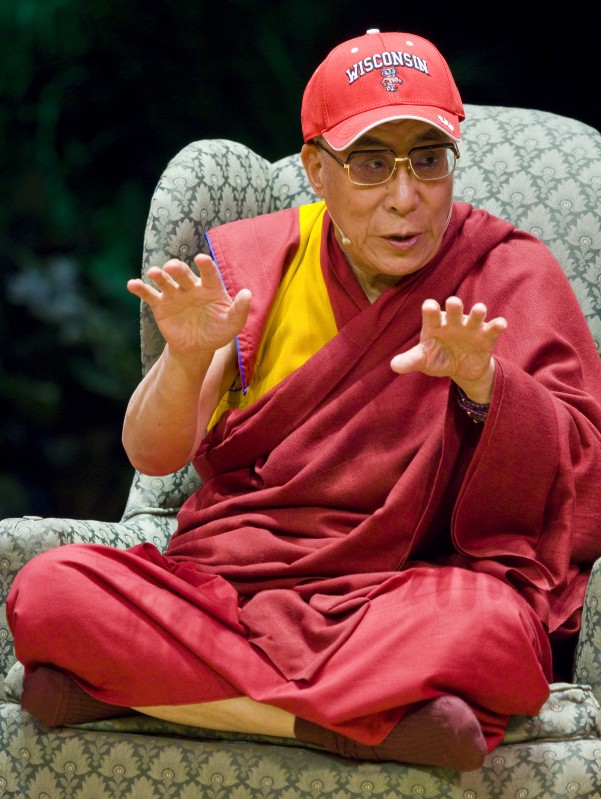
This 14th incarnation of the lineage has done a lot to explore the connection between science and Buddhism, to support women, and to be an ambassador of Tibetan Buddhism to the world, bringing  his ready smile and willingness to wear a local baseball cap around the globe.

What do you think?


Friday, September 5, 2014

That iPhone (and your happiness) is impermanent

It's a truth of existence that material things won't bring you lasting happiness. Things break. Or get outdated. Maybe the iPhone 5 brought you bliss -- but now the iPhone 6 is about to be introduced. And that might make you even happier. Until you find the bugs in it or the 7 is rumored.

Expecting things to make us happy only leads to disappointment, which leads to wanting new things. That desire for something to improve the present moment is what creates stress and dissatisfaction, aka unhappiness, the Buddha said.

A new study, Waiting for Merlot: Anticipatory Consumption of Material and Experiential Purposes,  found that people get more enduring happiness when they spend money on experiences than on acquiring things. That extends to waiting in line for those things.

People tended to be more competitive about purchases, and a comparison of news reports about people waiting in line found that long waits for material purchases were more likely to end in violence, researchers said.

One of the study's authors, Amit Kumar, a doctoral student at Cornell University, speculates that experiences give people the opportunity to bond and socialize. Even when if you aren't guaranteed a ticket to a concert or a taco from the cool new food truck, people often enjoy waiting in line. "While waiting for concert tickets, people reported singing songs together, or people would be playing games with each other while they're waiting," he says.

Waiting for the experience became part of the experience, not something that was preventing acquisition of The Thing That Would Give Us All the Happiness.

Westerners speak of the "pursuit" of happiness, which generally depends on running after external conditions ... There is only one problem: The very nature of desire is that it cannot be satisfied -- at least not for long.
The happiness that I'm talking about is not "pursued." In fact, the more we remains elf-contained and do not pursue thoughts or fantasies, or rush from one attractive object to another, the more we can access a wakeful contentment that is always with us. ... This wakeful state of ease is quite joyful and approaches a profound sense of well-being. -- Yongey Mingyur Rinpoche
It's important to note that contentment doesn't require you to renounce your smartphone or wear nothing but caftans. It's OK to like things -- just know that the happiness they bring is conditional, impermanent, and dependent. It won't last. Contentment, though, is unconditional, luminous, and always there. Pursue that.